
Friday, November 13, 2026Nov 13

Israeli farmers observe sabbatical _ with a wink

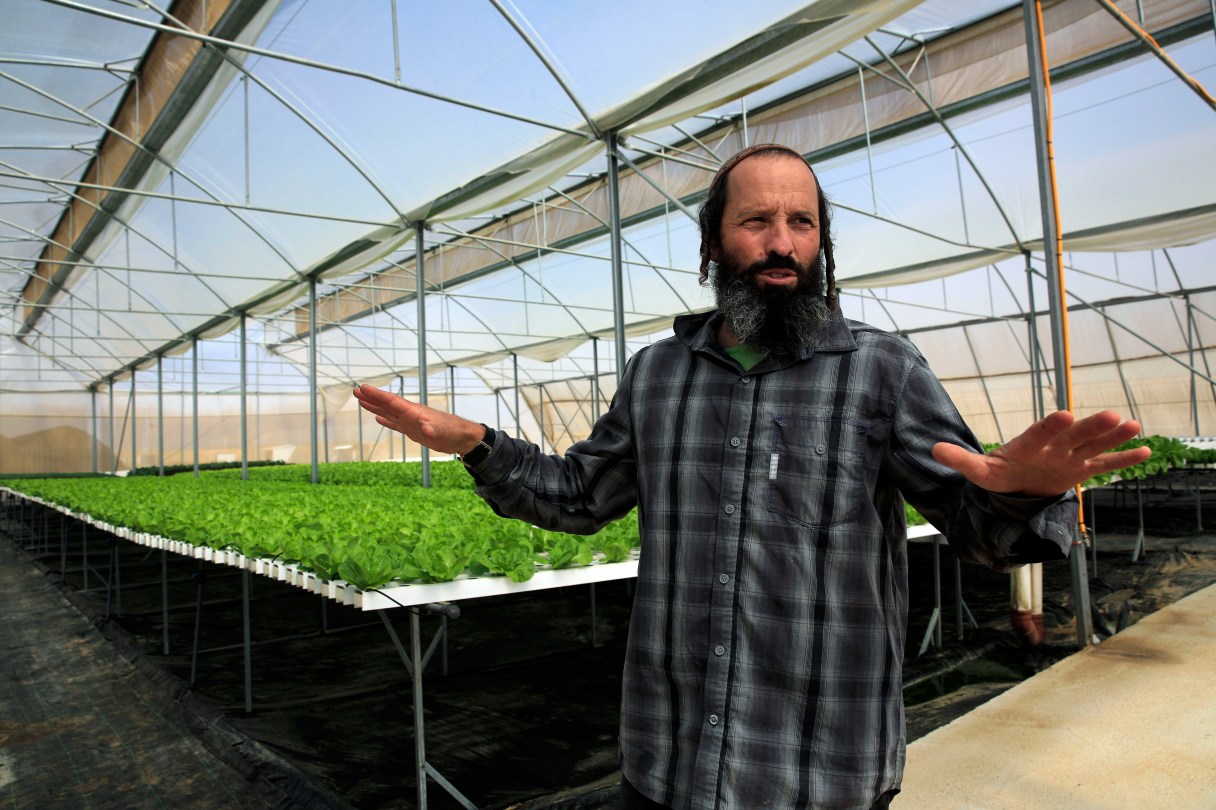
In this Sunday, Oct. 19, 2014 photo,  Gilad Fine, a religious Jewish farmer from Bnei Netzarim stands inside his greenhouse, between the southern tip of the Gaza Strip and the Egyptian border. Fine grows lettuce and kale using hydroponics on raised platforms to fulfill the biblical commandment to let his farmlands rest every seventh year. His greenhouse follows specific guidelines that certify the produce kosher for the sabbatical year called “shmita” in Hebrew, that began last month on the Jewish New Year, and extends through the fall of 2015. (AP Photo/Tsafrir Abayov)
In this Sunday, Oct. 19, 2014 photo, Gilad Fine, a religious Jewish farmer from Bnei Netzarim stands inside his greenhouse, between the southern tip of the Gaza Strip and the Egyptian border. Fine grows lettuce and kale using hydroponics on raised platforms to fulfill the biblical commandment to let his farmlands rest every seventh year. His greenhouse follows specific guidelines that certify the produce kosher for the sabbatical year called “shmita” in Hebrew, that began last month on the Jewish New Year, and extends through the fall of 2015. (AP Photo/Tsafrir Abayov) In this Sunday, Oct. 19, 2014 photo, Gilad Fine, a religious Jewish farmer from Bnei Netzarim stands inside his greenhouse, between the southern tip of the Gaza Strip and the Egyptian border. Fine grows lettuce and kale using hydroponics on raised platforms to fulfill the biblical commandment to let his farmlands rest every seventh year. His greenhouse follows specific guidelines that certify the produce kosher for the sabbatical year called “shmita” in Hebrew, that began last month on the Jewish New Year, and extends through the fall of 2015. (AP Photo/Tsafrir Abayov)

BNEI NETZARIM, Israel (AP) – Every seven years, according to the Bible, Israeli farmers must give their lands a rest for a year.

So how do modern-day growers reconcile the ancient spiritual practice with a need to feed the country’s 8 million mouths?

Most market their produce thanks to a clever workaround: they temporarily sold their farms, valued together at $33 billion, to a 25-year-old non-Jewish telemarketer named George.

“I own all those lands, and I don’t even own an apartment,” joked George Shtraykhman, an immigrant from St. Petersburg, Russia.

The seventh-year sabbatical, called “shmita” in Hebrew, began last month on the Jewish New Year, and extends through the fall of 2015.