
Thursday, November 12, 2026Nov 12

AP Analysis: US wary over hitting Syrian militants

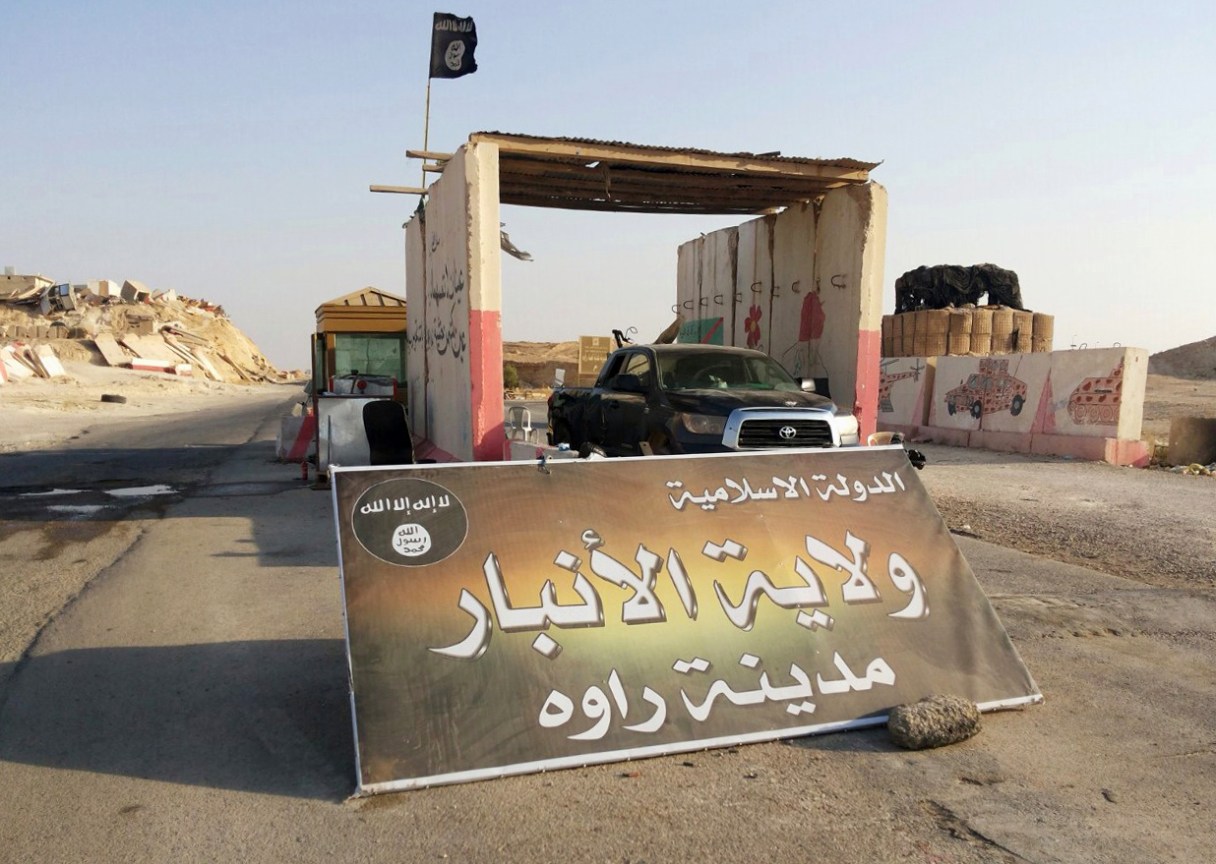
FILE - In this Tuesday, July 22, 2014, file photo, a sign is posted at a checkpoint belonging to the Islamic State group, captured from the Iraqi Army, at the main entrance of Rawah, 175 miles (281 kilometers) northwest of Baghdad, Iraq. Arabic reads, "Islamic State, the Emirate of Anbar, City of Rawah." The U.S. and its allies are trying to hammer out a coalition to push back the Islamic State group in Iraq. But any serious attempt to destroy the militants or even seriously degrade their capabilities means targeting their infrastructure in Syria. That, however, is far more complicated. If it launches airstrikes against the group in Syria, the U.S. runs the risk of unintentionally strengthening the hand of President Bashar Assad, whose removal the West has actively sought the past three years. Uprooting the Islamic State, which has seized swaths of territory in both Syria and Iraq, would potentially open the way for the Syrian army to fill the vacuum. (AP Photo, File)
FILE - In this Tuesday, July 22, 2014, file photo, a sign is posted at a checkpoint belonging to the Islamic State group, captured from the Iraqi Army, at the main entrance of Rawah, 175 miles (281 kilometers) northwest of Baghdad, Iraq. Arabic reads, "Islamic State, the Emirate of Anbar, City of Rawah." The U.S. and its allies are trying to hammer out a coalition to push back the Islamic State group in Iraq. But any serious attempt to destroy the militants or even seriously degrade their capabilities means targeting their infrastructure in Syria. That, however, is far more complicated. If it launches airstrikes against the group in Syria, the U.S. runs the risk of unintentionally strengthening the hand of President Bashar Assad, whose removal the West has actively sought the past three years. Uprooting the Islamic State, which has seized swaths of territory in both Syria and Iraq, would potentially open the way for the Syrian army to fill the vacuum. (AP Photo, File) FILE - In this Tuesday, July 22, 2014, file photo, a sign is posted at a checkpoint belonging to the Islamic State group, captured from the Iraqi Army, at the main entrance of Rawah, 175 miles (281 kilometers) northwest of Baghdad, Iraq. Arabic reads, "Islamic State, the Emirate of Anbar, City of Rawah." The U.S. and its allies are trying to hammer out a coalition to push back the Islamic State group in Iraq. But any serious attempt to destroy the militants or even seriously degrade their capabilities means targeting their infrastructure in Syria. That, however, is far more complicated. If it launches airstrikes against the group in Syria, the U.S. runs the risk of unintentionally strengthening the hand of President Bashar Assad, whose removal the West has actively sought the past three years. Uprooting the Islamic State, which has seized swaths of territory in both Syria and Iraq, would potentially open the way for the Syrian army to fill the vacuum. (AP Photo, File)

BEIRUT (AP) – The U.S. and its allies are trying to hammer out a coalition to push back the Islamic State group in Iraq. But any serious attempt to destroy the militants or even seriously degrade their capabilities means targeting their infrastructure in Syria.

That, however, is far more complicated. If it launches airstrikes against the group in Syria, the U.S. runs the risk of unintentionally strengthening the hand of President Bashar Assad, whose removal the West has actively sought the past three years. Uprooting the Islamic State group, which has seized roughly a third of Syria and Iraq, may potentially open the way for the Syrian army to fill the vacuum.

The alternative would be to finally get serious about arming the mainstream Western-backed rebels fighting to topple Assad. But there is a reason the administration of President Barack Obama has been deeply reluctant to throw its weight behind them.

The relatively moderate rebel factions fighting in Syria are in tatters. There are no secular groups, and the strongest factions are Islamic groups, many of which work with al-Qaida’s official branch in Syria, the Nusra Front.

The Nusra Front, which has somewhat dropped from international headlines because of the Islamic State group’s exceeding brutality, is on the U.S. list of terrorist groups and is still very active.