
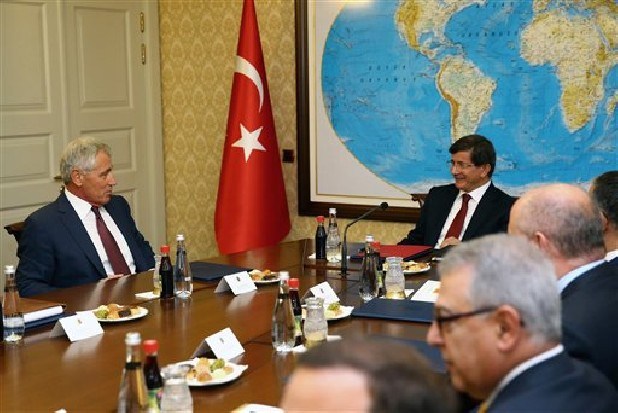
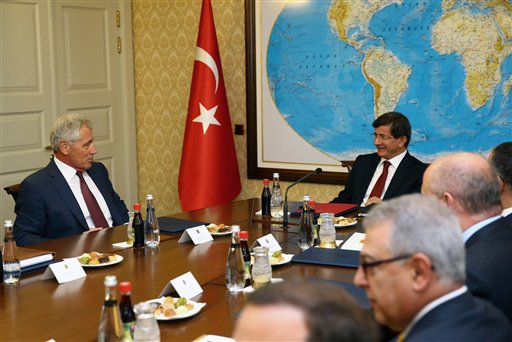
 In this photo provided by the Turkish Prime Ministry Press Service, Turkish Prime Minister Ahmet Davutoglu, right, and U.S. Defense Secretary Chuck Hagel speak during a meeting in Ankara, Turkey, on Monday, Sept. 8, 2014.
BEIRUT – Stitching together a broad coalition to tackle the extremist Islamic State group hinges on overcoming the reluctance of U.S. allies in the Middle East who are deeply frustrated with a White House they believe has been naive and weak on Syria’s civil war.
Key Sunni Arab states, Saudi Arabia chief among them, have wanted the U.S. to do more to provide robust support to mainstream Syrian rebels in their war against President Bashar Assad. The result is hesitation to answer President Barack Obama’s call for a regional front against the Islamic State group, even though it is widely reviled.
The United States is mounting a major campaign to get allies on board. Secretary of State John Kerry will visit the region and Defense Secretary Chuck Hagel was in Turkey on Monday to lobby the NATO ally.
But it is not always an easy sell.
“Trust is so low, especially in the Gulf region, for Obama’s leadership quality and the way he manages foreign policy. I don’t think any country is going to put its hand up or neck out by accepting an alliance with the U.S. that easily,” said Mustafa Alani, the director of the security and defense department at the Gulf Research Center in Geneva.