
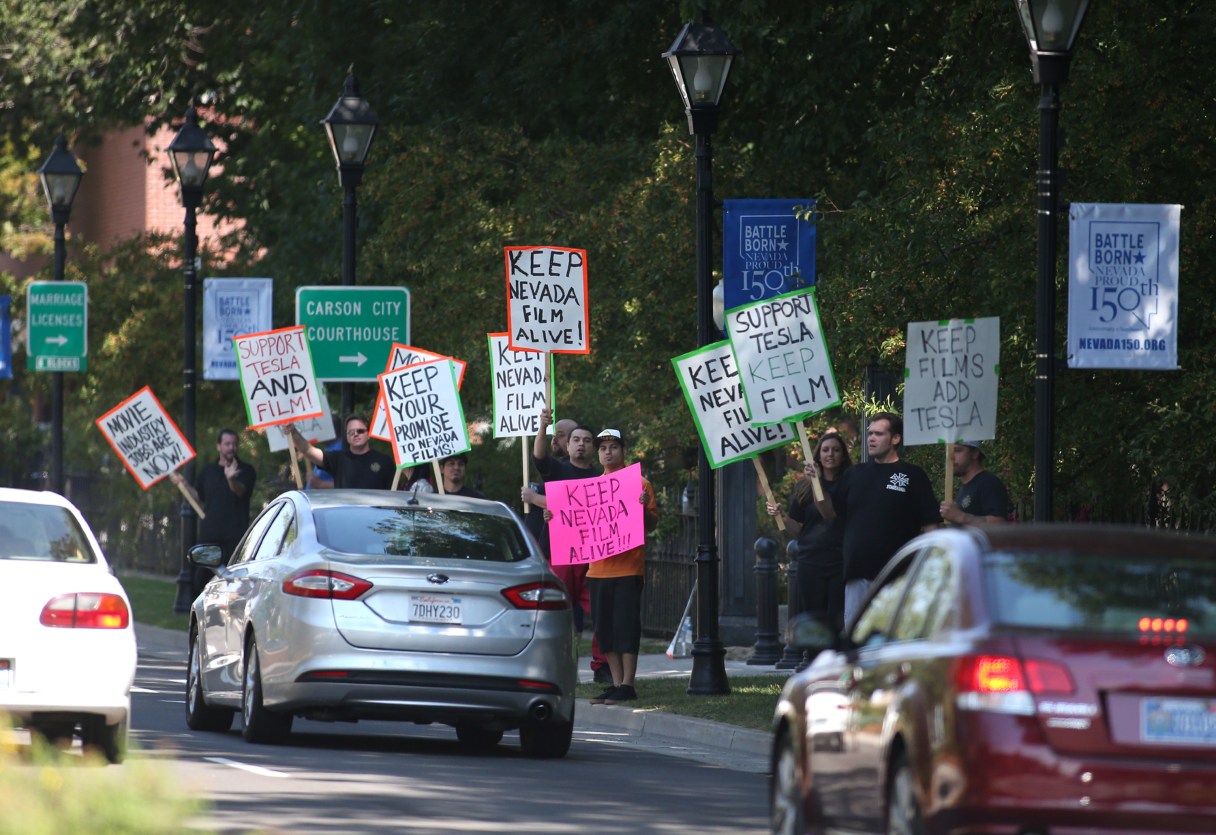
CARSON CITY, Nev. (AP) – The first two bills designed to seal a deal to bring Tesla Motors’ $5 billion battery factory to Nevada sailed through the Assembly unanimously Thursday as one lawmaker called the project the biggest thing to hit the state since the Hoover Dam.
After just two minutes of debate, the Assembly voted 39-0 and sent to the Senate a bill that would help finance Tesla’s tax breaks by ending a $125 million subsidy to insurance companies that locate their home offices in Nevada.
On another 39-0 vote about eight minutes later, they approved discounted electricity rates for the electric-car maker’s “gigafactory” expected to help create more than 20,000 jobs and inject up to $100 billion into the state’s economy over the next 20 years.
Assemblyman Ira Hansen, R-Sparks, was one of only two lawmakers to take to the floor during the brief debate on the two bills, calling it a “monumental and historic” opportunity.
“This is arguably the biggest thing that has happened in Nevada since at least the Hoover Dam,” Hansen said about the colossal dam built on the Colorado River southeast of Las Vegas in the 1930s during the Great Depression.
Meanwhile, the Senate was questioning Gov. Brian Sandoval’s economic advisers about the biggest chunk of the incentive package worth up to $1.3 billion for Tesla to build the plant at an industrial park along Interstate 80 about 15 miles east of Sparks.
Sen. Pete Goicoechea, R-Eureka, said he’s concerned some contractors might try to exploit the tax breaks by purchasing equipment under the guise of using it for up to $1.1 billion in sales, use and property tax abatements aimed at Tesla.
State Equalization Board Secretary Chris Nielsen assured him that auditing requirements will force contractors to justify their purchases.
The Senate bill requires Tesla to spend $3.5 billion in the state within 10 years. It mandates half the jobs go to Nevada residents, at both the factory expected to employ 6,000-plus and among the 3,000 projected construction jobs.
Elimination of the home office credit enacted in 1971 was included in one of three bills the Assembly had on its agenda Thursday, and lawmakers were optimistic the entire package would clear both chambers and land on the governor’s desk late Thursday or Friday.
Nielsen said only 1 percent of the roughly 1,200 insurance companies doing business in the state qualify for the credit and that eliminating it would save $125 million over five years.
Assembly Speaker Marilyn Kirkpatrick, D-Las Vegas, said she long has favored ending the credit that initially was enacted on a temporary basis in 1971, and Sandoval’s administration agreed that economic development incentives should be temporary ways to bring business to the state.
“Something that lasts for 43 years or longer is not an incentive. In our view it is a subsidy,” said Steve Hill, director of the Governor’s Office of Economic Development.
Opponents argue the biggest corporate giveaway in state history wouldn’t benefit typical middle-class Nevadans, but they conceded they were unlikely to block the deal.
“All the lobbyists for various interests say that unless you have a hand in the Tesla deal, it’s not good for you,” said Bob Fulkerson, state director for the Progressive Leadership Alliance of Nevada. “But everybody then also says that it’s a done deal.”