
Tuesday, November 10, 2026Nov 10

Astronauts getting 3-D printer at space station

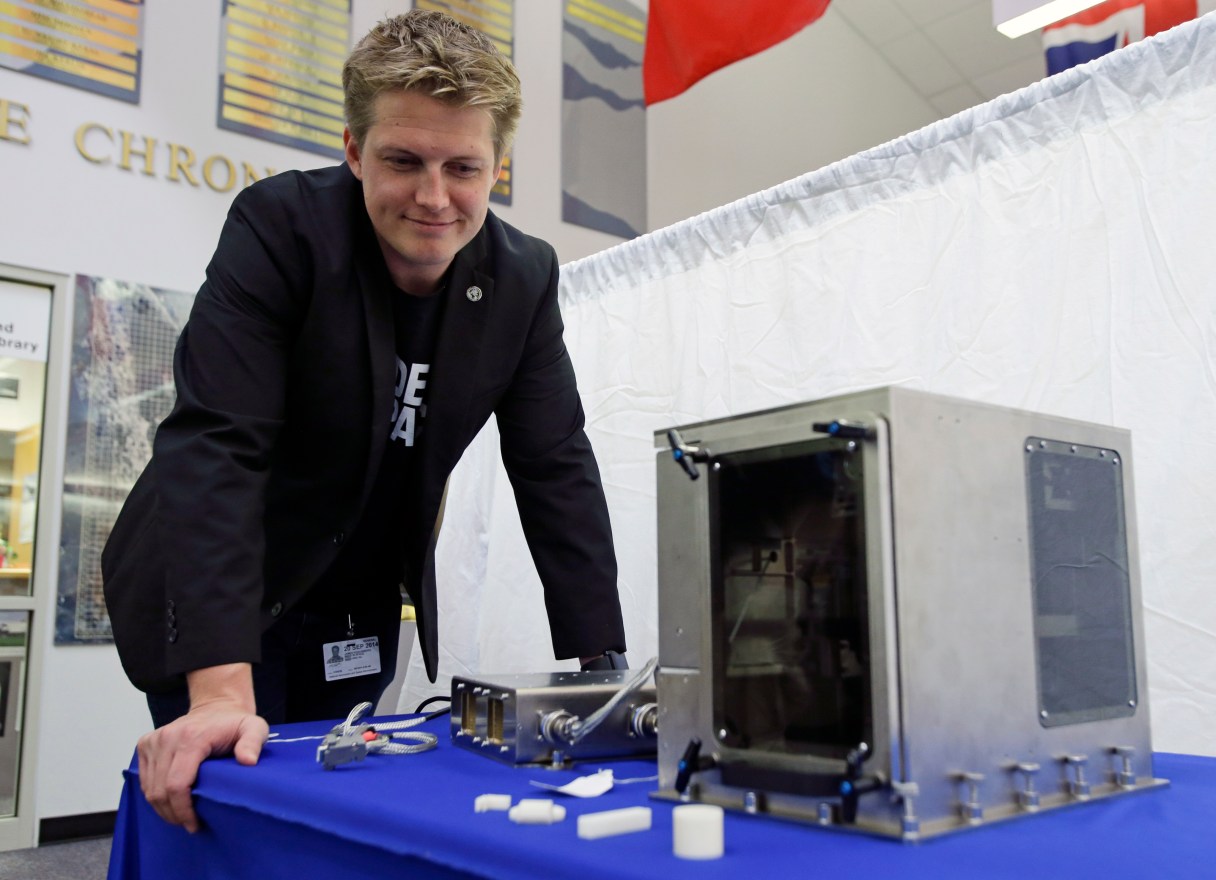
Brad Kohlenberg, a business development engineer with Made In Space, looks over  a 3-D printer identical to the one that will be transported to the International Space Station aboard the Falcon 9 SpaceX rocket at the Kennedy Space Center in Cape Canaveral, Fla., Friday, Sept. 19, 2014. NASA is sending a 3-D printer to the International Space Station in hopes that astronauts will be able to one day fix their spacecraft  by cranking out spare parts on the spot. (AP Photo/John Raoux)
Brad Kohlenberg, a business development engineer with Made In Space, looks over a 3-D printer identical to the one that will be transported to the International Space Station aboard the Falcon 9 SpaceX rocket at the Kennedy Space Center in Cape Canaveral, Fla., Friday, Sept. 19, 2014. NASA is sending a 3-D printer to the International Space Station in hopes that astronauts will be able to one day fix their spacecraft by cranking out spare parts on the spot. (AP Photo/John Raoux) Brad Kohlenberg, a business development engineer with Made In Space, looks over a 3-D printer identical to the one that will be transported to the International Space Station aboard the Falcon 9 SpaceX rocket at the Kennedy Space Center in Cape Canaveral, Fla., Friday, Sept. 19, 2014. NASA is sending a 3-D printer to the International Space Station in hopes that astronauts will be able to one day fix their spacecraft by cranking out spare parts on the spot. (AP Photo/John Raoux)

CAPE CANAVERAL, Fla. (AP) – The 3-D printing boom is about to invade space.

NASA is sending a 3-D printer to the International Space Station in hopes that astronauts will be able to one day fix their spacecraft by cranking out spare parts on the spot.

The printer, made by a Northern California company called Made in Space, is among more than 5,000 pounds of space station cargo that’s stuffed into a SpaceX Dragon capsule for a pre-dawn liftoff Saturday.

Besides real-time replacement parts at the station, NASA envisions astronauts, in the decades ahead, making entire habitats at faraway destinations like Mars.

“If we’re really going to set up shop on Mars,” we have to do this, Jeff Sheehy, NASA’s senior technologist, said Friday. “We really can’t afford to bring everything we need for an indefinite amount of time. We’ll need to get to the point where we can make things that we need as we go.”