
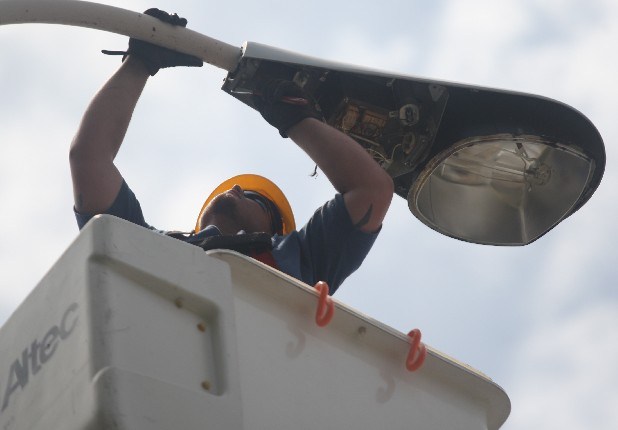
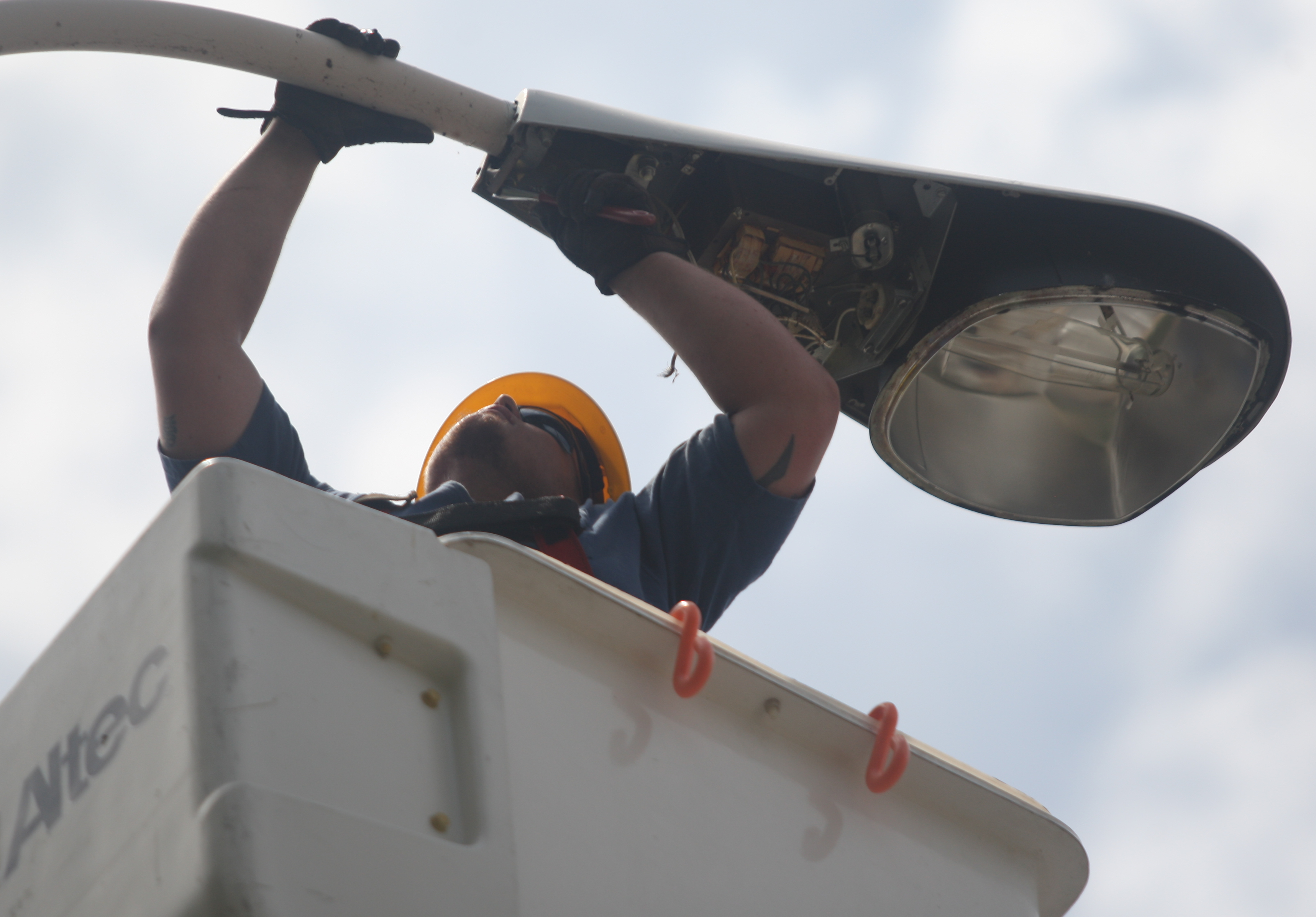
 Sam Smith works on an old streetlight on Lindsay Street.
Smith was installing a newer, LED streetlight.
EPB is looking for help to keep track of its streetlights.
The utility is accepting bids until 2 p.m. on Sept. 30 for parties interested in maintaining an inventory of EPB’s 27,000 streetlights and 25,000 private lights on a rolling three-year basis.
The request for proposals comes after months of unanswered questions about whether the utility overbilled the city by charging for thousands of lights that either didn’t exist or were misclassified.
Harold DePriest, CEO of EPB, has said that the utility formerly performed its own complete field inventories, both to keep track of streetlights as well as to keep track of pole attachments by customers such as AT&T, Comcast and others who hang wires on EPB’s light poles.
But the utility now acknowledges that a perfect storm of mistakes in the field, accounting mishaps and blown failsafes caused workers to improperly classify as many as 6,000 lights, and to charge for hundreds of lights that were no longer in service. Despite more than a year of internal and external attempts to unravel the extent of problem, there’s still no agreement on how much the utility owes taxpayers.
EPB says the misclassified lights are a financial wash, because any overcharges for energy were balanced out by offsetting undercharges by EPB for not billing the city enough for power line losses and all of the time that the street lights were on.
Former city contractor Don Lepard, who has filed a whistleblower lawsuit against EPB, claims the utility overbilled taxpayers $6.7 million over 20 years. Chattanooga’s independent auditor, Stan Sewell, says the amount owed to the city is about $1.2 million.
EPB accounting firm, Mauldin & Jenkins, has yet to release the final results of its own analysis, which initially said that the utility underbilled, rather than overbilled taxpayers. But the firm continues to work on its analysis and Sewell said this week that Mauldin & Jenkins has revised its initial estimates.
J.Ed. Marston, vice president of marketing for EPB, says that the utility’s current streetlight count has “been done to the specification and satisfaction of the city auditor and our independent auditing firm.”
However, the utility has not performed a physical inventory of all 55,000 of its lights. Auditors have performed several spot checks, and the utility has inventoried only its mercury vapor lights, most of which were found not to exist.
“The only purpose of this is to keep them current,” Marston said. “It’s not a new count related to figuring out what the problem is, it’s a new count so we can ensure that we are maintaining an accurate count.”
In the most recent figures released to the public this summer, the utility still listed several hundred mercury vapor lights in its inventory.
Energy-efficient high-pressure sodium lights began replacing mercury vapor lights in the 1970s. Mercury vapor lights are expected to last about 25 years, DePriest has said. Congress passed a law in 2005 banning the sale of mercury vapor lights to protect the environment.
“When you’re handling money, you want one person to receive the money, and a different person to count the money and a third person to count it a second time,” Marston said. “We want to make sure we have independent verification throughout the process and just catch errors as they’re introduced.”
Contact staff writer Ellis Smith at 423-757-6315 or esmith@timesfreepress.com with tips and documents.