
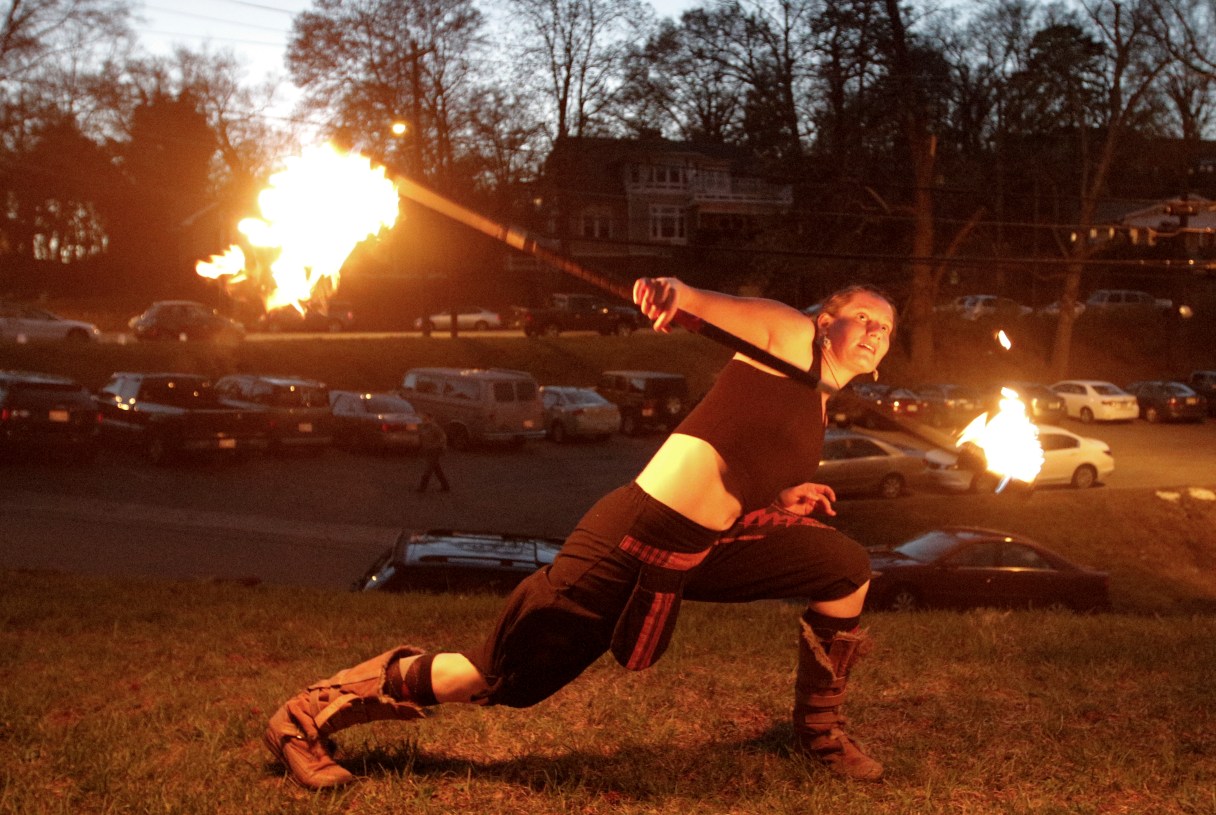
"Because, oh my dear God, it looks cool."
Read more
Additional information about the Chattanooga Fire Cabaret, including a roster and a schedule of upcoming events, is available at Facebook.com/ChattanooogaFireCabaret or ChattanoogaFireCabaret.com.
On a fall day in 2009, Kaitlyn Hampton and Aubrey Henriksen had just moved from the University of Tennessee at Chattanooga campus into an apartment near Hamilton Place. Sitting on the balcony of their new pad, they wracked their brains trying to decide how to pass the time.
Naturally, they settled on putting burning objects in their mouths.
“You just see fire-eating for the first time, and you think it’s awesome,” Hampton, 25, laughs. “I guess maybe most people don’t think that, but that’s what we started with.”
Henriksen, 25, says she fell in love with fire performance months earlier after seeing a girl dancing with a flaming hula hoop at the Electric Forest Festival in Rothbury, Mich. Hampton traces her passion back to the awe she felt watching a fire breather during a performance in a Memphis art gallery.
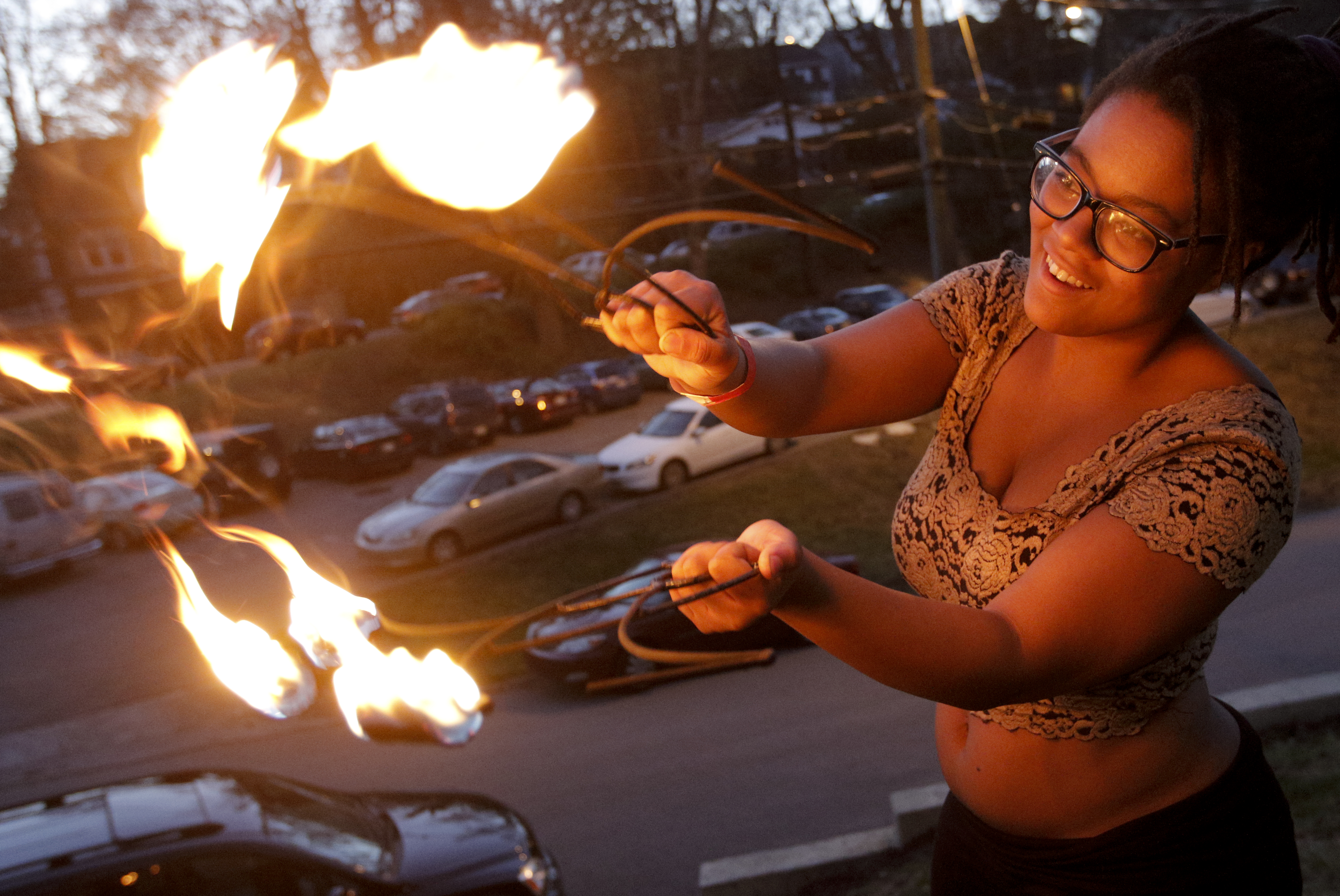 Tanqueray Harper dances with flaming props during a performance by the Chattanooga Fire Cabaret on March 28, 2015, at St. Marks United Methodist Church in Chattanooga.
“He looked just like a dragon,” she recalls. “It was just so cool.”
However, there were certain survival instincts Hampton and Henriksen had to overcome before they could earn their fire-eating stripes.
They began by holding burning wicks as close to their faces as they could stand, but when the time came to attempt the “eating” part, the stunt proved just a little too intense to … well … swallow.
“I couldn’t actually get it into my mouth; I was too scared,” Henriksen says. “We just started working our nerves up.”
Eventually, they managed to pluck up their courage enough to — very carefully — extinguish the flames. Building on this success, they explored other ways to manipulate fire, including twirling burning staffs in a kind of flaming homage to their time as members of their high school color guard team.
About a year after eating fire for the first time, Henriksen and Hampton formed the Chattanooga Fire Cabaret, a performance troupe whose members turn playing with fire into an art form. In the last five years, the cabaret has been involved in events around Chattanooga, from the Chattacon fandom convention and Holiday Starlight Parade to local music festivals and the MainX24 neighborhood celebration.
“You may call it pyromania,” the group’s Facebook biography reads. “We call it life.”
Better when burning
The eight members of the Chattanooga Fire Cabaret say they were drawn to fire performance for many reasons. Some loved the spectacle, others the sensation of control over a primal element. Many say they appreciate the close ties between fiery stagecraft and dance, in which many of them have prior training.
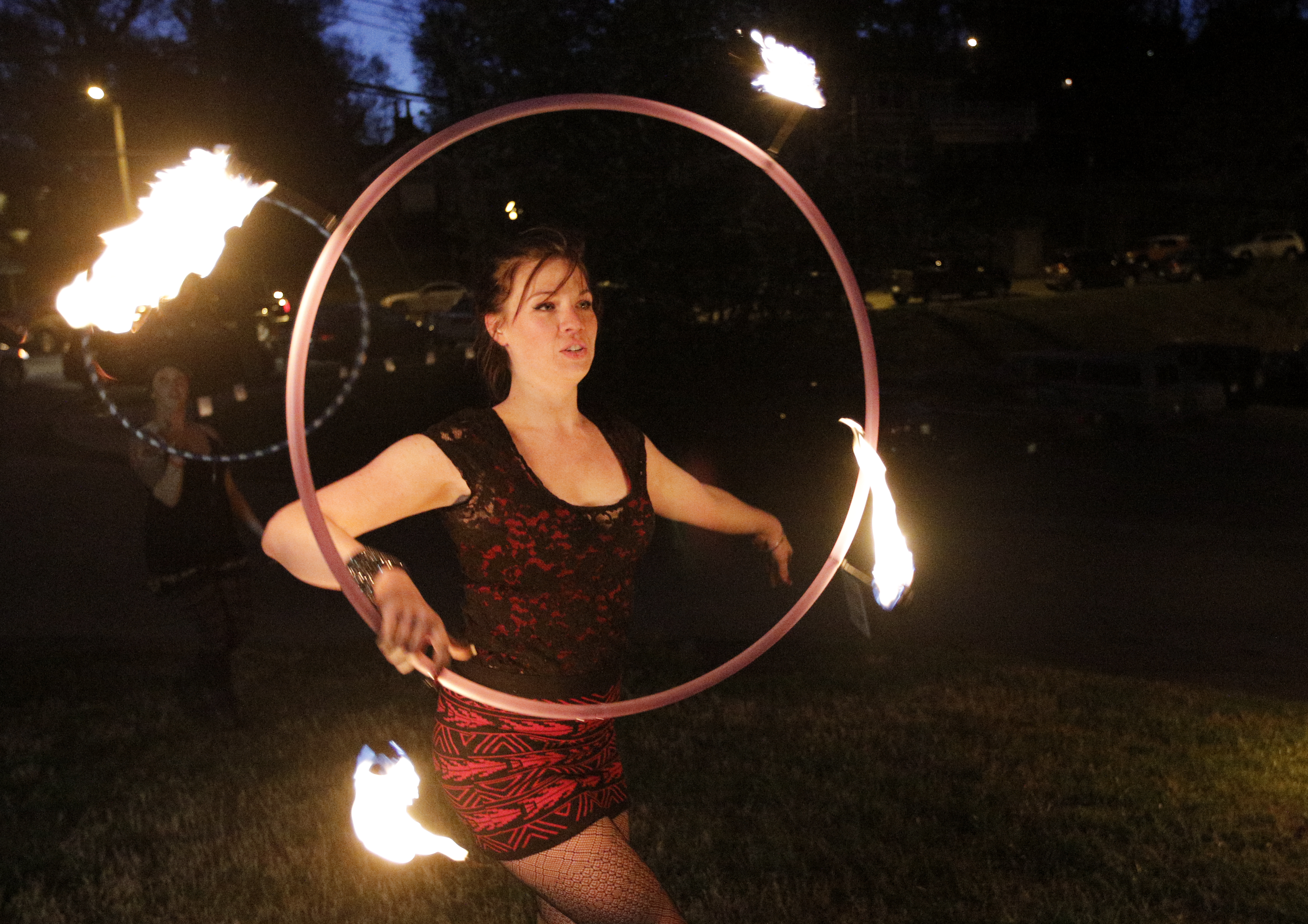 Kaitlyn Hampton dances with a flaming hula hoop during a performance by the Chattanooga Fire Cabaret on March 28, 2015, at St. Marks United Methodist Church in Chattanooga.
Most cabaret members also have a background in a nonflaming performance art, such as juggling or fan dancing. Another common technique is poi, a traditional South Pacific activity in which practitioners swing tethered weights in elaborate patterns.
Julia Bies, 26, has been a flaming hooper and fire eater with the cabaret since 2010. Short and with the faint tinge of a purple dye job lingering in her brown hair, she began hula hooping — the nonflaming variety — using a hoop that had been left behind by the ex-girlfriend of a man she was dating.
Like Henriksen, Bies says the idea of introducing fire into the equation didn’t occur to her until she saw a fire hooper at a music festival. When she tried it six months later, there were certain tricks that didn’t translate because of the protruding wicks, but the trails of light the flames left behind gave the activity a more meditative feel, she says.
“[Fire] adds this whole new thing to it that just starts really deep in the soul,” she says.
For Hal Meyer, 37, a programmer at air products manufacturer United Enertech, his three-year stint with the cabaret is the latest chapter in a lifelong love of street performance.
In the late ’90s, he was “doing the whole hippie hitchhiker thing” while traveling the U.S. and supporting himself through sidewalk performances with devil sticks, a pair of short sticks used to juggle a longer baton.
Meyer was making $30 to $40 a day in tips until a bystander offered a suggestion that loosened his audience’s purse strings.
“[He] was like, ‘Hey, man, that would be cool if they were on fire,'” Meyer says. “So I took a T-shirt out of my backpack, ripped it up, put some lighter fluid on it, tied it on the ends [of the baton] and lit it on fire.
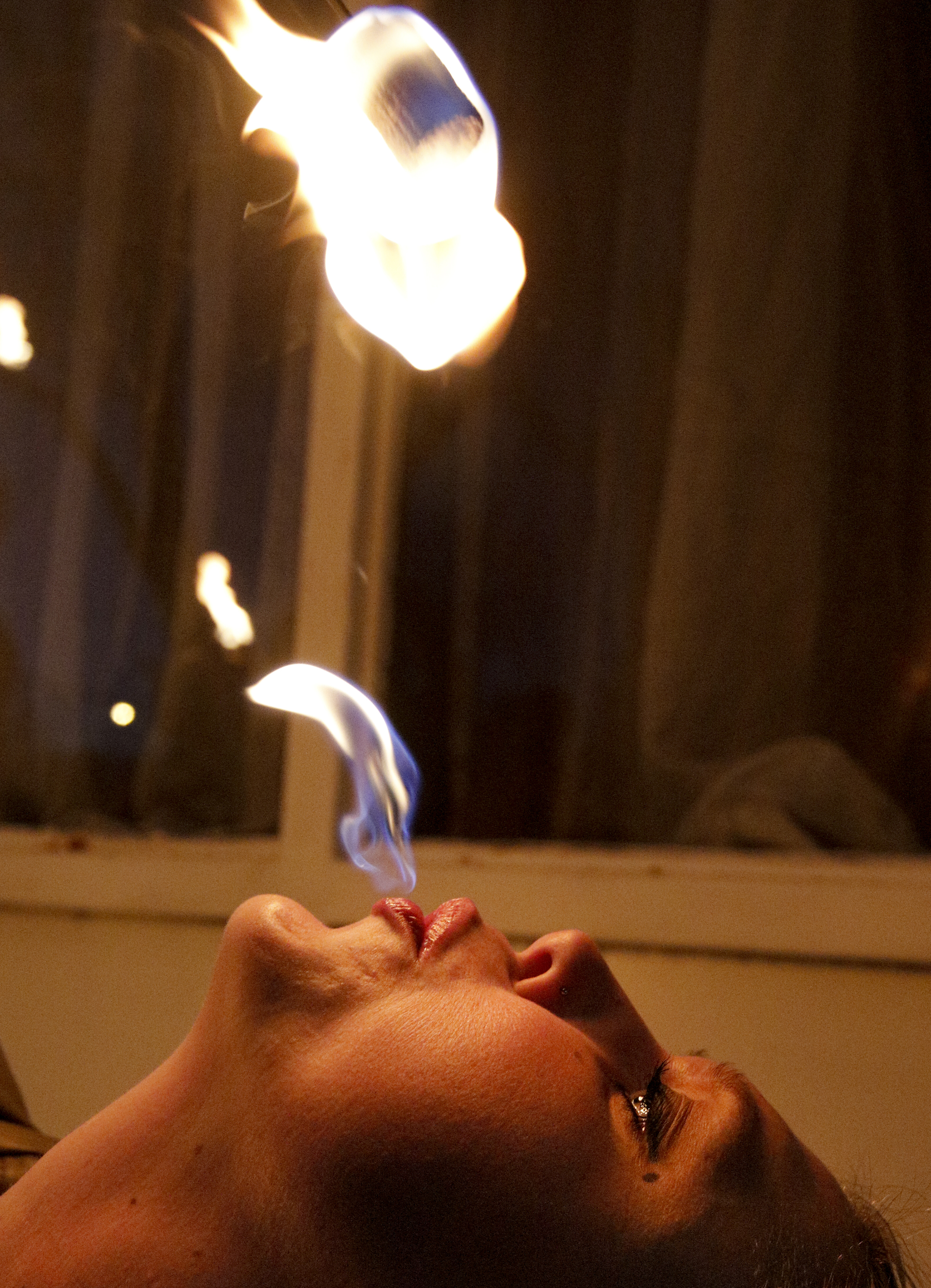 Aubrey Henriksen performs a technique called vapor pulling during a performance by the Chattanooga Fire Cabaret on March 28, 2015, at St. Marks United Methodist Church in Chattanooga.
“He was right; I got a lot more money.”
But more than helping him pad his wallet — he made about $200 that day — Meyer says setting his equipment on fire made his tricks “way cooler.”
“I think we all love fire,” he says, chuckling. “I think that’s one of the reasons why we do it.”
‘You can’t be dumb’
The members of the cabaret are exuberant in their adoration of flames. For some, such as Bies, it manifests as a philosophical, almost spiritual connection. For others, it’s a kind of giddy fascination.
When discussing the ways fire improves their respective arts, they respond in a rush, often talking over each other excitedly and trailing off into laughter.
Yet safety is never far from their minds.
The cabaret has a dedicated safety officer, Henriksen’s boyfriend, Chris Scoggins, and its members reduce the risk by abiding by certain commonsense rules, such as “be careful what you touch” and “try not to breathe the toxic fuel.”
“You can’t be dumb,” Bies says, simply.
To limit the chance of premature combustion, they use wicks made of inflammable Kevlar webbing — the same material used to make firefighter uniforms — soaked in lamp oil, which is difficult to ignite. Before taking the stage, they dip their wicks in a more flammable substance such as camp stove fuel.
When performing, cabaret members wear clothing made of natural fibers that don’t burn as easily. Synthetic fibers are a definite no-no, they say.
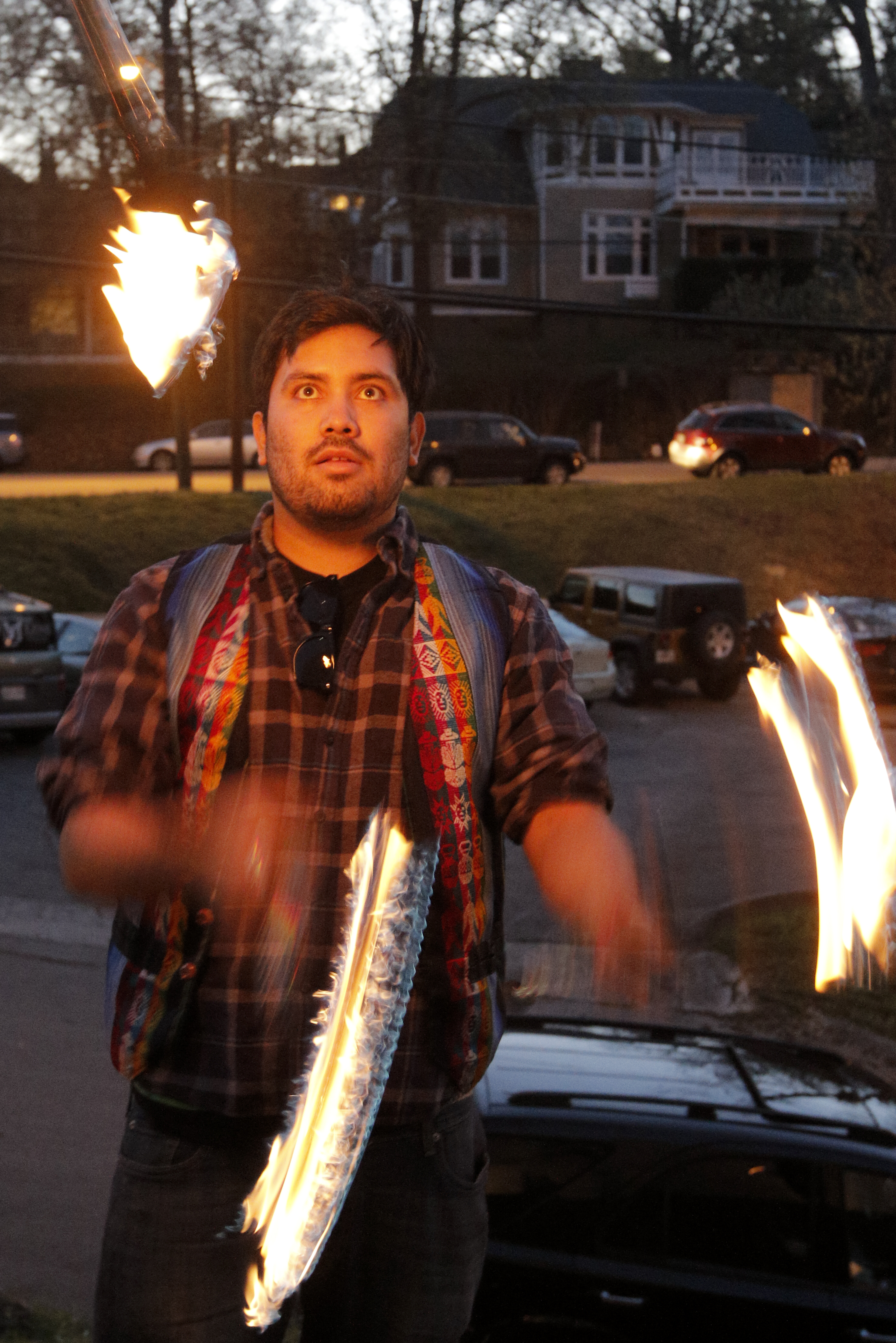 Anthony Calderon juggles flaming batons during a performance by the Chattanooga Fire Cabaret on March 28, 2015, at St. Marks United Methodist Church in Chattanooga.
“Even silk is better,” Henriksen says. “If polyester catches on fire, it will melt to your skin and burn you pretty bad. I know people that’s happened to before, and it’s not good. Anytime you see someone fire hooping with a tutu on, just back away.”
Not that burns don’t happen. Gathered together, cabaret members trade war stories of their close calls, the times they’ve accidentally set fire to their hair or clothing or — for the fire eaters among them — scalded their tongues.
“It’s like a hot coffee,” Hampton says. “It’s not so bad that night; it always hits the next day.”
So far, however, no one has been seriously injured, they say, quickly rapping their knuckles on the nearest piece of wood.
When the cabaret started five years ago, Henriksen bought a large wool blanket to smother any errant flames at shows. They carry a fire extinguisher “just in case,” but the blanket is more efficient, she says.
At least, she thinks it would be. She’s bought three of them so far — they’re dark gray and tend to get left behind at nighttime gigs — but she’s never had to use one.
Fire is something to enjoy, but only responsibly.
“I wouldn’t call us pyromaniacs,” Henriksen says. “I never wanted to set things on fire, but I enjoy spinning it.”
Contact Casey Phillips at cphillips@timesfree press.com or 423-757-6205.
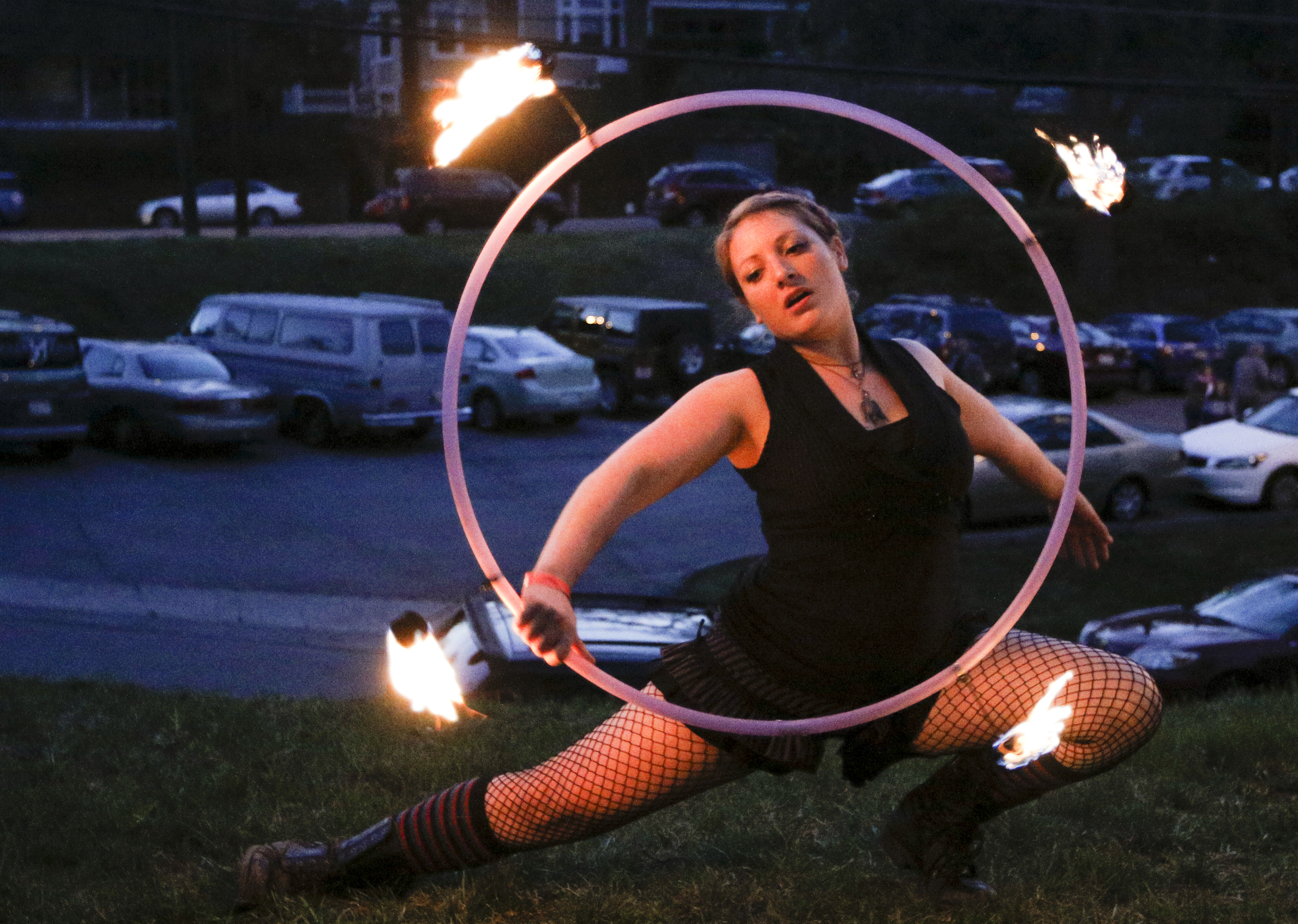 Julia Bies, right, dances with a flaming hula hoop during a performance by the Chattanooga Fire Cabaret o March 28, 2015, at St. Marks United Methodist Church in Chattanooga.