
Saturday, November 14, 2026Nov 14

Ex-U.S. guards face long prison sentences for Iraq shootings

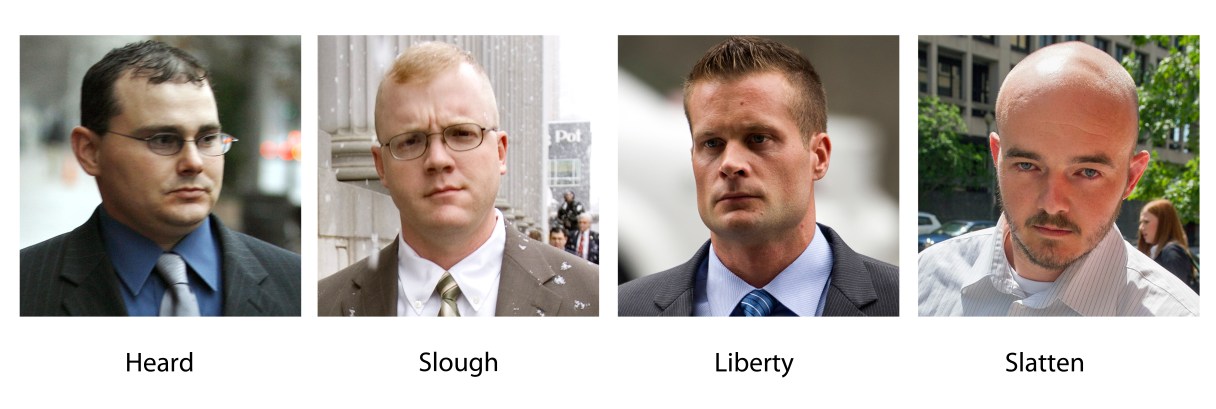
FILE - In these various file photos, Blackwater guards, from left, Dustin Heard, Paul Slough, Evan Liberty and Nicholas Slatten. A years-long legal fight over a deadly mass shooting of civilians in an Iraq war zone reaches its reckoning point, when four former Blackwater security guards are sentenced for the rampage. Three of the guards, Dustin Heard, Evan Liberty and Paul Slough, face mandatory decades-long sentences because of firearms convictions. A fourth, Nicholas Slatten, faces a penalty of life in prison after being found guilty of first-degree murder. (AP Photo/File)

WASHINGTON (AP) – Four former Blackwater security guards face decades in prison when they are sentenced Monday for their roles in a 2007 shooting of Iraqi civilians.

Three of the guards – Dustin Heard, Evan Liberty and Paul Slough – face mandatory, decades-long sentences because of firearm convictions. A fourth, Nicholas Slatten, faces a life sentence after being found guilty of first-degree murder.

The men were charged in the deaths of 14 Iraqis at Nisoor Square, a crowded traffic circle in downtown Baghdad. The killings caused an international uproar, and the men were convicted in October after a legal fight that spanned years.

Prosecutors have described the shooting as an unprovoked ambush of civilians, though defense lawyers countered that the men were targeted with gunfire from insurgents and Iraqi police, and shot back in self-defense.

The lawyers are expected to argue for mercy Monday by saying that decades-long sentences would be unconstitutionally harsh punishments for men who operated in a stressful, war-torn environment, and who have proud military careers and close family ties.