
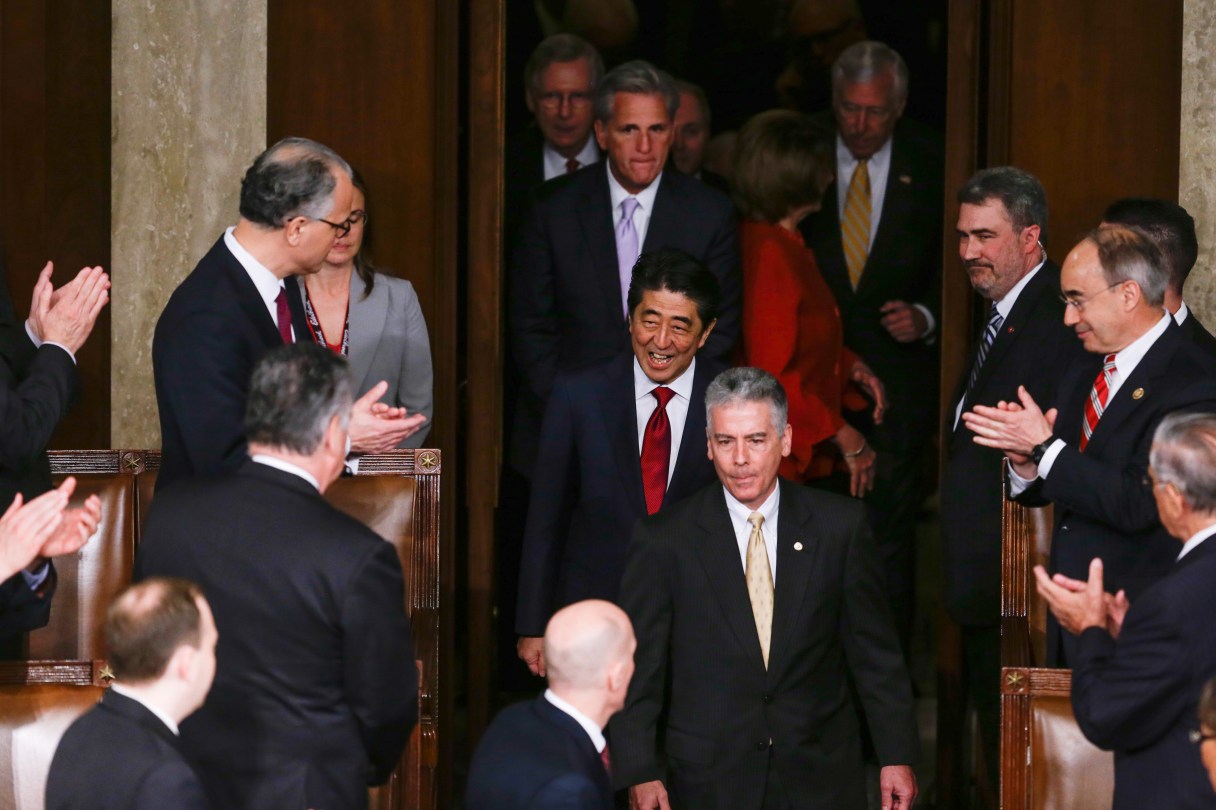
Japan Prime Minister Shinzo Abe is starting a three-day visit to California with plans to check out some of the region’s tech innovations, lend support to expanded commercial ties, and even promote a Japanese-made bullet train during a meeting with the state’s governor.
On a swing through Silicon Valley Thursday, Abe will speak with Stanford University experts about innovation and also work to build relationships with tech firms and investors. The head of one of the world’s leading car producing nations will also visit electric carmaker Tesla Motors.
Traveling to San Francisco later in the day, the Japanese leader will meet with Gov. Jerry Brown and invite him to try the bullet train simulator that Abe is bringing, said Takako Ito, a foreign ministry spokeswoman. Brown has pushed for a $68 billion rail project that would connect San Francisco to Los Angeles.
Abe’s California schedule includes a round-table with business leaders at a resort on Sand Hill Road, a busy stretch of street known as the epicenter of tech venture capital companies that have launched Amazon, Facebook, Twitter and more. He will go to Stanford for a speech and meetings with Japanese foreign exchange students, followed by visits to social media giant Facebook, and the offices of Tesla Motors, whose electric cars are built in a nearby plant first opened by General Motors more than 50 years ago.
“This Japanese administration has been focusing on changing its economy to a growth-based system built on innovation,” said Japanese economic researcher Takeo Hoshi, a senior fellow at Stanford University’s Freeman Spogli Institute for International Studies. “This is probably the best place in the world to look at that.”