
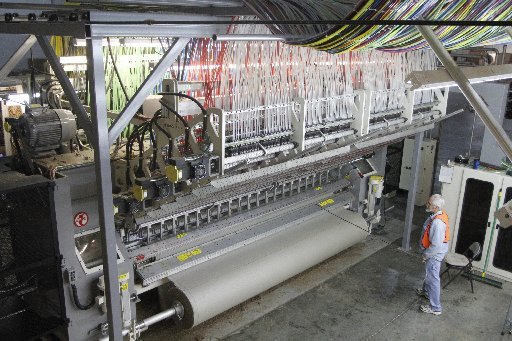
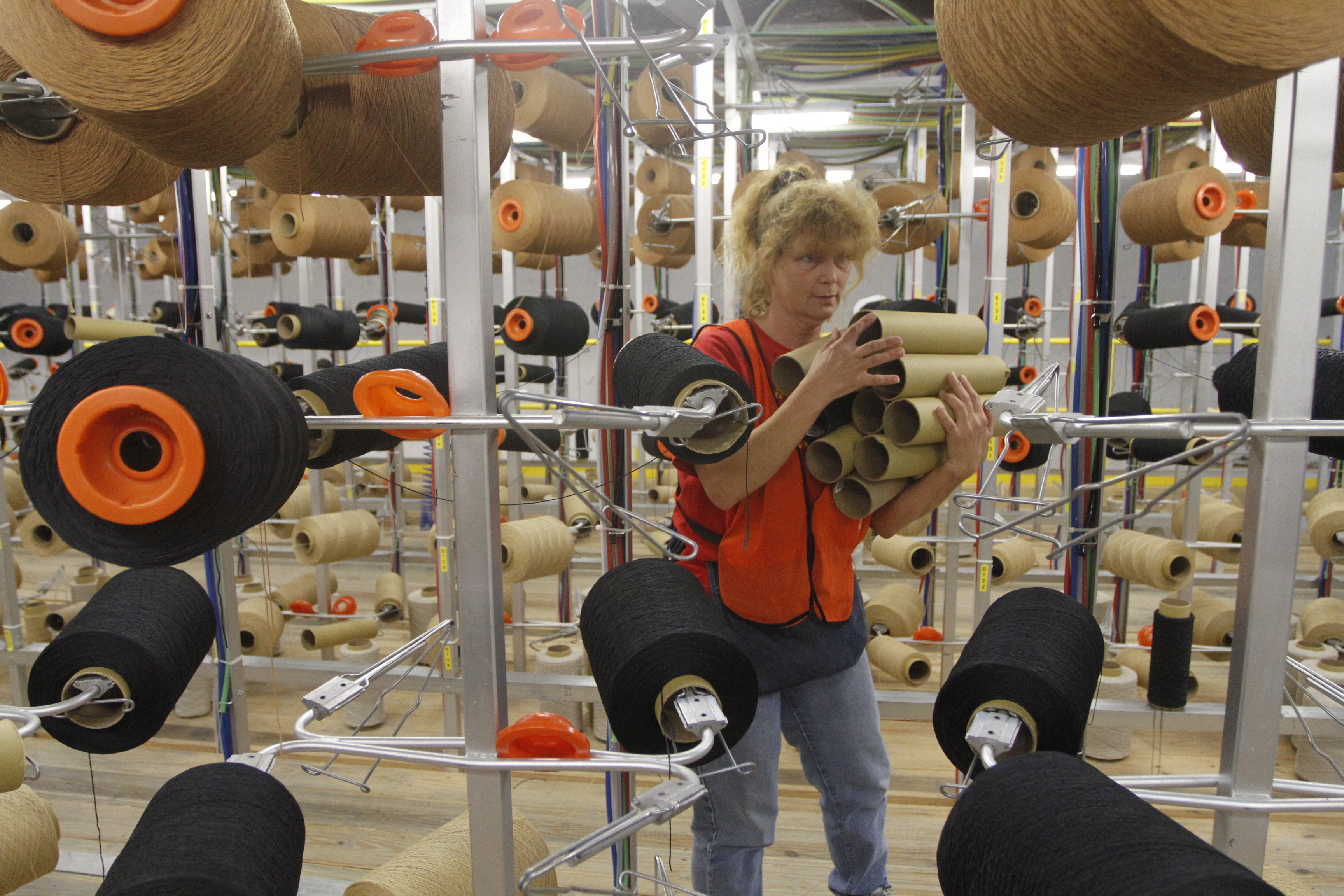
 Donna Shook removes used spools of thread from the creeling area at the Dixie Group carpet plant in Eton, Ga., in this file photo.
The first three months of 2015 haven’t been everything Dixie Group would have ordered up if officials at the Chattanooga carpet maker had their way, but the company’s general upward trajectory coming out of late November maintained its course nonetheless.
In Wednesday’s first-quarter financial report, Dixie Group showed 15-cents-per-share losses, with sales near $96 million in the quarter. Losses from continuing operations totaled $2.4 million as the company settles into its restructured facilities and pays for higher medical costs and new equipment.
Dixie Group’s first quarter sales were, on the plus side, about 13 percent higher than a year ago.
Still, Chairman and CEO Dan Frierson said in a conference call that “our financial results were less than satisfactory in the quarter.”
The first-quarter financial report blames “higher training [costs],” along with “waste costs associated with our restructuring” — including the task of integrating California-based Atlas Carpet Mills, which Dixie Group acquired roughly a year ago — for the higher operating costs.
The carpet maker is coming off a bumpy mid- to late-2014 — during which its shares closed near $16 a share last April and then $6 a share in November.
But “the first quarter is our weakest quarter, and we don’t need to perform as well as the industry,” said Frierson.
He said many carpet makers do “a lot of sale of stock items and we do not.”
And since late November, Dixie Group shares have been on a general climb, reaching $10 a share for the first time since last summer.
Shares of Dixie Group fell Wednesday by 18 cents per share, or nearly 1.8 pecent, to close at $10.18 in trading on the Nasdaq exchange.
Jon Faulkner, CEO, vice president and head of investor relations at Dixie Group, said that “due to some service issues we had late last year and some quality issues, we did not see as big a spread between us and the industry as we would normally expect.”
But he expects the gap between Dixie Group and the field to widen in Dixie Group’s favor as the year goes on.
“We would anticipate later this year that we would show much better top line performance than we have done so far,” he said.
Part of that improvement will include getting the Atlas Mills division firing on all cylinders.
Quality issues, problems getting hold of raw materials and the delayed arrival of new technologies caused Atlas’ sales to be lower than anticipated.
“It did start out somewhat slowly,” said Faulkner. “We did not introduce new products on a timely basis last year due to several issues.”
But around the end of the year, he said some of the kinks were straightened out, and the company was able to roll out new products.
And acquiring Atlas “was still a very good transaction for us,” said Faulkner.
In general, residential sales were up slightly in the first quarter of this year over last, and commercial sales remained strong, said Wednesday’s report.
Asked Wednesday morning whether a rise in new home constructions is needed to lift Dixie Group’s “sluggish” first quarter residential sales, Frierson responded that “we have repeatedly said the main drivers are the stock market and consumer confidence.”
That being said, “I would say resales of homes are as important as housing starts,” he added.
And “obviously if housing markets were to shrink, that would be an issue and depressing.”
Looking ahead, Dixie Group officials said they won’t make any forward projections with a timeline, but predicted business would bounce back — with residential demand growing and commercial demand staying strong — through the rest of the year, heading into 2016.
Going forward with a now fully-staffed facility, Dixie Group officials said they make $13.5 million worth of capital investments through the remainder of this year and said at the end of the first quarter, the company’s debt stood at about $123 million.
Dixie Group stocks closed Wednesday at $10.11 a share, down 25 cents from the start of the day.
Contact staff writer Alex Green at agreen@timesfreepress.com or 423-757-6480.