
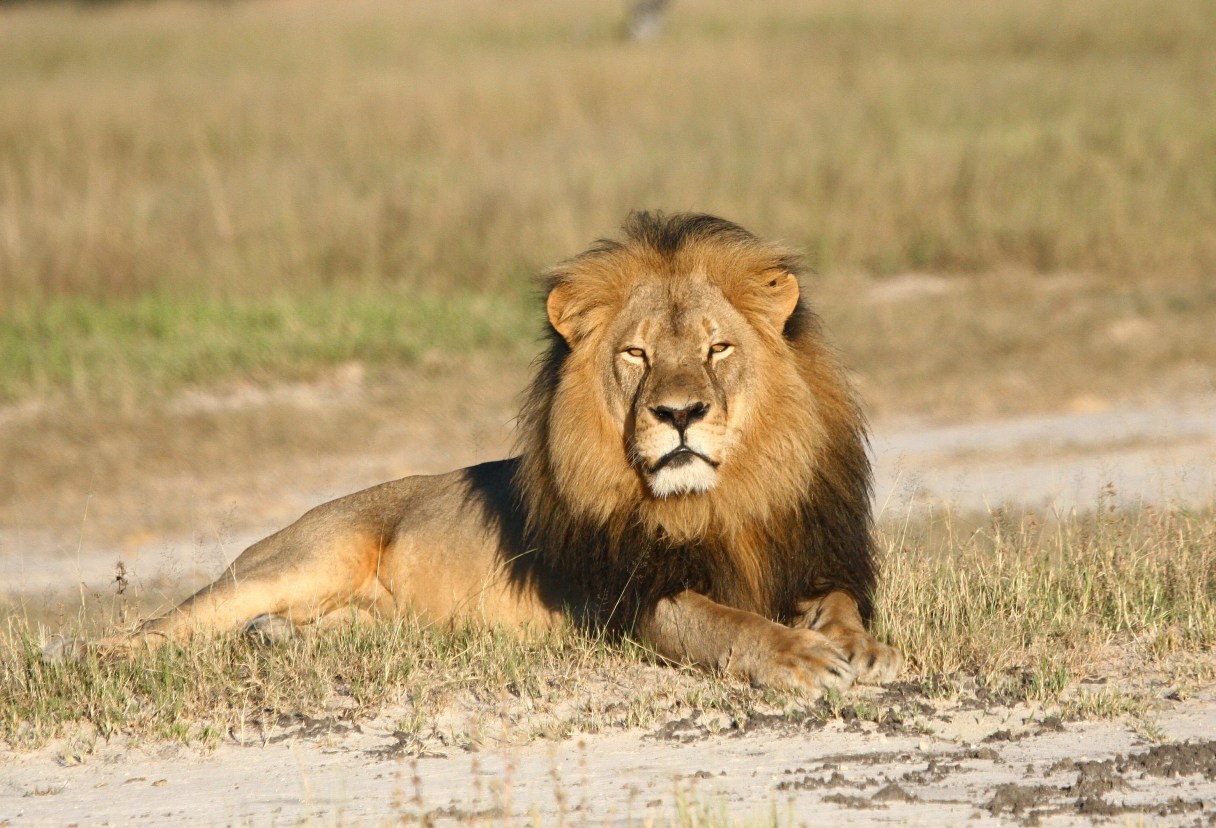
Two weeks ago I watched with revulsion as the story about the killing of Cecil the lion unfolded. In case you somehow managed to miss it, it goes like this: This past July, American dentist Walter Palmer reportedly paid $50,000 for a permit to hunt and kill a lion in Zimbabwe. Cecil lived in the protected Hwange National Park, but he was lured out of the park and onto an adjacent farm by an elephant carcass strategically placed there by Palmer and his hunting guide.
When Cecil emerged from the park, Palmer shot and critically wounded him with a bow and arrow. Cecil got away, but 40 hours later, Palmer and his guide tracked him down. Palmer shot him again, this time killing him, then removed the lion’s head for his trophy wall.

If you care about animals, everything about this story is hideous and heartbreaking. But, as is the case with many tragic stories, the backstory is just as sad. Palmer is a longtime big game recreational hunter. Older photos show him holding up a dead leopard and posing next to a dead rhino. Reportedly, Palmer’s hunting guide was upset when he realized they had killed Cecil. Palmer’s response was to ask whether the guide could find him a large elephant to kill before his trip was over.
When the story hit headlines and the Internet, international public outrage ensued. Palmer’s office in Indiana has been shut down since the incident, and a memorial to large game animals quickly grew out front. Palmer, who had begun receiving death threats, went into hiding, awaiting news of his possible extradition to Zimbabwe.
There are many things I don’t understand when it comes to people’s relationships with animals. I don’t understand how people can hurt or kill animals for fun and recreation. I don’t understand chaining dogs by their necks to a post or a doghouse. I don’t understand thoughtless abandonment.
I’m delighted by the international outpouring of compassion over Cecil’s death. But here in America, according to the ASPCA, about 7.6 million companion animals enter our animal shelters nationwide every year. The most commonly stated reason for taking an animal to a shelter? People moving to a residence where the animal isn’t allowed.
Each year, almost 3 million of these animals are euthanized. Domestic pet homelessness has many roots, including ignorance or an unwillingness to sterilize, which has led to too many animals and too few homes, and economic downturn leading to job losses and peoples’ inability to care for their animals financially.
Aside from the animals in shelters, 70 million strays are left to wander the streets of America, where they are routinely hit by cars, starve to death or die of preventable and treatable diseases. Where is our national outrage about this?
And what about right here at home? According to Spay Tennessee.org, fewer than half the 95 counties in Tennessee even have an animal shelter. Our euthanasia rate is five to six times the national average. And if that’s not sad enough, in counties without shelters, abandoned and neglected animals are commonly killed by drowning, shooting, freezing or starving to death. They are found in ditches, in dumpsters and deceased at the end of chains. Where is our outrage about this?
Granted, things have gotten better for our domestic and farm animals than they used to be. But the sad truth is that our euthanasia rates are still through the roof, the major cosmetic companies continue to perform cruel and unnecessary experiments on animals, and the majority of farm animals we eat live and die under circumstances that would leave most of us heartbroken – as heartbroken as we profess to be about Cecil – if we spent any time thinking about it.
Of course, outrage is not a movement or a solution. So what can we do? We can educate ourselves. Volunteer at a shelter. Go meatless one or two days a week. Go to http://features.peta.org/cruelty-free-company-search/index.aspx to find out which cosmetic companies you can trust.
Understand that, when you buy an animal from a breeder, you miss the opportunity to save a homeless animal from a shelter. Take the time to train your dog; behavior problems are another main reason dogs are taken to shelters. Don’t give a dog or cat to a child and assume she knows how to treat it humanely or care for it.
It’s important to care about Cecil and the plight of big game everywhere. It heartened me to see it. But here at home our animals are suffering right under our noses. Compassion is important but it must be more than a stance. It should be a call to action. It’s one of the oldest teachings there is.
Contact Dana Shavin at Danalise@juno.com. Her memoir, “The Body Tourist,” is available from Amazon.