
Sunday, November 15, 2026Nov 15

Islamic State images purport to show destroyed Syrian temple

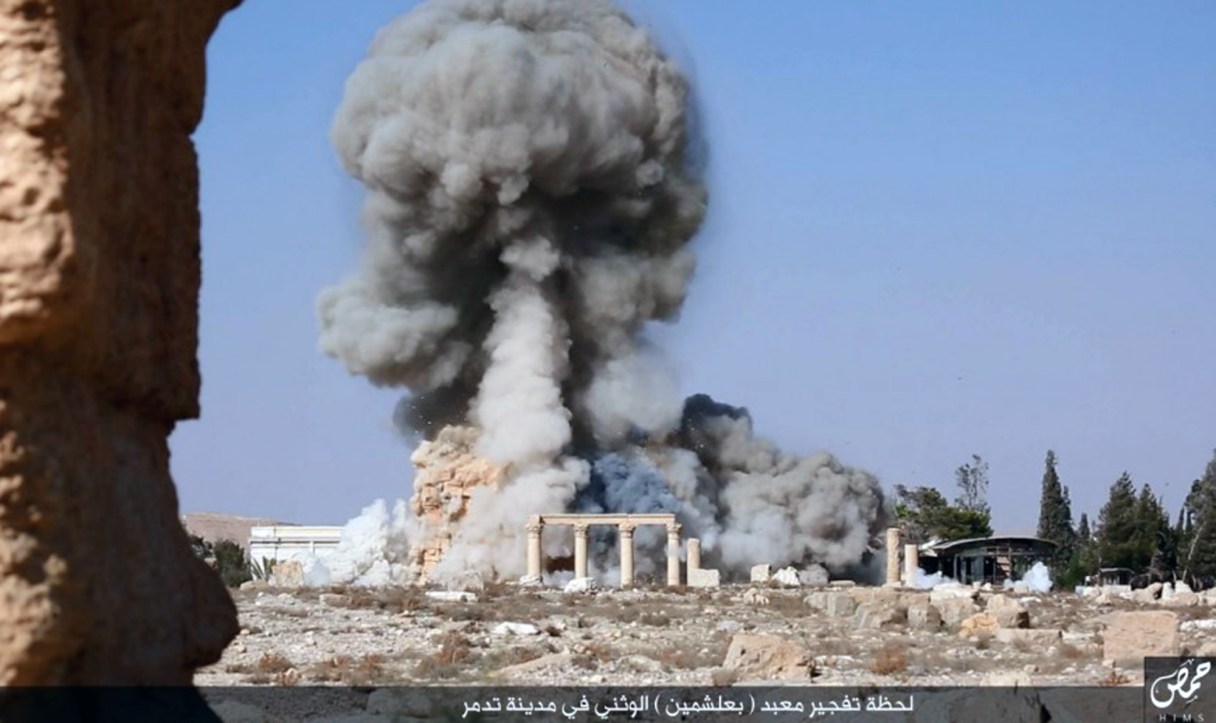
This undated photo released Tuesday, Aug. 25, 2015 on a social media site used by Islamic State militants, which has been verified and is consistent with other AP reporting, shows smoke from the detonation of the 2,000-year-old temple of Baalshamin in Syria's ancient caravan city of Palmyra. A resident of the city said the temple was destroyed on Sunday, a month after the group's militants booby-trapped it with explosives. Arabic at bottom reads, "The moment of detonation of the pagan Baalshamin temple in the city of Palmyra." (Islamic State social media account via AP)

BEIRUT (AP) – The Islamic State group released propaganda images Tuesday that purport to show militants laying explosives in and then blowing up the 2,000-year-old temple of Baalshamin in Syria’s ancient caravan city of Palmyra.

The images, posted on social media by supporters of the group, showed militants carrying barrels of explosives, and laying them inside the temple. Other smaller wired cans lay around the temple walls and columns. Then an image shows a grey plume of smoke rising above the temple from a distance, and then an image of the temple reduced to a pile of rocks. One caption read: “The complete destruction of the pagan Baalshamin temple.”

The Associated Press could not independently verify the images. However, they were released like other group propaganda and carried a logo it often used in the city of Palmyra, in Syria’s central Homs province.

The images also corresponded to prior AP reporting. A resident of Palmyra had told the AP the temple was destroyed on Sunday, a month after the group’s militants booby-trapped it with explosives.

The U.N. cultural agency UNESCO on Monday called the destruction of the temple a war crime.