
Read more
Chattanooga traffic gridlock sets new records
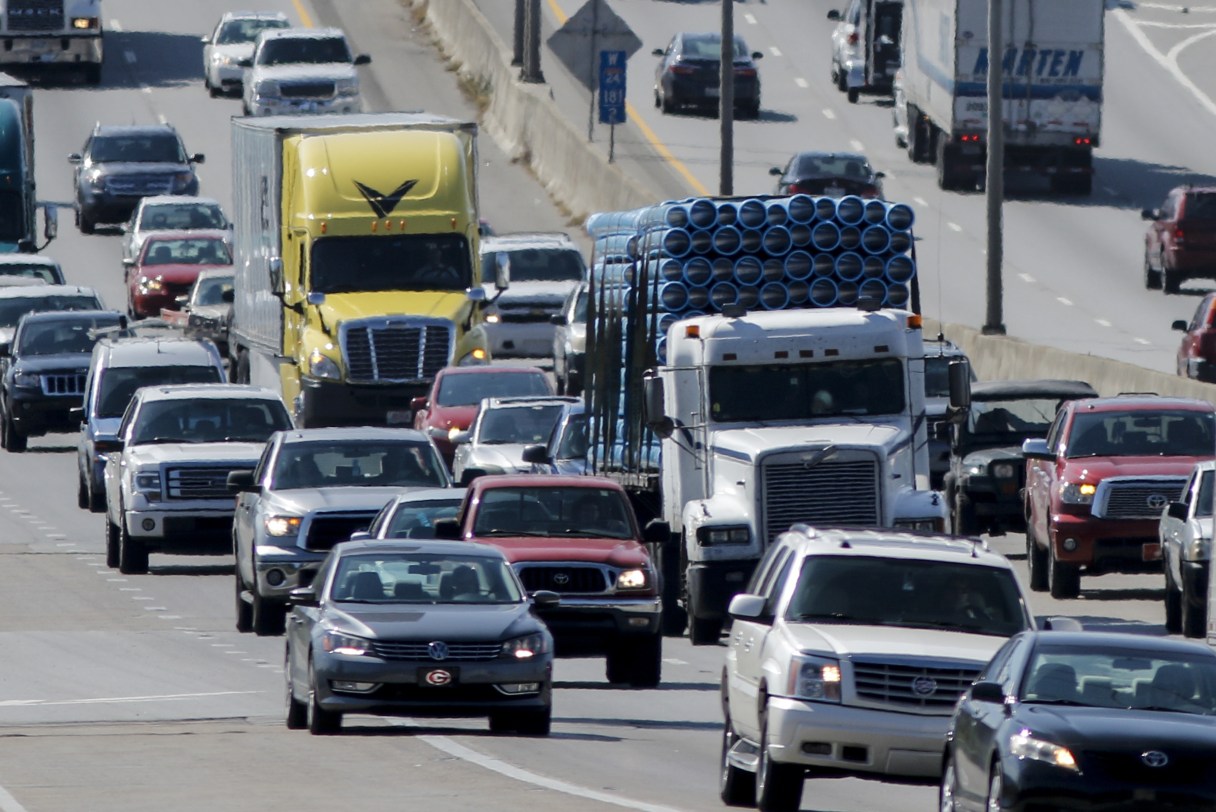
Rush hour, the 5 p.m. time when most commuters leave their jobs for home, is now rush hours in Chattanooga.
Commuters can pretty well expect to find themselves in heavy interstate traffic most weekdays between 4 and 7 p.m. That’s a change from even a decade ago, when interstate traffic didn’t begin to build until around 4:30 p.m. and was pretty much thinned out around 6:30 p.m.
A new survey from the Texas A&M Transportation Institute says Chattanooga is not the only place experiencing such crowded highways. For areas of fewer than 500,000 people like the Scenic City, the problem is four times worse than it was in 1982, the survey said.
People who live here can believe it. Even weekends – especially Saturday – can feature times of heavy traffic.
Since the survey grouped Chattanooga in a list of 370 mostly smaller urban areas, its position near the top of the list is not surprising.
In total hours of delay, the city ranked fourth behind Concord, Calif., Mission Viejo-Lake Forest-San Clemente, Calif., and Augusta-Richmond County, Ga.-S.C. Take away the expected-to-be-crowded California suburbs of San Francisco and Los Angeles, and Chattanooga was second on the list behind Augusta. In hours of delay per auto commuter, it ranked seventh with 28, where it was tied with five other cities.
Chattanoogans whose jobs take them from downtown to the suburbs would say the traffic is worst wherever they are, but most interstate drivers would acknowledge the Ridge Cut and the Interstate 24-Interstate 75 split as the thickest knots through which they travel.
The Ridge Cut is more clogged than its needs to be daily because slower tractor-trailer trucks climb the grade to the top of Missionary Ridge in all three lanes. A sign before the grade instructs truckers to stay in the two right-hand lanes, but it’s routinely ignored. Repeated traffic tickets given to violators might cut down on such clogs.
Fixes for the Interstate 75/24 split have been studied for years. As recently as October 2014, a public hearing for an $89 million plan to deal with the congestion at the intersection of I-75 and I-24 was held at the East Ridge Community Center. Two years earlier, a stakeholders meeting on a potential I-75/24 rebuild occurred at the Development Resource Center.
On northbound I-75, according to Times Free Press archives, ideas included reworking the entry ramp from Ringgold Road and extending the welcome center ramp to minimize traffic weaving, and widening and flattening the sharp curve where I-75 turns northeast and I-24 traffic merges in. The interstate at that point would grow from six to eight lanes.
In addition, the westbound ramp to I-24 would be a new flyover leaving from the right side of I-75 and merging into westbound I-24 in the slow lane near Spring Creek Road.
A suggested longer-term fix – the year 2029 was mentioned in 2012 – would be an I-75 bypass that would go from Ringgold, Ga., to the Bradley County line in Tennessee.
Transportation officials acknowledged late last year even the near-term fixes weren’t all that near and that the design for the I-75-I-24 interchange hadn’t been funded yet. Traffic volume at the time, at various parts of the interchange, was said to be from 107,000 to 124,000 vehicles per day.
Highway changes, of course, are only one part of a permanent transportation solution.
A new lock at Chickamauga Dam would allow multiple tons of cargo now carried by tractor-trailer trucks to be shipped on barges. Work at the dam has been stopped since 2012, though, and a new economic analysis by the U.S. Army Corps of Engineers said the cost of a replacement lock at Chickamauga Dam may not outweigh the benefits of building it.
Yet, U.S. Sen. Lamar Alexander and other supporters of the new lock insist it not only will reduce tractor-trailer traffic but also will lower overall transportation costs and recruit more industry to the region.
Light rail is another option being studied by the city. In May, the City Council pledged $290,000 from a federal transportation grant toward a $690,000 study that would look at possible routes, ridership, construction costs and overall interest.
What’s clear is although the city hasn’t seen huge population growth, it has seen steady traffic growth. We all would like to cut down on our commute times, but a long-term fix must involve more than additional cars and wider roads.
How diverse and how expensive that fix is will be the determining factors in what is ultimately built.