
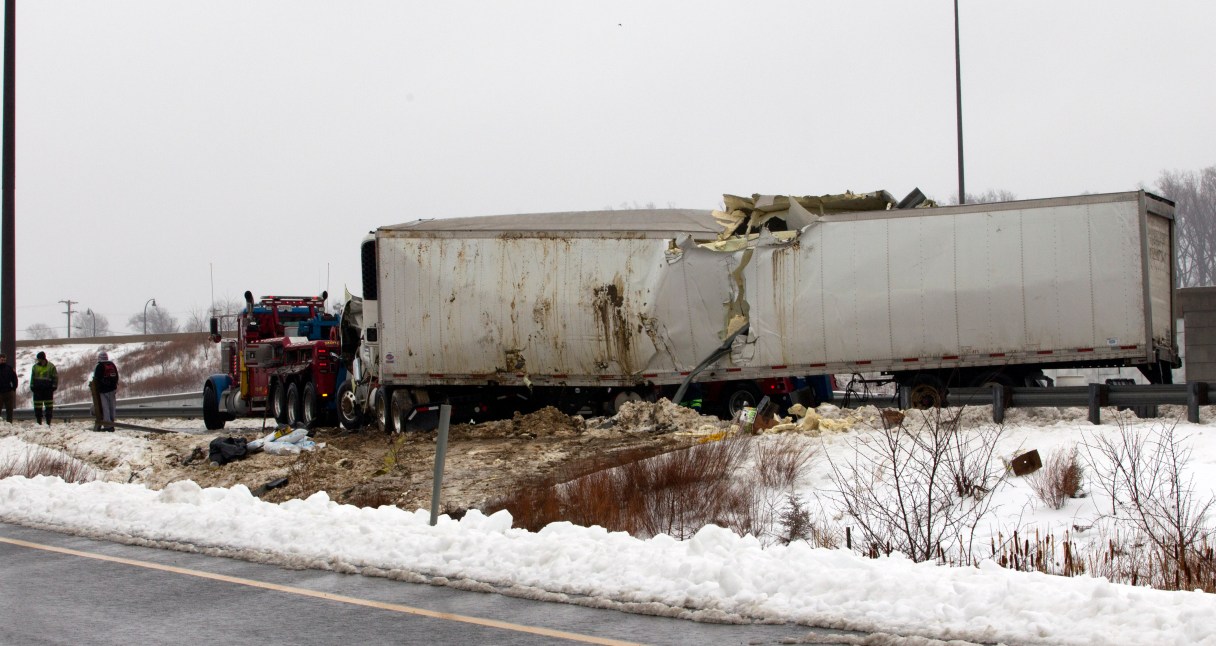
If you’re a tow truck operator, and you’re dispatched to clear an interstate wreck involving a semi truck or a concrete mixer, you know before the job is finished there’s a chance you’ll be slapped with thousands of dollars in fines for operating your truck overweight on the road.
It’s just the way things are, says Shannon Yates, co-owner of Doug Yates Towing and Recovery.
“We fight it everyday,” he said.
But now, if everything goes as expected, towing operators like Yates will get a break.
Included in the federal highway omnibus funding bill that’s expected to pass in Congress today, there’s a provision allowing tow trucks to operate over federal weight limits on federal roads, if they’re hauling a big truck away from the scene of an accident or emergency.
The provision is called the FAIR TOW Act, and was introduced in the House of Representatives back in July by U.S. Rep. Chuck Fleischmann, R-Tenn.
“There are two issues out here, first of all safety,” Fleishmann said. “We want to get these broken-down, heavy vehicles off of the road, and the other thing about it is we want to incentivize people to go pick these up.”
He said smaller tow operators have resisted investing in heavier equipment and performing heavy hauls because of the potential for fines.
Fleischmann originally introduced the FAIR TOW Act as a separate, stand-alone bill in the House. But he said Wednesday he is thankful the measure was ultimately included in the high-profile, long-term federal highway funding legislation that has been on the front burner in recent weeks, in the run up to the potential Dec. 4 federal road funding cutoff.
With inclusion in the road funding bill, the FAIR TOW Act will have the same “language and the same force of law,” he said, the process was simply expedited.
“Many stand-alone bills sometimes flounder out there waiting for a Senate companion bill to go with it, or waiting on an executive action,” Fleischmann said on Wednesday.
Fleischmann brought the provision to his Congressional colleagues after earlier this year being approached by officials at Miller Industries, the globally-recognized manufacturer of tow trucks and equipment headquartered just around the corner from Fleischmann’s Ooltewah home in Chattanooga.
William G. Miller II, president at Miller Industries, said the Ooltewah-based company acts as a sort of de facto mouthpiece at times for the towing industry, which is still largely decentralized.
“I think the towing industry is still a very interesting industry because it’s predominantly small, independent companies that are entrepreneurs,” he said.
Miller said as large equipment and trucks have increasingly gotten bigger and heavier, towing operators have been pushed to increasingly build and buy bigger and heavier trucks and mechanisms to move them. He said some tow operators have tried to skirt weight laws by using smaller, lighter equipment to move heavy equipment, which can present a bigger threat because of insufficient brake capacity.
“It takes weight to move weight,” he said.
While Chattanooga and state highway patrol officers in this area have typically been good about not fining heavy hauls, Yates – whose company does about 75 percent heavy jobs – said he has run into the problem.
“I’ve been ticketed in Georgia for it a couple of times,” he said
He recalled one instance in particular, when he was dispatched to pick up a tractor-trailer just below the truck scales off Interstate 75 in Ringgold.
Yates legally had to pull off at the Ringgold truck scales knowing he was overweight, and a state patrol officer handed him a hefty fine for it.
He said a change has been a long time coming.
“It only makes sense,” he said. “We’re not trying to transport freight from Georgia to California.”
The FAIR TOW Act provision will not allow tow operators to haul large equipment or trucks at-will on federal roads. It only protects operators hauling a heavy truck or piece of equipment away from an accident, and requires they drop it at the nearest repair location.
Long, planned hauls will still require special permits.
Miller said he hopes going forward, states will consider looking at the federal provision and consider adopting similar, state-level laws.
“Guys go out and do this for you and then get fined on the way home,” he said. “Hopefully this helps correct that, and helps the industry as a whole grow and become better.”
Contact staff writer Alex Green at agreen@timesfreepress.com or 423-757-6480.