
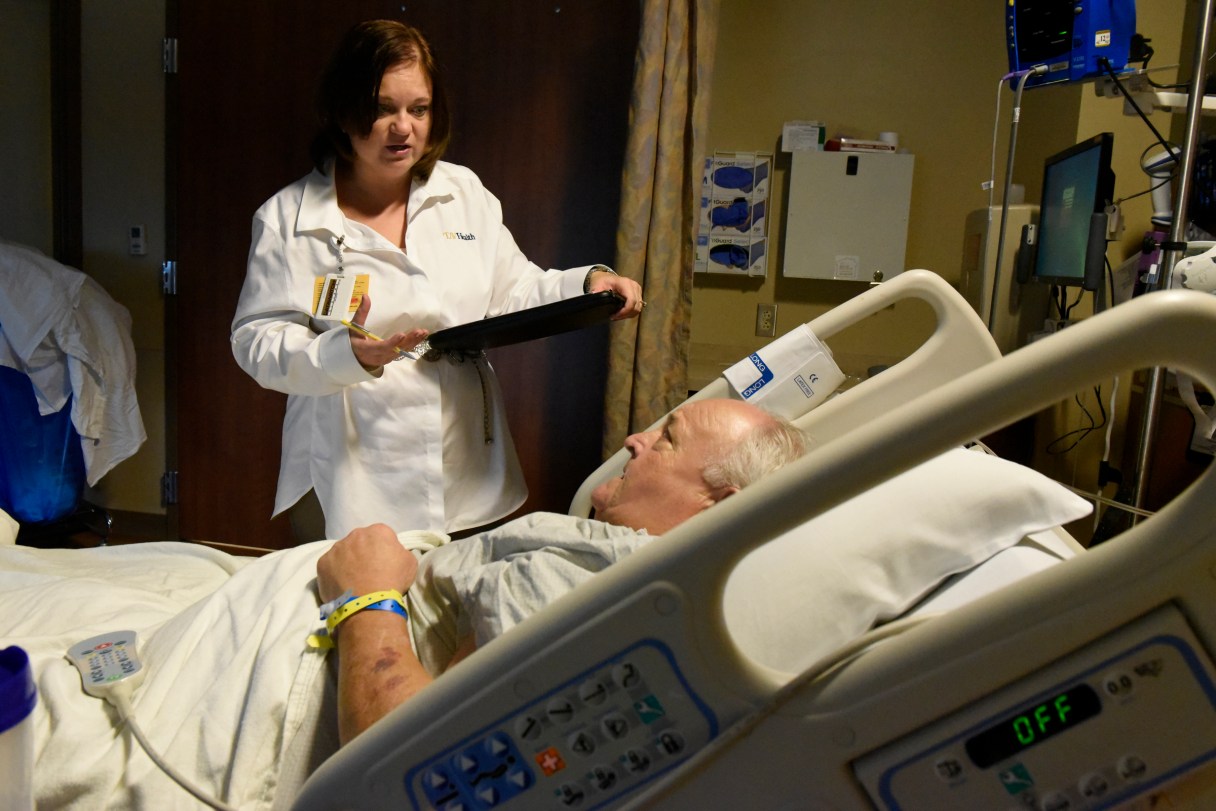
Emily Gunn said the more phone calls she made, the more she realized her patient was having problems following doctor’s orders.
Linda was a 50-year-old local woman without health insurance who had left CHI Memorial’s heart failure unit only a few days earlier.
Gunn’s job, as coordinator of Memorial’s Heart Failure Transition program, was to make sure Linda continued to heal after leaving the hospital. If Linda had to return to the heart failure unit, Medicare would penalize the hospital and take back part of the money it had paid for Linda’s treatment. And it would note that Memorial had failed in treating Linda’s problems.
So Gunn and her staff worked the phones.
She called Linda and realized the woman had not filled her prescriptions because she couldn’t afford them. Gunn arranged for a charitable donation to cover the cost.
During another call, she realized Linda didn’t have a blood pressure cuff, so Gunn contacted Goodwill Health to obtain one for free.
Linda also needed scales – rapid weight gain might indicate she was accumulating fluid, and that could be dangerous.
And she obviously needed financial help, so Gunn helped her apply for a reduction on her bill and get on a payment plan.
Over the next four months, Gunn and her staff will continue to check in on Linda, for two reasons.
“One is to improve the quality of her life,” she said, “and the second is to prevent her needing readmission to the hospital.”
Gunn’s example shows how a combination of the Affordable Care Act and hospitals’ increased ability to track data is changing the way many patients are treated in Chattanooga hospitals.
If interviews with seven doctors, nurses and administrators from CHI Memorial, Erlanger, and BlueCross BlueShield are any indication, it seems to be working to improve treatment.
Here’s what people may start to see when they end up in the hospital for major surgery:
‘ The hospital staff will treat them and try to get them out the door as quickly as possible.
‘ Once at home, patients are more likely to get visits from caregivers – for as long as four months.
‘ From beginning to end, all the care will be coordinated by one entity, generally, the hospital.
All of this is the result of two intersecting forces: The requirements of the Affordable Care Act – also known as Obamacare – to trim health care costs, and much better electronic data collection by doctors and hospitals.
“We know health care is too expensive for society right now,” said Dr. William Oelerrich, a cardiologist in Memorial’s Heart Institute. “We have to find ways of making efficient changes without hampering quality.”
While much attention is focused on the Affordable Care Act’s requirement that everyone buy health insurance, the massive legislation also has several measures aimed at cutting the cost and improving the quality of care.
One major way the federal government is doing that is by paying hospitals a set fee for a given treatment, such as heart surgery or a hip replacement, and then leaving it up to the hospital to coordinate all of the caregivers involved.
Under the old approach, often called “fee for service,” each part of the health care system saw the patient, provided treatment, wrote out a bill, and sent the patient on to the next level. And at the very end, the patient sometimes ended up not healthy – and back in the hospital again.
“With the fee-for-service model, each individual provider focused on their part of the pie, but nobody’s looking at the overall picture,” said Lisa Slattery, vice president of quality management for BlueCross BlueShield of Tennessee, the state’s largest health insurer.
Medicare, in early November, launched a push to change that, at least for hip and knee surgery. The number of hip and knee surgeries has soared in recent years, and they tend to be expensive.
Medicare paid out $7 billion for them in 2014 alone.
In the test, occurring in 67 hospitals around the U.S., a hospital will be assigned as the primary caregiver and offered a flat fee, or “bundle,” for treating the patient. It will be up to the hospital to monitor the care provided by all of the other places that provide treatment, and if the patient ends up back in the hospital, Medicare will take back some of its payment.
Medicare claims similar programs are already lowering medical bills and providing better care.
But it means doctors at hospitals such as Erlanger and Memorial now find themselves trying to urge fellow doctors in independent practices or nursing home administrators in different states to change the way they treat patients.
“We’re expanding the responsibility from just an in-patient event to the in-patient and subsequent events, and so you become not just responsible for the initial episode, but you try to coordinate the care,” Oelerrich said.
“The difference is that care may be in places where the hospital system is not typically involved, in a nursing home, or home health facility not owned by the hospital.”
Gunn said hospital staffs are preparing guidelines for proper follow-up treatment that they can discuss with rehab facilities or nursing homes.
Some nursing homes only weigh patients once a month, for example, while heart specialists want them weighed at least once a week, if not daily. Some nursing homes offer only one menu for all patients, while doctors may want different diets for those recovering from different treatments. The goal is for the hospital to guide the care, start to finish.
“So much of health care costs are driven by fumbles across the continuum of care,” said Slattery. “Somebody moves from a hospital to a nursing facility, but all of the info on them does not follow.”
DATA DRIVEN
Doctors at both Erlanger and Memorial say the other trend is that physicians and hospitals are finally beginning to collect really useful data about how well their treatments work.
Hospitals have always collected a lot of data, but much of it was recorded on paper.
“If all of your data is handwritten in a chart, it is very, very labor intensive to analyze,” said Dr. Michael Blake, who has been working on quality issues at Erlanger for 20 years.
Through electronic records data, hospitals can learn what changes actually improve care.
“We now have information about cost at multiple nursing-type care facilities, and there is a fair amount of variation in the cost,” Oelerrich said. “So we start to say, how do we need to use this info to modify those cost numbers and looking at readmission rates and looking at keeping people out of the hospital.”
Mike Bettinger, director of process improvement at Erlanger, said the difference in focus is obvious even when doctors attend a medical convention.
“If you went to a conference, there didn’t used to be quality papers. They used to be about a new way to do an operation. Now they are about taking data sets of 100,000 people and looking at the impact of something. It’s a whole different mindset, and I think it is a good thing.”
“Physicians are competitive,” said Dr. Joseph Cofer, who is heading Erlanger’s efforts, along with Bettinger and Blake, to improve quality. “If you get data you believe in, and if you give a physician his or her outcomes, show him or her he is not as good in this or that as he could be, physicians will change their behavior.”
The changes forced by the ACA and better data won’t work with every medical situation. More complex problems, such as heart failure, have so many variables outside a hospital’s control they don’t easily lend themselves to the bundled payment approach, for example. But the changes do seem to be making a difference.
At Memorial’s heart failure unit, “costs are getting controlled, the length of stay is getting controlled, and our readmission rate has decreased significantly,” Gunn said.
The heart failure unit’s readmission rate has dropped from 18 percent in 2012 to 12.5 percent currently, she said, and as the hospital gets more data on former patients, that number should continue to go down.
Over the past three years, Gunn added, “we have 1,600 patients we’ve been in contact with for four months after they left hospital.”
Contact staff writer Steve Johnson at sjohn son@timesfreepress.com, 423-757-6673, on Twitter @stevejohnsonTFP or on Facebook at stevejohn sonTFP.