
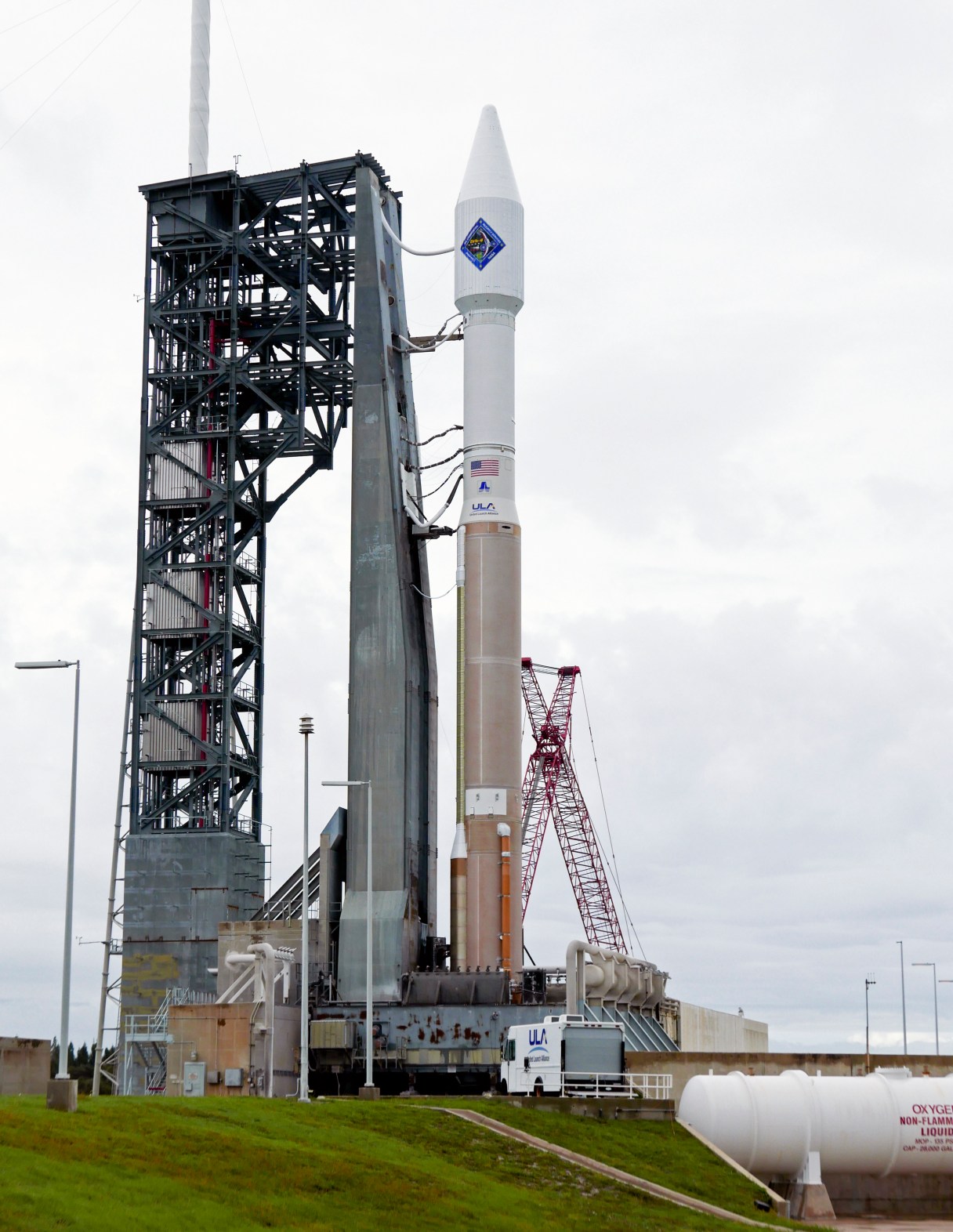
CAPE CANAVERAL, Fla. (AP) – Wind remained a concern Sunday for a space station delivery mission that’s already running late.
It was the fourth launch attempt for the unmanned Atlas rocket, loaded with food, experiments and Christmas presents for the astronauts at the International Space Station.
“Back in the saddle,” rocket maker United Launch Alliance’s president, Tory Bruno, said in a tweet.
Forecasters gave 40 percent odds of launching, better than the previous three days, when the weather foiled every effort to make the first U.S. shipment in months. But the wind still was dangerously high; the launch team was hoping the gusts would ease in time for a 4:44 p.m. send-off. Conditions improve dramatically Monday.
The rocket holds 7,400 pounds of supplies, all packed into a capsule named Cygnus after the swan constellation.
Shipper Orbital ATK shifted the Cygnus to another company’s rocket because its own, the Antares, has been grounded since October 2014. NASA’s other commercial supplier, SpaceX, is also sidelined by a launch accident.
With six astronauts on board, the space station has dipped below NASA’s desired six-month food supply. So lots of groceries are going up.
SpaceX made the last successful supply run from the U.S. in April. Its next cargo ship, launched two months later, ended up in the Atlantic following a failure of its Falcon rocket.
The California-based SpaceX aims to resume deliveries next month, while Virginia’s Orbital hopes to get its Antares flying again in May. In the meantime, Orbital is counting on this Atlas and another one to fill the gap. Russia, which also lost a shipment earlier this year, has another supply run coming up in two weeks.
United Launch Alliance builds and flies the powerful Atlas V, a workhorse normally used to hoist satellites for the Air Force and others. This is its first station mission. Boeing plans to use the Atlas V to launch its commercial crew spacecraft for NASA, the Starliner, as early as 2017.
NASA hired out station supply and crew missions to industry, for billions of dollars, as its 30-year shuttle program wound down.
___
Online:
Orbital ATK: https://www.orbitalatk.com/
NASA: http://www.nasa.gov/mission_pages/station/main/index.html