
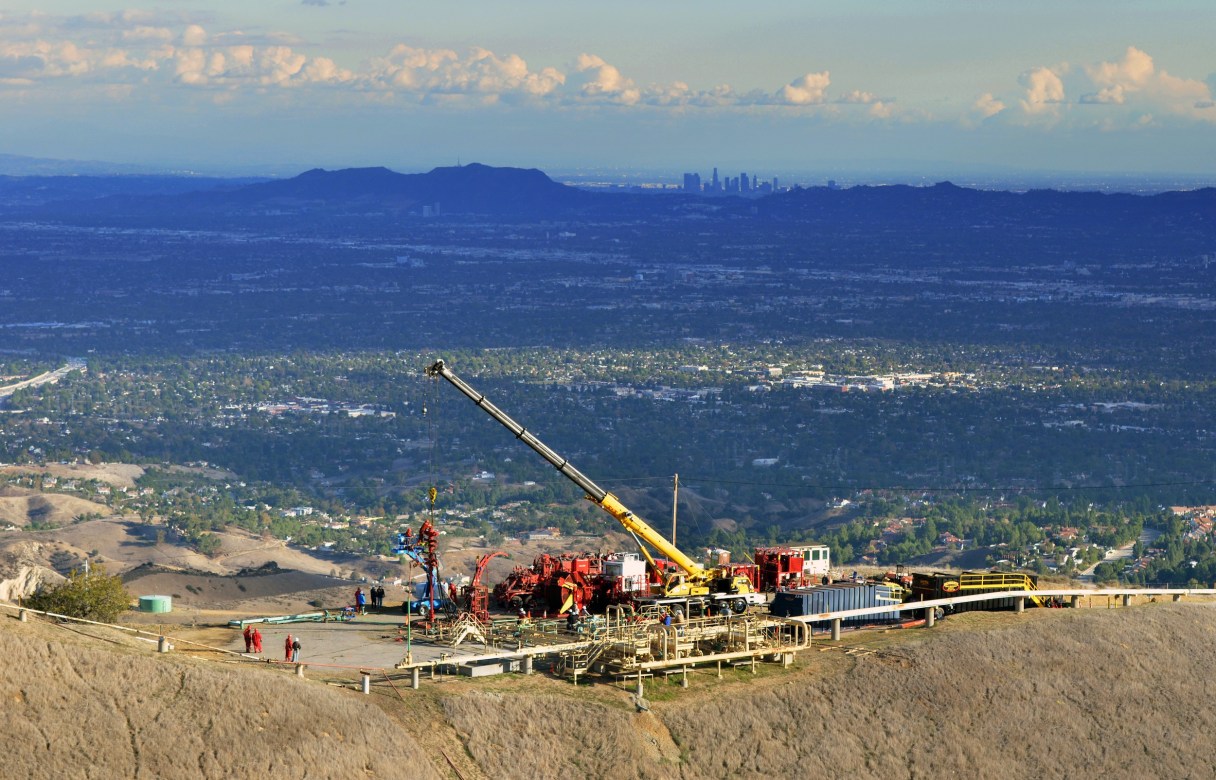
It’s not getting much media attention, but a methane leak from a well owned by Southern California Gas Co. is looking very much like the horrifying Deepwater Horizon oil spill that gushed for 87 days beginning in April 2010.
According to MSNBC and the Emergency and Disaster Information Service operated by the National Association of Radio Distress-Signalling and Infocommunications, a giant stream of methane – a climate-warming gas up to 70 times more potent than carbon dioxide – is blowing hundreds of feet into the air in Los Angeles County in the Porter Ranch community near Los Angeles. And it has been leaking since October. Worse still, authorities are saying it may take four more months to stop the leak.
Pilots recently were told by the FAA to stay clear of the area, and more than 1,800 families downwind have been relocated. An additional 1,433 families have asked to be moved. Two schools have been closed, and about 2,000 students are attending different schools.
“I think what we are seeing is probably one of the single largest releases of methane in California history,” said Tim O’Connor, who used to inspect major facilities like refineries for the Bay Area Air Quality Management District and works for the Environmental Defense Fund. “People I speak with who are experts in the field say this is the biggest, most complex leak that they have ever seen.”
Authorities estimate the rupture in the well, perhaps more than a mile deep, is sending 100,000 pounds of methane into the air per hour. Another estimate is 1 million metric tons per month.
That means this plume spells danger not just for residents in Southern California, but all over the planet.
Methane traps heat more powerfully than carbon dioxide during its approximately 20-year stay in the atmosphere, giving it an outsize role in rising sea levels and disrupted weather. NASA has gotten special permission to fly near the plume to collect data, according to MSNBC.
“We have never had an escape this large,” said Gillian Wright, vice president for customer services for Southern California Gas. “I have to really emphasize this is an extremely rare event. The extent and the difficulty of resolving this leak are highly, highly unusual.”
All the methods the company has tried so far to kill the well have failed. Experts who fought the Kuwaiti oil field fires have joined the effort, but the safety of the some 100 workers on the site also is a concern. If the wind is blowing methane over certain equipment, crews cannot start that equipment, she said.
Some researchers say not enough attention has been paid to to underground gas storage fields, a mainstay of the natural gas distribution system. In the western United States these storage areas often consist of older oil fields where the original production wells have been converted to injection wells for gas. Sometimes new injection wells are drilled. The natural gas is gathered from remote areas, in this case Texas, New Mexico, the Rocky Mountains or Canada. Pipelines bring it to places like Aliso Canyon where it is compressed and pushed into formations until it is withdrawn when Southern Californians fire up their heaters in winter. Aliso Canyon is the largest such facility on the West Coast, Wright told reporters.
Officials with the Environmental Defense Fund said the gas gushing from Aliso Canyon is roughly equal to that emitted by six coal-fired power plants or 7 million extra cars.
How can it be in this time of technology that something like this can happen? Four more months? After nearly three already?
This is shameful.