

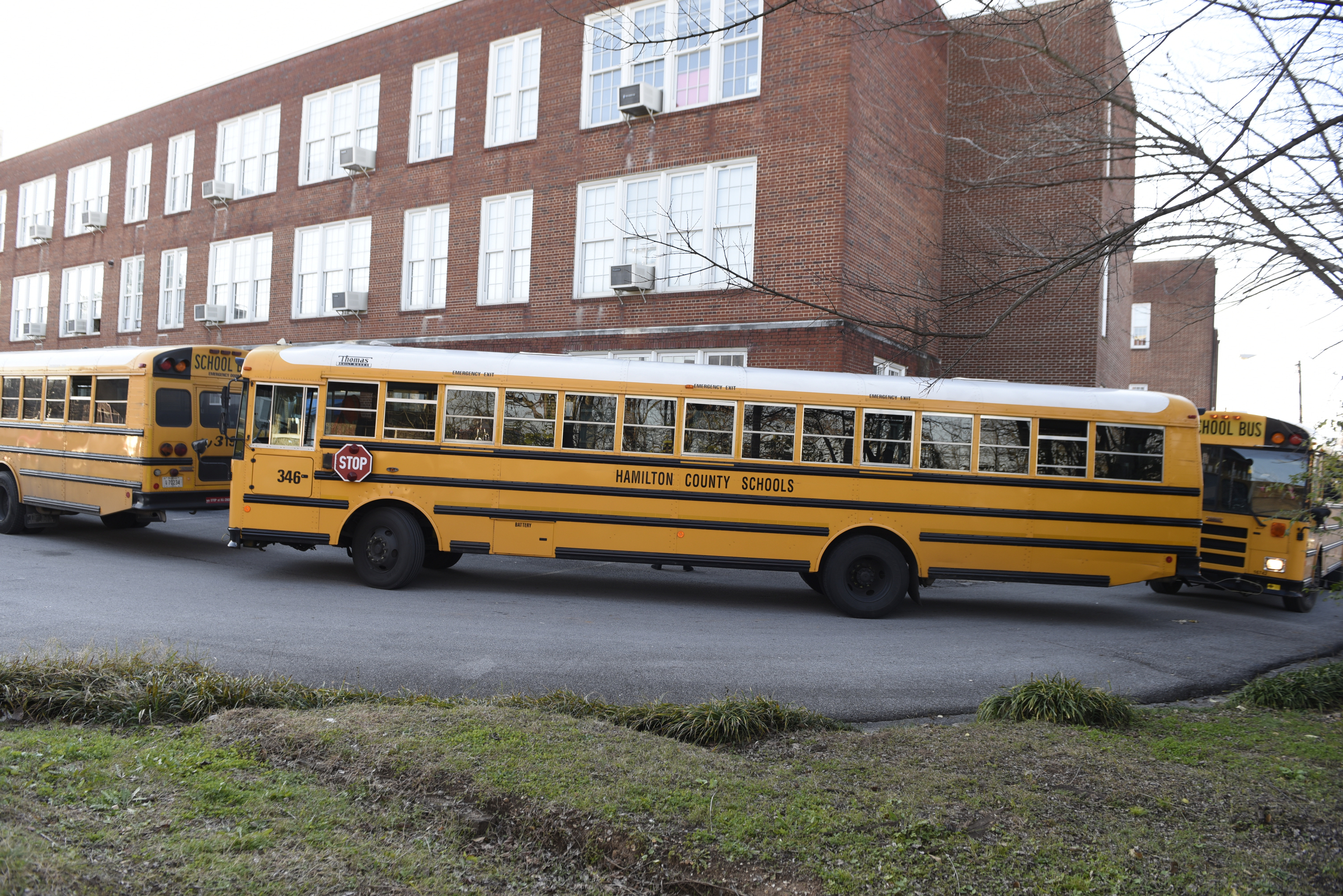
 School buses wait to pick up students at the end of the day at the Chattanooga School for the Arts and Sciences on Monday, Dec. 7, 2015, in Chattanooga, Tenn.
Some Hamilton County kids are riding in new school buses and Chattanooga is snugging up its buildings to save energy thanks to a windfall from falling fuel prices.
Chattanooga and Hamilton County are paying around 40 percent less for gasoline and diesel fuel this fall than three years ago, when prices hit nearly $3 a gallon for contracted fuel purchases.
Just since July 1, when the fiscal year began, Chattanooga’s average cost for gasoline and diesel plummeted from $2.45 a gallon to $1.58 as of Oct. 15. Hamilton County saw the average price for all gasoline, E-10 ethanol and diesel shrink from $2.10 to $1.58 in the same period, according to figures supplied by the two governments.
That means city and county leaders, just like local taxpayers, have more money in their wallets to spend on other needs.
“Just like anybody’s home budget, when a price goes down, it gives you a little bit of room to do the other things that you care about,” Chattanooga Mayor Andy Berke said.
“For us, we’re able to use these funds as we try to take care of our core priorities” such as public safety, housing and education support, Berke said.
Part of that is retrofitting city buildings to make them more energy efficient, he said. Spending money to save money by reducing energy costs is a “strategic investment that will save taxpayer dollars in the long run,” Berke said.
Hamilton County Schools also found a good use for the money it has saved on fuel costs, Assistant Superintendent Christie Jordan said.
“This fuel savings could not have come at a better time for us, because we have more ridership,” Jordan said.
The school system has added more than 1,500 students in just three years, she said. The fuel price drop saved about $300,000 in fiscal 2015, which paid for six buses this year. And the system plans to add four more buses in fiscal 2017, Jordan said.
“If we can use savings to offset additional needs, that keeps the budget balanced. I love that,” she said.
County Mayor Jim Coppinger said there aren’t any specific plans for the fuel savings money the county has amassed.
“We don’t get overexcited here about reductions in fuel costs because it’s volatile,” he said. “We’ve seen it vacillate back and forth over the years. We’re grateful that it’s down, and we’re hopeful it will remain down.”
Trends show they might be able to count on moderate prices for some time. The Organization of Petroleum Exporting Countries recently agreed to keep crude oil pumping at high levels. And with U.S. oil production soaring, Congress last week passed a budget that ends a 40-year-old ban on crude oil exports.
Coppinger, Jordan and Berke are of the same mind, however, when it comes to budgeting for fuel in the coming year – be optimistic, but cautious.
“We all know that what can go down can also go up,” Berke said.
Contact staff writer Judy Walton at jwalton@timesfreepress.com or 423-757-6416.