
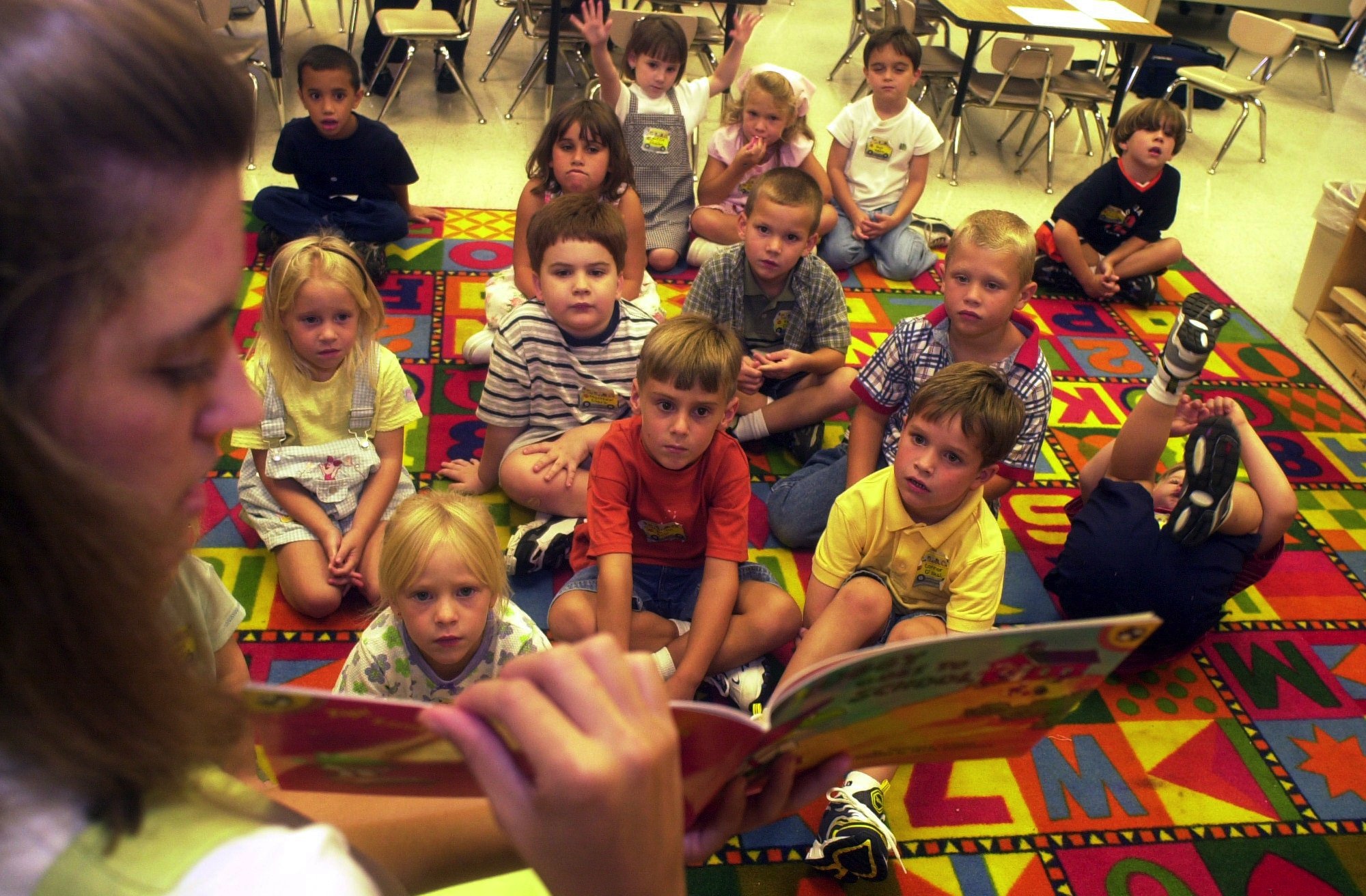
 A teacher found an attentive audience, if only for a moment, from these kindergarteners as she read to them.
Concern has long been high about the state of public education in Chattanooga and Hamilton County – with little result.
Perhaps the reason we’ve been concerned with little result is because most of us, quite selfishly, often link talk about improving education with a groaning expectation of yet another request for money. Yet another call for a tax increase.
If that’s true, it means most of us are missing the point.
The point is not what we might pay in taxes, it’s what business growth and wage growth we will stifle if we don’t improve education here.
In other words, we need to begin talking about the yawning gap between what employers today and tomorrow need from Hamilton County graduates and what those graduates will add to our economy when they land and keep better jobs vs. what those graduates won’t add (in fact will cost us) if they can’t find, land or keep jobs at all.
This is not hyperbole. Jobs and the revenue they produce run our county by funding our schools, our police services, our waste treatment facilities, our road work. The more businesses and jobs we have, the bigger the coffers and more evenly spread our tax burden is.
Today, businesses in Hamilton County have about 15,000 unfilled jobs because they can’t find educationally qualified applicants. County officials predict that number will grow. In coming years, 83 percent of job postings here paying a livable wage of at least $35,000 a year are expected to require some type of education beyond high school. That could be anything from a 12-week commercial driving course or a six-month or one-year technical training program to a two-year associate’s degree or a four-year bachelor’s degree. It could even be a vocational certificate achieved during high school through some hybrid or dual-enrollment program.
Already, businesses are hiring outside of Hamilton County – so much so that only 56 percent of Hamilton County jobs are held by Hamilton County residents, according to the U.S. Census Bureau.
But the problem isn’t one of getting Hamilton County young people to enroll for higher education programs. The problem is getting our young people ready for first grade, ready for fourth-grade reading, ready and capable of graduating high school, ready for college or certificate programs in any way.
Nearly 60 percent of all Hamilton County third-graders do not read on grade level. That means they can’t read well enough to learn on their own in years to come. It’s a given, then, that our schools keep falling further behind the state and other metro areas in every single high school test and on average ACT scores.
Nor does the problem begin at the third grade: Fewer than half of children entering kindergarten are “ready to learn.” In other words, they lack the verbal skills to interact with learning. Just 43 percent of 3- and 4-year-olds are enrolled in early childhood learning programs. Children who have been read to from an early age come to school with 7,000 words in their vocabularies, while children who are not read to come to school with about 500 words.
Is it any wonder, looking at these numbers, that four in 10 students in our county live in poverty? And of course poverty begets poverty, so we are caught in a vicious cycle of major barriers for academic success – and therefore economic success.
This is why it is absolutely imperative that we stop thinking of education needs and costs only in terms of taxes. We must begin to understand that adequate education funding, even if it means a tax increase, can – in a reasonably quick time – equal increased jobs growth and therefore increased business revenue that will, in and of itself, better fund our schools.
Local leaders didn’t say all this quite this way in their recent Chattanooga 2.0 report.
Instead, they spoke far less selfishly. They spoke mostly for our children – and for the jobs our young people may or may not be able to get and keep here.
Perhaps that’s for the best, since it has been quite clear in recent years that Hamilton County commissioners and the Hamilton County mayor are hearing only the bleats of “no new taxes.”
But let’s just cut to the chase: Our children – some 74,460 under 18 now (about 43,000 of them in Hamilton County public schools right now) – are our future because they are the workers who will or won’t be able to land and keep the jobs to fund our county next year and the years after that. We can’t afford not to fund their chances of pulling themselves and us out of the hole we’ve dug.
In the coming 100 or so days, local leaders, including those from the Chattanooga Area Chamber of Commerce, local education groups and foundations, will be convening community conversations to discuss the report’s findings.
Please join the discussions. And remind yourself and others that talk is cheap and we’ve already talked for years.
The time has come to do something.