
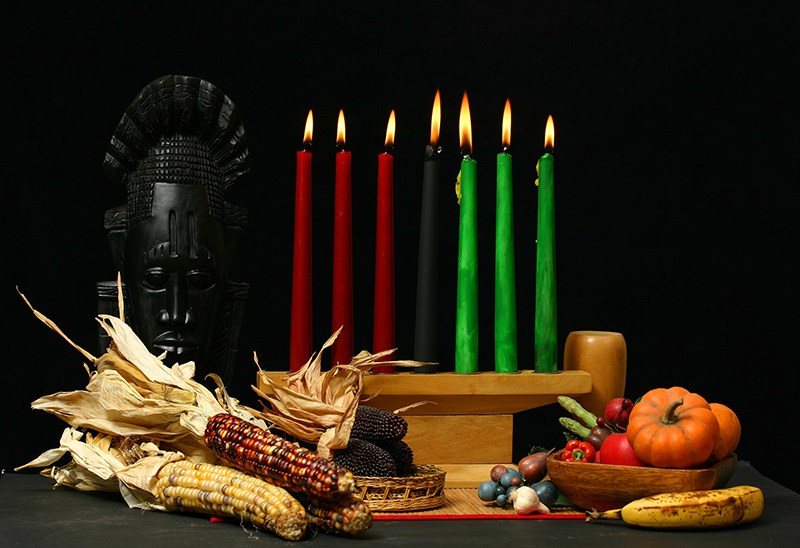
The Seven Principles of Kwanzaa
Each of the seven days of Kwanzaa honors a different principle, called Nguzo Saba. Each of the seven are considered a key to building strong families and communities. The kinara is the centerpiece of the Kwanzaa celebration. It holds seven candles representing the principles: three green candles on the left, three red on the right and one black candle in the center. A new candle is lit each day of Kwanzaa; one the first day, two on the second, three on the third, etc. Following are the principles, how they are pronounced, their meanings and how they might be acted out that day. 1. Umoja (oo-MOH-ja) Meaning: unity Action: People getting together to build a strong community. 2. Kujichagulia (koo-jee-cha-goo-LEE-yah) Meaning: self-determination Action: Speaking for yourself; making choices that benefit the community. 3. Ujima (oo-JEE-mah) Meaning: collective work and responsibility Action: Helping others within the community 4. Ujamaa (oo-JAH-ma) Meaning: Cooperative economics Action: supporting businesses that care about the community 5. Nia (nee-AH) Meaning: a sense of purpose Action: setting goals that benefit the community 6. Kuumba (koo-OOM-bah) Meaning: creativity Action: making the community better and more beautiful 7. Imani (ee-MAH-nee) Meaning: faith Action: believing that a better world can be created
Hixson resident Yozefu Rugina began observing Kwanzaa in 1992 during the peak of its popularity. Born in Rwanda, raised in Tanzania and Kenya, Rugina immigrated to the United States in 1975.
After graduating from Georgia Tech in 1977, he went to work in carpet exportation, which required trips to Liberia, Egypt, Cameroon and the Ivory Coast. He frequently bought art in his homeland and shipped it back to Chattanooga – enough that he opened a store in 1992.
“I had people start gathering at the store, asking for products for Kwanzaa,” he says. Talking to customers ultimately led to his own observance of Kwanzaa.
“What appeals to me is the emphasis on family, food and community,” he says.
Still, while Rugina observes the seven days of Kwanzaa, he is one of a diminishing number.
Today is the first day of Kwanzaa, the African-American celebration based on seven principles highlighting community, unity, family and harvest.
Kwanzaa always begins the day after Christmas and, like Christmas, is represented in colors of red and green. However, it’s not meant to replace Christmas; it is a cultural observance, not a religious holiday, and many blacks celebrate both.
Kwanzaa was founded in 1966 by Maulana Karenga, a professor of black studies. At its peak in popularity in the ’80s, it was observed by an estimated 30 million people. But by 2006, a study by the National Retail Federation found that only 2.3 percent of blacks still celebrated Kwanzaa in this country; last year, an estimated 500,000 (or 1.25 percent) of America’s 40 million blacks participated in the observance.
So what’s causing Kwanzaa to play out? Answers vary from the aging of the Black Power student movement of the ’70s to the advent of classroom studies in black culture to the size of a city’s black population.
On an NPR broadcast in 2012, Mark Anthony Neal, professor of black culture at Duke University, went back to Kwanzaa’s origins to help understand its sagging popularity. He explained Kwanzaa was developed at the height of the black nationalist movement “and everything was about creating our own institutions.”
“There was a lot of intensity around finding some way to express our black pride within that context. But it also started in a time when there was no black studies department and no Internet,” he said.
For today’s millennials, that’s a hard concept to digest. They’ve had access to black studies classes since high school and college – and if there’s a question, Google is at their fingertips. Neal says that, for these thirtysomethings, “there’s just not that kind of intensity around the holiday we saw in the 1980s.”
James McKissic, director of Chattanooga’s office of Multicultural Affairs and a millennial, says he “honors the seven principles and meditates on them each day of Kwanzaa, but I don’t do a full Kwanzaa celebration.”
McKissic hesitates to say Kwanzaa is dying out, but he says he sees more people celebrating in group events. Yet, as interest declines, so do the number of community gatherings.
“There are still people who celebrate as a family or individually, but most people celebrate it as a church or community gathering,” McKissic says. “When those gatherings go away, it does tend to make it seem like less people are participating.”
Locally, the Bessie Smith Cultural Center hosted Kwanzaa observances until last year, he says. Union Hill Missionary Baptist discontinued its observance two years ago. McKissic says his own church, First Baptist, doesn’t hold an observance.
“But I think if you went to Atlanta or Birmingham or Nashville, you might see a lot more observances because they have significantly greater black populations and more black universities to put on these programs. Larger cities with bigger African populations have more celebrations than you find in Chattanooga,” he explains.
But in Atlanta, while there are one or two weeklong series of events from groups like the Metro Atlanta Kwanzaa Association, most of the celebrations are single-day events, according to online events calendars. In Birmingham, the Civil Rights Institute is having a single day of Kwanzaa events today, but the rest of the celebrations are single-day events scattered across the week – and there aren’t many of those listed.
The Kwanzaa culture hasn’t totally been lost to millennials and younger, McKissic says, it’s just taken on a new manifestation: social media. After all, the foundation of Kwanzaa is “unity” and what media connects Americans more?
“My friends and I will share the principle for each day of the duration of Kwanzaa. If you watch Facebook the day after Christmas, you will see people sharing the Kwanzaa principle of that day, greeting people with it. The principles still mean a lot to a lot of people,” says McKissic.
Contact Susan Pierce at spierce@timesfreepress.com or 423-757-6284.