
To learn more
Ev Cassagneres’ “The Untold Story of Lindbergh’s 1927-1928 Good Will Tours,” which chronicles the celebrated stops pilot Charles Lindbergh made after his history-making, trans-Atlantic flight, is available at the public library.
Before Lovell Field opened in 1930, two grass strips handled air traffic for the city. One was Brainerd Field, located west of today’s Brainerd Golf Course. The other was Marr Field, named for Walter L. Marr, in East Chattanooga.
After learning how to make bicycles, Marr joined the Buick Motor Co. where he invented the gasoline valve-in-head engine. He became the company’s chief engineer.
The successful inventor moved to Signal Mountain for health reasons in 1926 and constructed “Marrcrest,” a mansion still standing near James Boulevard.
The Chattanooga Chamber of Commerce had proposed in the 1910s the creation of a new airport. Walter Marr, who had an interest in the development of aviation, worked closely with the chamber in building a landing strip that was “west of Missionary Ridge, east of the railroad tracks off Amnicola Drive, and north of Glass Street in East Chattanooga.” He helped supervise construction and drove a bulldozer to build the runway.
At its opening in December 1919, the officer in charge of Army aviation in the Southeast praised Marr Field as a leading aviation facility, but it soon became apparent that its proximity to Missionary Ridge made the field hazardous to air traffic.
Interstate Airlines began flying from Chicago to Atlanta and often stopped at Marr Field when darkness prevented its planes from reaching Atlanta. Erratic air currents coming from the ridge created problems. When a pilot and four passengers on an interstate airmail plane died in a crash in December 1928, Marr Field was condemned. Air service moved to Lovell Field in 1930.
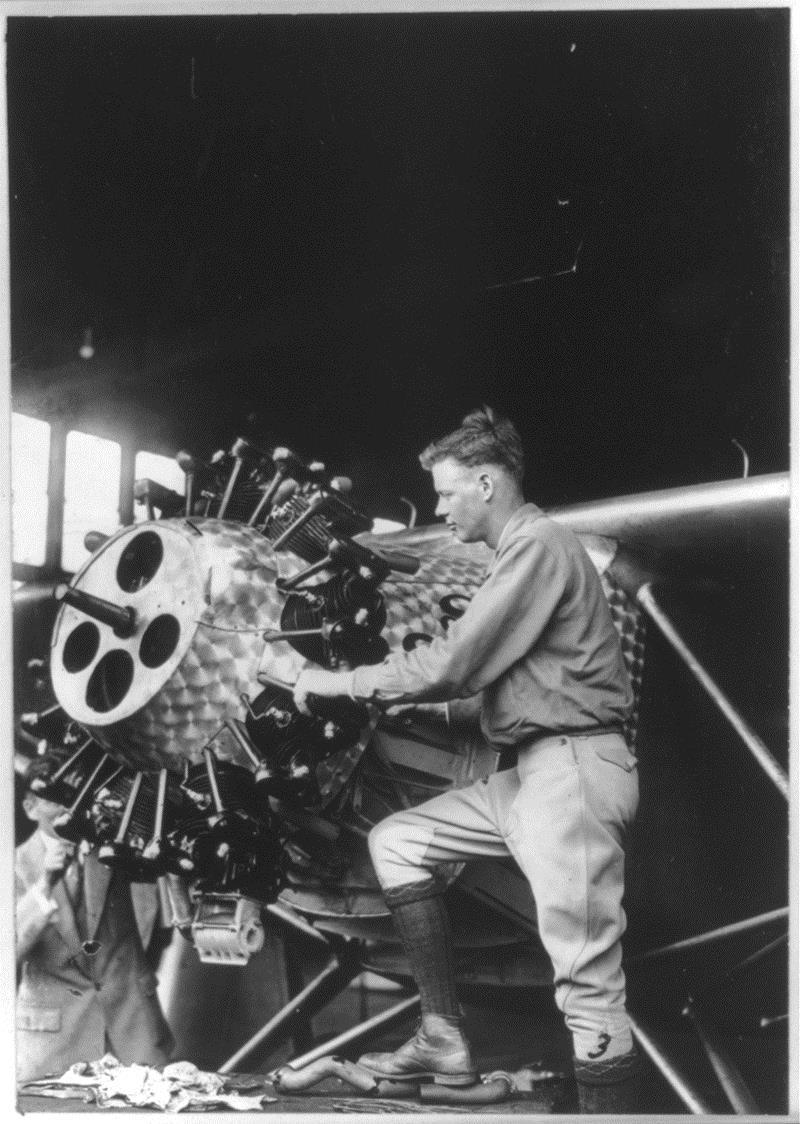
Before its closure, the most famous aviator of the era, Charles Lindbergh, visited Marr Field. Several months before in May, “Lucky Lindy” had flown a nonstop 33 1/2-hour solo flight from Long Island across the Atlantic Ocean to Paris.
His Pulitzer Prize-winning 1953 autobiography, “The Spirit of St. Louis,” described his odyssey – from raising funds for the flight, overseeing construction of his single engine monoplane, doing test runs for weight and fuel and then crossing 3,200 miles of open sea.
Jimmy Stewart played Lindbergh in the 1957 movie classic “The Spirit of St. Louis,” with scenes of clearing telephone lines at takeoff, skimming over wavetops, fighting ice and sleep, navigating by the stars and surviving crowds upon landing at Paris’ Le Bourget.
On return, the celebration included a ticker-tape parade down New York City’s Fifth Avenue.
Lindbergh then flew a three-month nationwide tour to raise popular interest in commercial aviation. More than 20 million Americans came out to see the renowned flier.
On the morning of Oct. 5, 1927, Lindbergh steered “The Spirit of St. Louis” toward Chattanooga. Throngs of spectators began to arrive at dawn as carpenters erected refreshment stands. The 6th Cavalry Band from Fort Oglethorpe played music on its march through East Chattanooga. The crowd searched the sky, and one youngster shouted, “There he is, there’s Lindy.” Other sharper eyes saw that it was a chicken hawk.
At 10:17 a.m., the Ryan NYP came into view over North Chattanooga and factory whistles blew. Mounted soldiers had begun to patrol streets leading into town.
The escort airship and then “The Spirit of St. Louis” landed at Marr Field. The two craft were quickly surrounded by a protective cordon of 18 Eagle Scouts including John Vass Sr., George Campbell and Stanley Farmer, later football coach at Central High School. Lindbergh was received by Mayor Ed Bass, Marr, Coca-Cola bottler John T. Lupton and Col. T.A. Roberts, commander of the Fort Oglethorpe garrison.
In the next hour the famous pilot became part of “the greatest celebration since the days of the world war,” including a parade into downtown Chattanooga and his advocacy of commercial aviation from a speaker’s stand on an old truck on Broad Street near 11th Street.
After a short speech, “Lucky Lindy” returned to Marr Field, stepped into his cockpit and donned his helmet and goggles. He circled the airport several times and began the 2-1/2 hour flight to Birmingham.
During his tour of 15 Latin American countries, Lindbergh met his future wife, Anne, daughter of U.S. Ambassador to Mexico, Dwight Morrow.
Jerry Summers is an attorney with Summers, Rufolo & Rodgers, P.C. For more information, visit Chattahistorical assoc.org.