
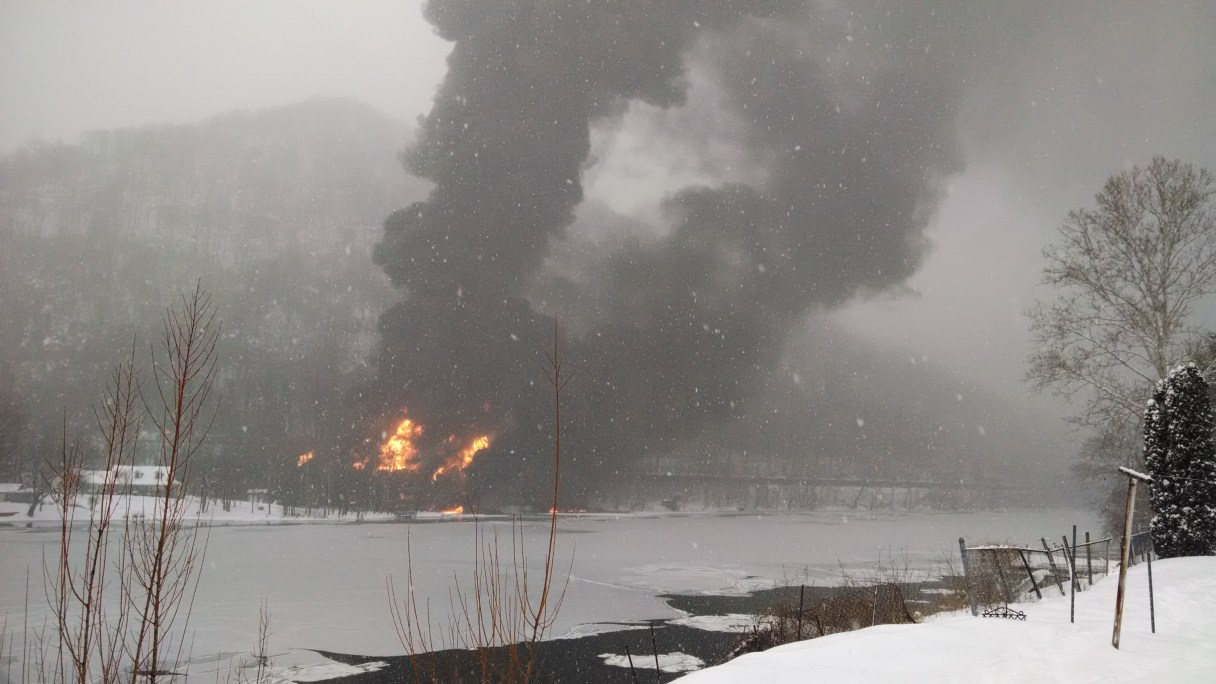
MOUNT CARBON, W.Va. (AP) – The fiery derailment of a train carrying crude oil in West Virginia is one of three in the past year involving tank cars that already meet a higher safety standard than what federal law requires – leading some to suggest even tougher requirements that industry representatives say would be prohibitively costly.
Hundreds of families were evacuated and nearby water treatment plants were temporarily shut down after cars derailed from a train carrying 3 million gallons of North Dakota crude Monday, shooting fireballs into the sky, leaking oil into a Kanawha River tributary and burning down a house nearby. It was snowing at the time, but it is not yet clear if weather was a factor.
The train’s tanks were a newer model – the 1232 – designed during safety upgrades voluntarily adopted by the industry four years ago. The same model spilled oil and caught fire in Timmins, Ontario on Saturday, and last year in Lynchburg, Virginia.
A series of ruptures and fires have prompted the administration of President Barack Obama to consider requiring upgrades such as thicker tanks, shields to prevent tankers from crumpling, rollover protections and electronic brakes that could make cars stop simultaneously, rather than slam into each other.
If approved, increased safety requirements now under White House review would phase out tens of thousands of older tank cars being used to carry highly flammable liquids.