
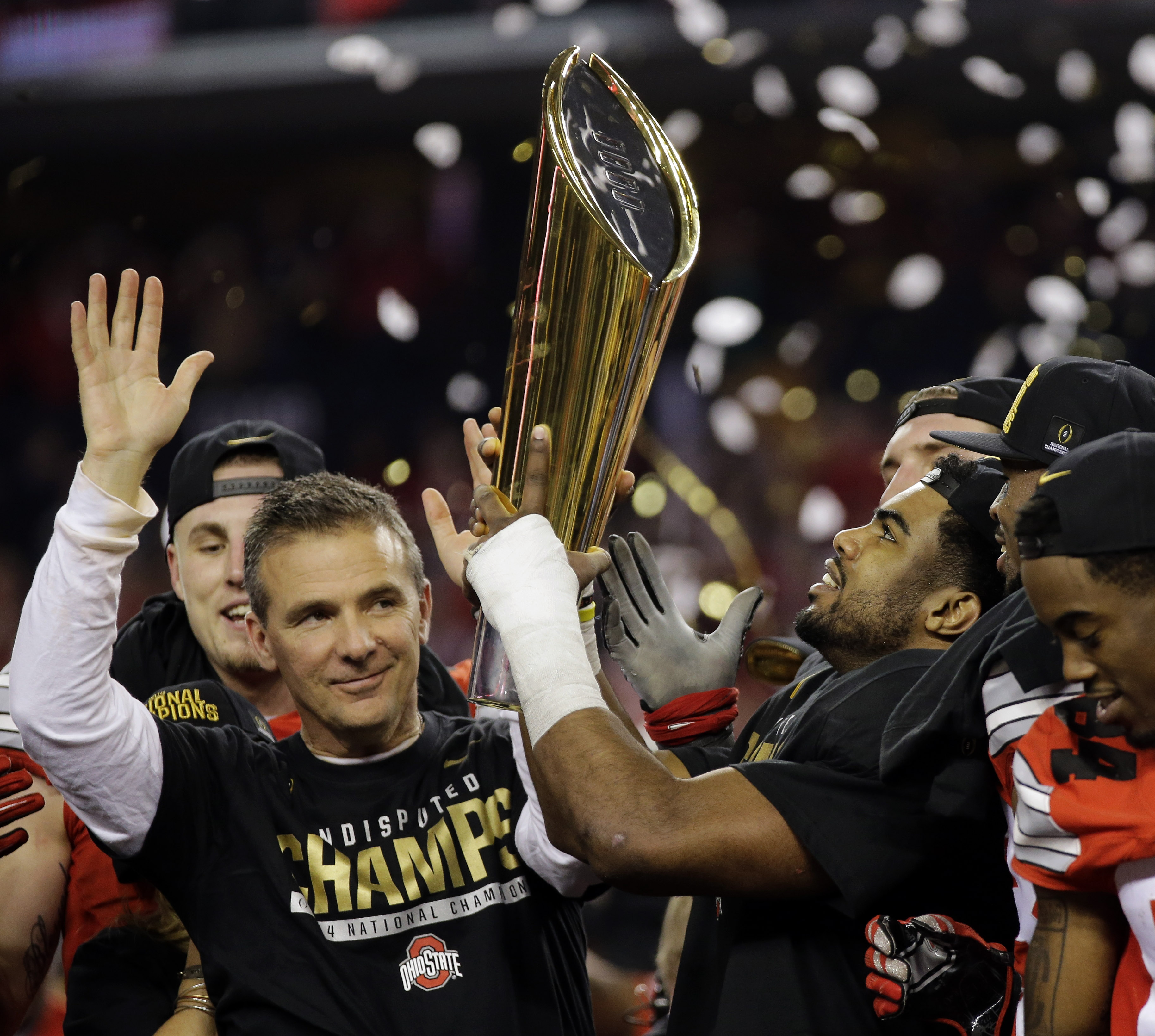
 Ohio State head coach Urban Meyer and Ezekiel Elliott celebrate after the NCAA college football playoff championship game against Oregon Monday, Jan. 12, 2015, in Arlington, Texas. Ohio State won 42-20. (AP Photo/Eric Gay)
What was the lasting image after Ohio State blitzed Oregon 42-20 early Tuesday morning?
Was it the confetti falling on a Buckeyes bunch that appears built for the long haul and arguably has three of the top 10 returning quarterbacks in the country if Cardale Jones, J.T. Barrett and Braxton Miller all return to Columbus?
Was it the facade falling on the SEC, which did not have a title-game participant for the first time since 2005?
Was it the thought flashing that Urban Meyer, who joined Nick Saban as the only coaches to win national titles at different schools at college football’s highest level, may be the best coach in the land?
The potential is there to say yes on each, and before anyone gets too melancholy about the end of the college football season or potentially the end of an era of SEC dominance, let’s all relax.
It’s fair to wonder, of course, especially after Ohio State flexed its muscles and flummoxed the Ducks. The beating was impressive and thorough, and it would have been much worse if OSU had not fumbled four times — including several self-inflicted miscues in Oregon territory.
But before we twist the debate forward into the future and use it to divide conference lines and who is better than whom, we’d be remiss not to note one unequivocal fact: The team that was controversially included a month ago rolled through the first playoff in major college football history.
Yes, in the previous versions of the championships of college football’s highest level, Ohio State would have been left out, and the bemoaning about SEC bias and outcries from Congress would echo across the sport.
Does that fact state the case that the playoff worked? In a lot of ways, yes, it does. So does the statement that the top three watched shows in the history of cable television were the three games in the College Football Playoff.
Remember, a playoff is not designed to find the best team. A playoff is designed to find the hottest team at the end. Often those descriptions can overlap, but they certainly are not mutually exclusive, and Ohio State was a 75-to-1 shot to win the national title after its week-two loss to Virginia Tech.
Does the fact that TCU, the team that was ranked No. 6 before the bowls and felt cheated out of the final spot, looked as good as anyone not named Ohio State mean we’re expanding the field to eight teams sooner rather than later? Absolutely.
And we’re pretty sure that’s not as good a thing as it may seem.
First, the college football coaches will follow suit with Meyer’s recent lament that more games should mean more scholarships. That has a massive ripple effect that ranges from Title IX issues to rich-getting-richer complaints to further expanding the money pool for the programs not among the elite in college sports.
Second, this seems like it will only expedite the big five conferences moving out, and we’re not excited about that change, either. Do you think the big five conferences are going to want to share the spigot of money the college football playoff will offer for the next decade?
Finally and most importantly, it will be the first step to watering down the best regular season in sports.
By being so eager to expand, it means we are potentially willing to trade three months of college football bliss for a third week of playoff drama.
And if that happens, we all lose, no matter who wins.
Contact Jay Greeson at jgreeson@timesfreepres.com or at 423-757-6273. Follow him on Twitter @jgreesontfp.