
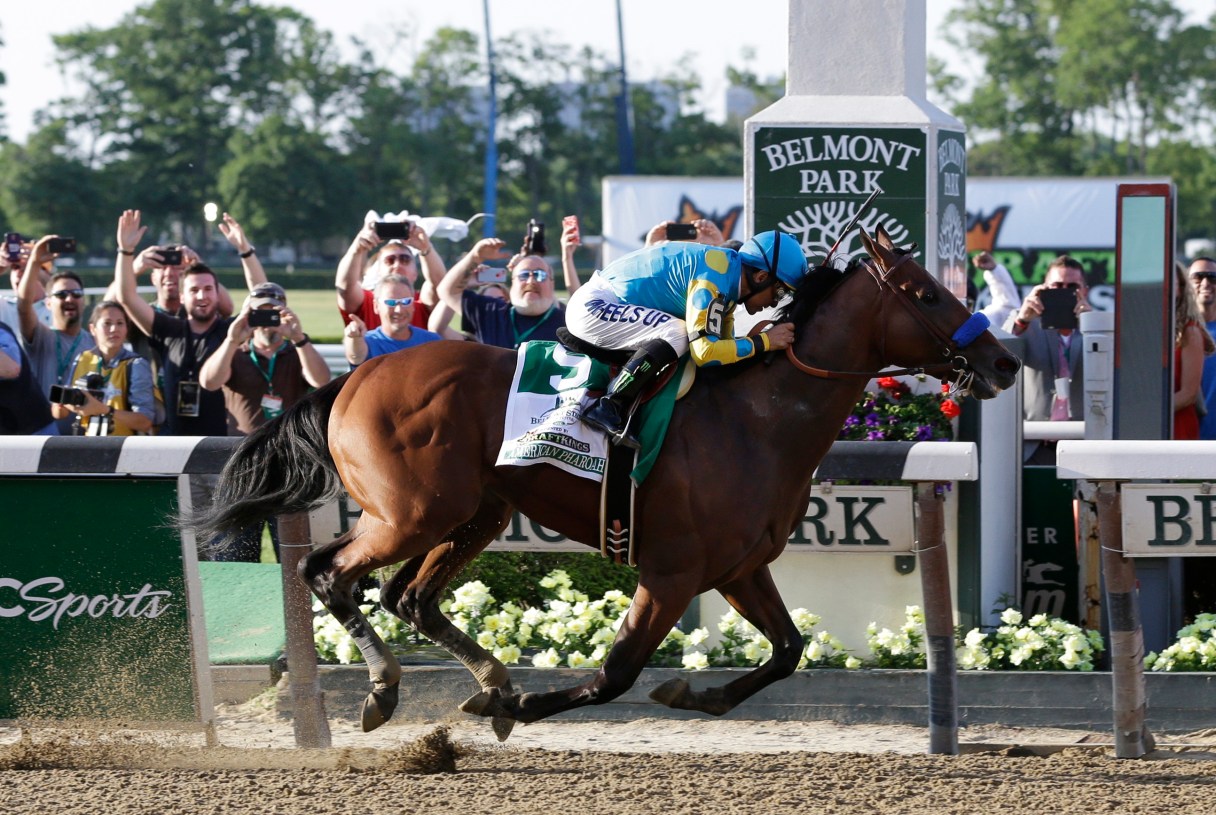
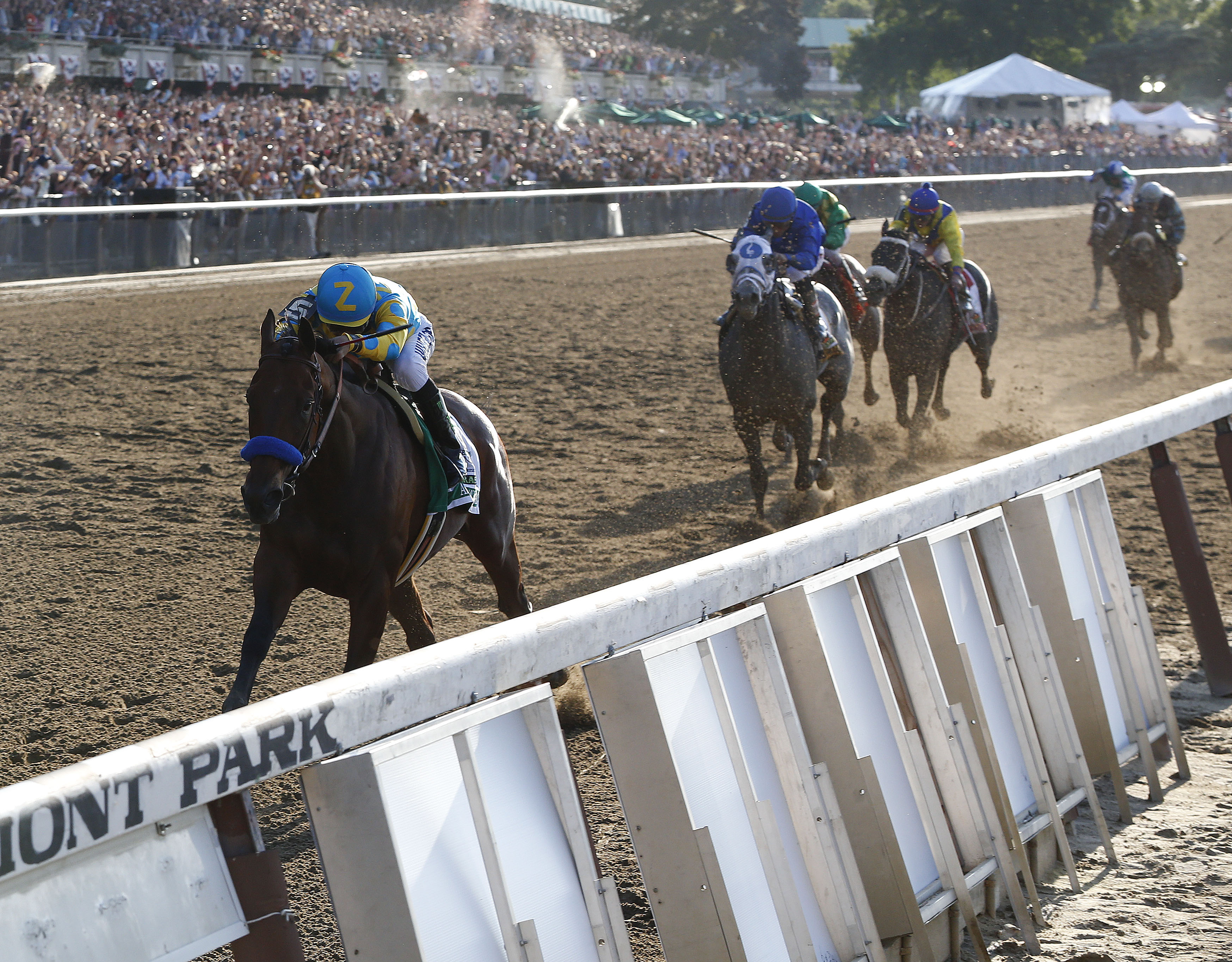
 American Pharoah and jockey Victor Espinoza approach the finish line to win the 147th running of the Belmont Stakes horse race at Belmont Park on Saturday, June 6, 2015, in Elmont, N.Y. American Pharoah is the first horse to win the Triple Crown since Affirmed won it in 1978.
Read more
Wiedmer: Can American Pharoah save horse racing?
Triple Crown Successes-Failures
NEW YORK – Twelve 3-year-olds have won the Triple Crown (Kentucky Derby, Preakness and Belmont Stakes). Twenty have failed by losing in the Belmont. How they raced in the Belmont. Success 2015 – American Pharoah ends a record 37-year drought leading all the way to finish 5 1/2 lengths ahead of Frosted. 1978 – Affirmed duels with archrival Alydar for about the final five-eighths of a mile and beats him by a head. The other three starters finish far back. 1977 – Seattle Slew has no problems disposing of seven rivals, leading all the way and winning by 4 lengths. 1973 – In probably the greatest performance ever by a racehorse, Secretariat wins by from 31 to 45 1/4 lengths over four rivals in 2:24, which still stands as a world record for 1 1-2 miles on dirt. 1948 – Citation leads seven rivals every step of the way and wins by 8 lengths. 1946 – Third with about an eighth-mile remaining, Assault charges to victory by 3 lengths in a seven-horse field. 1943 – Count Fleet gets no competition from two rivals and wins by 25 lengths. 1941 – Whirlaway opens a 7-length lead at midpoint, then finishes in hand for a 2 1/2 length win in a four-horse field. 1937 – War Admiral takes lead shortly after start and holds it for a 3-length win in seven-horse field. 1935 – Shuffled back at the start, Omaha overtakes Firethorn in the stretch and wins by 1 1/2 lengths in a field of four. 1930 – Gallant Fox leads almost all the way and wins by 3 lengths in a four-horse field. 1919 – Sir Barton has no trouble beating only two rivals, winning by 5 lengths over 1 3-8 miles. Distance becomes 1 1-2 miles in 1926. Failure 2014 – California Chrome, fourth with five furlongs to go, is well off the rail on the far turn. Ranges up and sets down coming five wide into the stretch, but fails to pick up the pace to finish in a dead-heat for fourth with Wicked Strong. 2008 – Big Brown finishes last to Da’ Tara, the longest shot on the board. Big Brown is rank at the start and fails to respond when Kent Desormeaux asks him to run in the last turn. At that point, Desormeaux eases him up. 2004 – Smarty Jones extends his lead approaching the quarter pole and maintains a clear lead inside the furlong marker. Fights gamely into deep stretch then yields grudgingly while weakening in the late stages to finish second, a length behind Birdstone. 2003 – Funny Cide leads to the far turn, relinquishes the lead to Empire Maker at the three-sixteenths pole, battles along the inside to the top of the stretch then weakens finishing third, five lengths back. 2002 – War Emblem stumbles badly out of the gate then bumps Magic Weisner at start in an 11-horse field. Is rank for three-quarters of a mile and takes brief lead nearing the half-mile pole. Remains a factor to the turn and gives way finishing eighth, 19 1/2 lengths back. 1999 – Charismatic takes the lead briefly at the turn but Lemon Drop Kid and Vision and Verse fly by him on the outside and he finishes third 1 1/2 lengths back. 1998 – Four lengths ahead with an eighth-mile remaining, Real Quiet gets nipped by a nose at the wire by Victory Gallop in a nine-horse field. 1997 – Silver Charm fails to hold off Touch Gold in the final eighth-mile and finishes second three-quarters of a length back, in a seven-horse field. 1989 – Sunday Silence can’t match Easy Goer in final quarter of a mile and finishes second, eight lengths back in a 10-horse field. 1987 – Checked sharply on final turn, Alysheba finishes fourth, 14 lengths behind winner Bet Twice in a 10-horse field. 1981 – Pleasant Colony, never better than third, finishes a little more than 1 1/2 lengths behind Summing, with Highland Blade second in an 11-horse field. 1979 – The 1-5 favorite, Spectacular Bid leads with a quarter-mile left, but weakens to finish third in an eight-horse field, 3 1/4 lengths behind Coastal and another head behind Golden Act. 1971 – Canonero II leads 12 rivals for the first mile before finishing fourth, 4 1/4 lengths behind winner Pass Catcher. 1969 – Majestic Prince closes to second in a six-horse field with an eighth-mile remaining, but he can’t catch Arts And Letters and is beaten by 5 1/4 lengths. 1968 – Forward Pass leads until eighth-pole, then finishes second by 1 3/4 lengths to Stage Door Johnny in nine-horse field. 1966 – Leading 10 rivals with a quarter-mile remaining, Kauai King fades to fourth, 7 lengths behind winner Amberoid. 1964 – Northern Dancer is second in a nine-horse field with an eighth-mile remaining, but he finishes third 6 lengths behind Quadrangle and 4 lengths behind Roman Brother. 1961 – Carry Back never gets into contention and finishes seventh in a nine-horse field, 13 3/4 lengths behind winner Sherluck. 1958 – Tim Tam is unable to cut in Cavan’s lead and finishes second by 6 lengths in an eight-horse field. 1944 – Pensive leads with a quarter-mile remaining, but he loses by a half-length to Bounding Home in a seven-horse field.
NEW YORK – By mid-stretch, Bob Baffert knew it. American Pharoah was going to win the Triple Crown.
He took his eyes off the horse to soak in the crazed scene of the packed grandstand. Fans jumped up and down, hugged, and tossed drinks in the air.
The race wasn’t even over yet, and the crowd knew it, too. Thirty-seven years of waiting to see one of the rarest feats in sports was almost over.
“The crowd was just thundering and I was just enjoying the crowd and the noise and everything happening,” the white-haired trainer said. “What a feeling.”
Finally, a Triple Crown winner. And this one was never in doubt.
American Pharoah led all the way to win the Belmont Stakes by 5 lengths on Saturday, becoming the first horse since 1978 to sweep the Kentucky Derby, Preakness and Belmont Stakes – one of the sporting world’s rarest feats.
“Wow! Wow!” jockey Victor Espinoza said moments after crossing the finish line. “I can only tell you it is just an amazing thing.”
The bay colt with the unusually short tail easily defeated seven rivals in the grueling 1 1/2-mile race, covering the distance in 2:26.65 – sixth-fastest in Belmont history – to end the longest stretch without a Triple Crown champion in history.
“That little horse, he deserved it,” said Baffert, who at 62 is the second-oldest trainer of a Triple Crown winner. “He’s the one that did it. We were basically just passengers.”
American Pharoah is the 12th horse and first since Affirmed in 1978 to win three races on different tracks at varying distances over a five-week span. He won the Derby by one length on May 2 and then romped to a seven-length victory in the rainy Preakness two weeks later before demolishing his rivals Saturday.
Baffert and Espinoza ended their own frustrating histories in the Triple Crown. Baffert finally won on his record fourth Triple try, having lost in 1997, 1998 (by a nose) and in 2002. Espinoza got it done with his record third shot after failing to win in 2002 and last year on California Chrome.
“I was prepared for somebody coming because I’ve been through this so many times,” Baffert said.
Nobody did.
Espinoza hustled American Pharoah to the lead leaving the No. 5 post and quickly got him over to the rail. Materiality was on his outside in second, but never applied any serious pressure traveling along the backstretch before falling away on the second turn.
American Pharoah started kicking away heading into the final turn. He opened up on the field as he powered through the 1,097-yard stretch, displaying his fluid, springloaded stride in which he appears to float over the ground.
“It’s just an amazing feeling that you have when you’re 20 yards from the wire,” Espinoza said. “And then at the wire I was like, ‘I cannot believe I did it.'”
American Pharoah ran the final quarter-mile – a stretch that has dashed numerous Triple Crown dreams – in 24.32 seconds, faster than Secretariat’s time of 25 seconds in winning the 1973 Belmont.
“That’s a hell of a horse,” said Gary Stevens, who finished seventh aboard Tale of Verve. “The race was over in the third jump from the gate.”
After making his way back to the crowd, Espinoza took American Pharoah nearly the length of the sprawling grandstand so fans could pay their respects to the champion.
As the horses were heading to the starting gate, owner Ahmed Zayat was overflowing with confidence and turned to his wife.
“I told her, ‘Get ready to be the owner of the 12th Triple Crown winner,'” he said.
Baffert felt equally good, sensing American Pharoah was on the verge of a winning performance when he saddled the horse in the shady paddock.
“I said to put him on the lead and go for it, and if he doesn’t make it, don’t worry about it,” the trainer said, “but he just kept on rocking and rolling.”
Sent off as the overwhelming 3-5 favorite, American Pharoah paid $3.50, $2.80 and $2.50.
Frosted returned $3.50 and $2.90, while Keen Ice was another two lengths back in third and paid $4.60 to show.
Mubtaahij was fourth, followed by Frammento, Madefromlucky, Tale of Verve and Materiality.
American Pharoah delivered a victory for the Egyptian-born Zayat, who bred the colt and put him up for sale before buying him back for $300,000. His name came from the family’s online contest, in which a woman from Missouri submitted the winning moniker, but the misspelling – it should be pharaoh – wasn’t noticed until the name was already official.
American Pharoah joined the exclusive club of Triple Crown winners Sir Barton (1919), Gallant Fox (1930), Omaha (1935), War Admiral (1937), Whirlaway (1941), Count Fleet (1943), Assault (1946), Citation (1948), Secretariat (1973), Seattle Slew (1977) and Affirmed.
A sign with American Pharoah’s name and silks was quickly put up in the infield next to the 11 other Triple Crown winners.
The crowd of 90,000 – capped to avoid overcrowding and long lines from last year’s total of 102,199 – roared as American Pharoahturned for home.
It’s unlikely the champion heard them since American Pharoah wears ear plugs to block noise that might get him worked up.
Since 1978, the rigors of the Triple Crown had done in 13 other horses who won the Derby and the Preakness – with 12 losing the third leg and I’ll Have Another scratched with a leg injury in 2012. Their failures left the sport and its fans craving a worthy successor to the 11 previous champions.
American Pharoah – his tail shortened after being bitten off on a farm when he was a youngster – turned out to be that horse.
“I was really getting to dislike this trophy – it’s come with a lot of misery,” Baffert said of the sterling silver Triple Crown trophy housed for the last 37 years in the Kentucky Derby museum.
“But it’s owed to the fans of New York that kept paying their money, showing up, hoping. They finally got it.”
Unlike Affirmed, who dueled Alydar in all three races, American Pharoah didn’t have a specific rival since he was the only horse to run in all three Triple Crown races. Going into the Belmont, American Pharoah had beaten all of his seven challengers before.
And when the race known as “The Test of the Champion” came?
He passed, with flying colors.
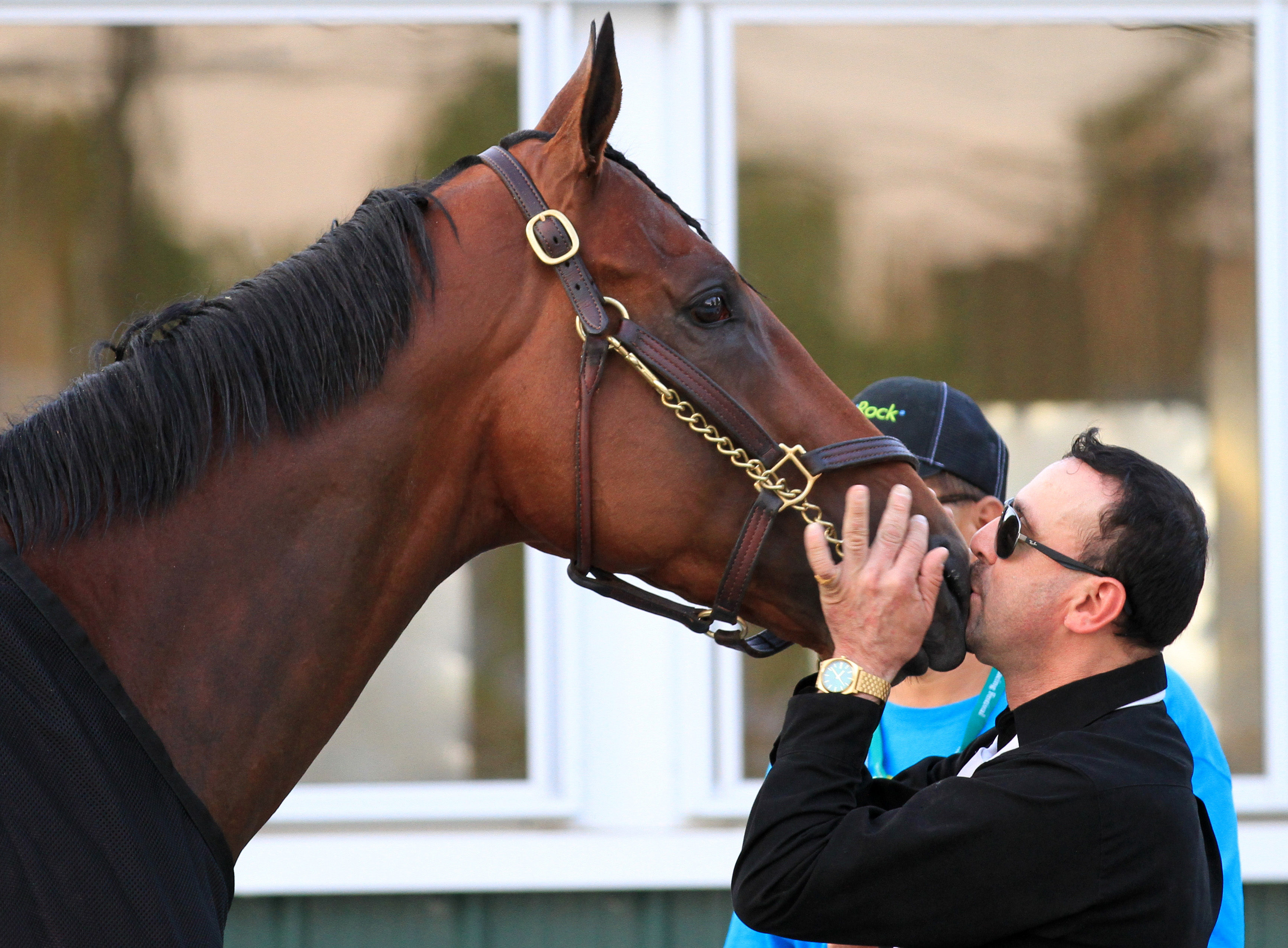 Exercise rider Jorge Alvarez kisses American Pharoah on the nose after American Pharoah won the 147th running of the Belmont Stakes horse race to win the first Triple Crown in 37 years at Belmont Park, Saturday, June 6, 2015, in Elmont, N.Y.