
 Staff photo by John Rawlston/Chattanooga Times Free Press
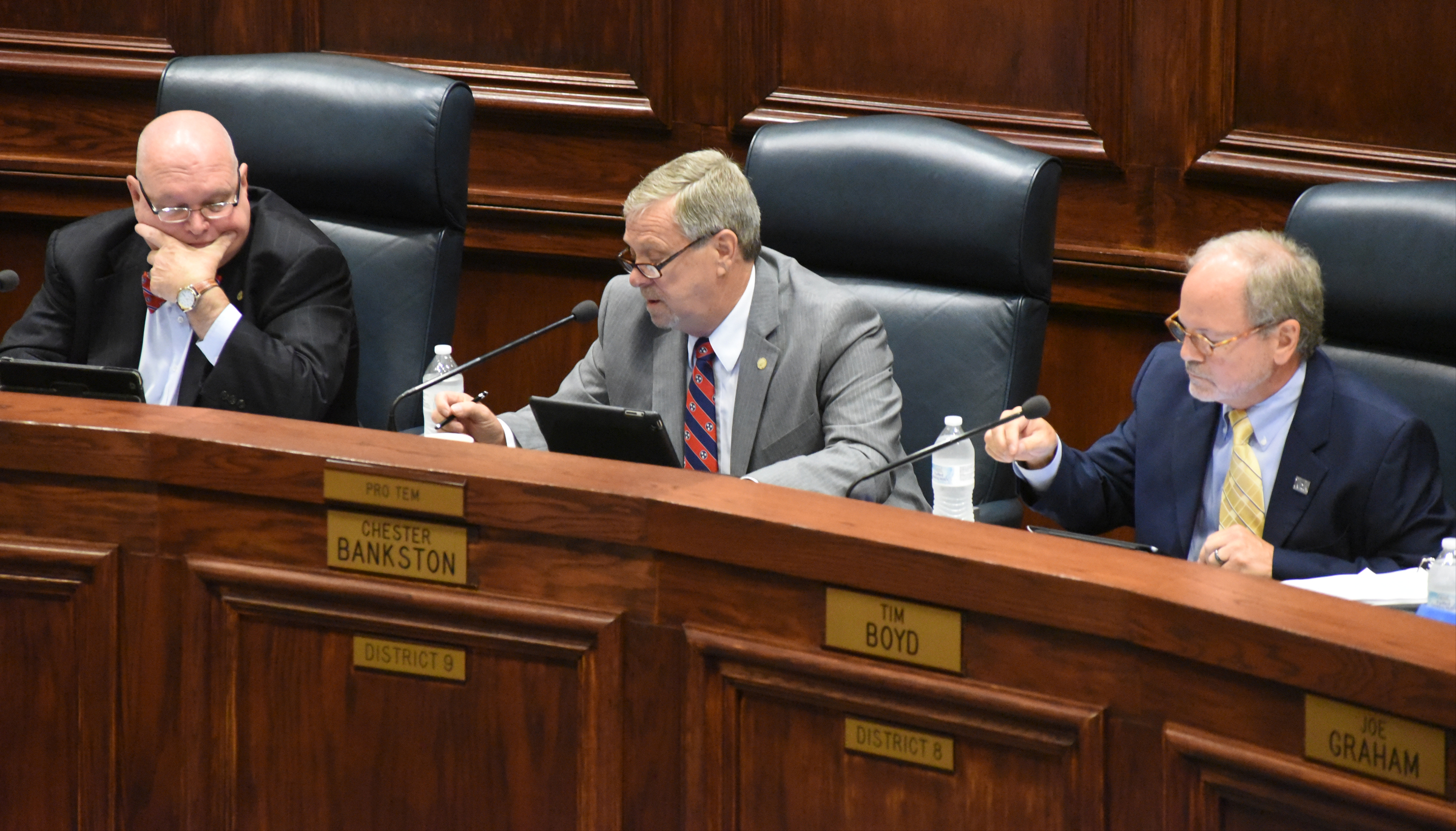
Jim Fields, left, and Tim Boyd, right, listen as fellow commissioner Chester Bankston proposes restoring discretionary funds for each commissioner to the budget during the Hamilton County Commission meeting Wednesday, June 17, 2015, at the downtown courthouse in Chattanooga, Tenn.
Hamilton County commissioners won’t raise your taxes, but they don’t mind spending your savings.
Moments before passing the 2016 budget, six of nine county commissioners pulled $900,000 from the county’s fund balance in a last-minute move to preserve special projects funds for themselves.
Before the vote Wednesday morning, no commissioner had said a word publicly about the move, and those who voted in favor supported it immediately with no debate.
Under the amended budget they passed, each commissioner will get $100,000 to spend on projects in his or her district in 2016, continuing a decades-old practice. The funds this year had to be spent on capital projects on public property because the funds came from bonds. But in 2016, there will be no holds barred.
Good government and watchdog groups have long criticized the practice as political pork spending.
Mayor Jim Coppinger didn’t include the nearly $1 million so-called discretionary fund in the upcoming budget, saying there was no revenue to support it. The county hasn’t raised taxes in eight years, and he doesn’t intend to change that, he said.
After the meeting, Coppinger called the budget amendment “fiscally irresponsible” and said the commission circumvented months of work by financial experts.
“The commission acted unilaterally to go into the rainy day fund without consulting our financial staff or our financial advisers who we hired,” Coppinger said. “Sometimes I think people lose sight of the fact that it’s Hamilton County taxpayer dollars.”
For the districts
District 9 Commissioner Chester Bankston made the motion to amend the budget, and Tim Boyd seconded. Commissioners Warren Mackey, Sabrena Smedley and Chairman Jim Fields also supported it. All but Mackey are Republicans.
Bankston said afterward, “It was the right thing to do.”
“I have so many projects in my district that just don’t get funded outside of discretionary spending,” he said. “I have the largest district. I have 11 schools in my district and every one of them gets a part of that money.”
Boyd said he voted for the sake of schools, too, and to avoid amending the budget any time an emergency comes up.
“If I didn’t have discretionary funds and East Ridge High School baseball field really needed new bleachers, due to a safety concern or whatever, we would have to amend the budget to do that,” Boyd said.
He added that the discretionary funds are the most heavily scrutinized.
“If you use those discretionary funds foolishly, everybody in the world is going to come down on you. That money is scrutinized more than any other money in the budget and it doesn’t represent a portion of 1 percent of it,” Boyd said.
Smedley cited other important spending, such as buying defibrillators for local schools.
After a student in her district had a seizure and was saved because the school had a defibrillator on hand, Smedley made sure all District 7 schools had them.
She said she prided herself for “being fiscally conservative” and “vow[ed] to be transparent” about her expenditures.
Critics take shots
Conservative groups agree with Coppinger.
Mark West, president of the Chattanooga Tea Party, said the discretionary fund program should have never started.
Hamilton County is the only one in the state that allows commissioners to direct more than $5,000 a year. Commissioners don’t even need their colleagues’ approval for discretionary expenses under $15,000.
And even when there is a vote, commissioners don’t question the purchases, West said.
“Fiscal conservatives are people who believe in transparency and accountability, and I think the current system lacks both,” West said.
Justin Owen, president and CEO of the Beacon Center, a conservative think tank in Nashville, agreed.
Owen called the program “a slush fund” and likened it to legislative earmarks.
“It’s very difficult for someone to claim to be a conservative and then go grab $100,000 in taxpayer money to dole out wherever,” he said. “If there is a case where they had to spend money that wasn’t budgeted, there needs to be a vote in the light of day and it should be an action of the whole commission.”
Proclaimed accountability in the current process is an illusion, he said, because commissioners are inclined to go along with their colleagues’ purchases.
“No commissioner’s going to vote against [a purchase]. They are going to rubber-stamp it because when they have their pet project, they will want it passed,” Owen said.
Republican Commissioner Marty Haynes was among three commissioners who voted against the amendment.
“I just don’t think it’s the right thing to do to take it out of the fund balance long term,” Haynes said “If we have worthwhile projects in our districts – whether it’s a volunteer fire department or a school need – we can bring it before the commission and let it stand on its merits.”
Haynes ultimately voted to pass the amended budget, but he said that was only because he wanted to make sure other important items, such as the Humane Educational Society and the increases to the sheriff’s office, didn’t have their funding delayed.
Republican Joe Graham, the only commissioner to vote against both the amendment and the amended budget, said he was disappointed with the outcome.
“I’ve been very vocal the last couple of weeks, that I very much supported the budget. But when the amendment happened, I didn’t know that was coming. The budget was fine before the amendment, I was very impressed with that budget,” he said.
Greg Beck, a Democrat, said the commission had no business changing the budget right before the vote.
“The mayor had his reasons. It’s kind of hard for me to amend the budget without knowing all the particulars,” Beck said.
He also said he would not pull from the fund balance when the commission wasn’t including an early retirement plan for sheriff deputies, the so-called bridge plan.
“I had some officers back there in dire need of a plan who are putting their lives on the line every day. We didn’t fund that,” Beck said.
Beck voted to pass the amended budget, but that was a canny political move. Only someone on the prevailing side of a vote can bring it back to the table for future discussion, he said.
“If we wanted to amend the budget back or revisit, I could be part of the prevailing side,” he said.
The numbers
Commissioners who support the funds say the money goes toward educating children, supporting volunteer fire departments or other vital initiatives.
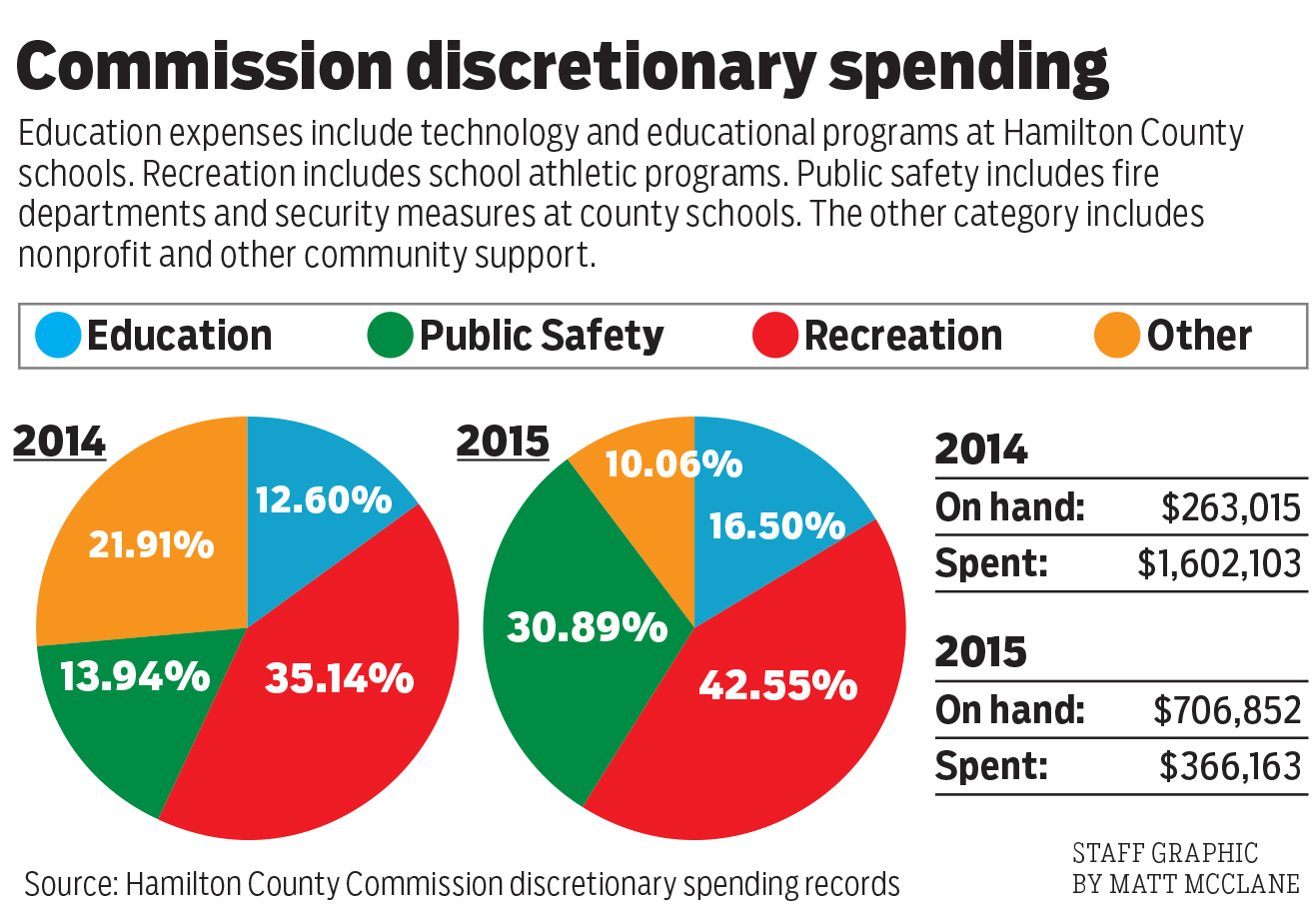
But a Times Free Press review shows that most of the funds in the last two years were spent on school athletics and other recreation projects, not strictly educational or public safety programs.
In 2014, $562,926 of the $1.6 million spent – or 35 percent of the money – went toward school athletics or public parks. Only $201,900, or 12.6 percent, went toward books, classroom technology or county educational programs. That year, 13.9 percent, or $223,300 went to public safety programs.
So far this year, 42 percent of the $706,852 spent went toward recreation, 31 percent went to public safety, and 16.5 percent went to education.
Contact staff writer Louie Brogdon at lbrogdon@timesfreepress.com, @glbrogdoniv on Twitter or at 423-757-6481.