
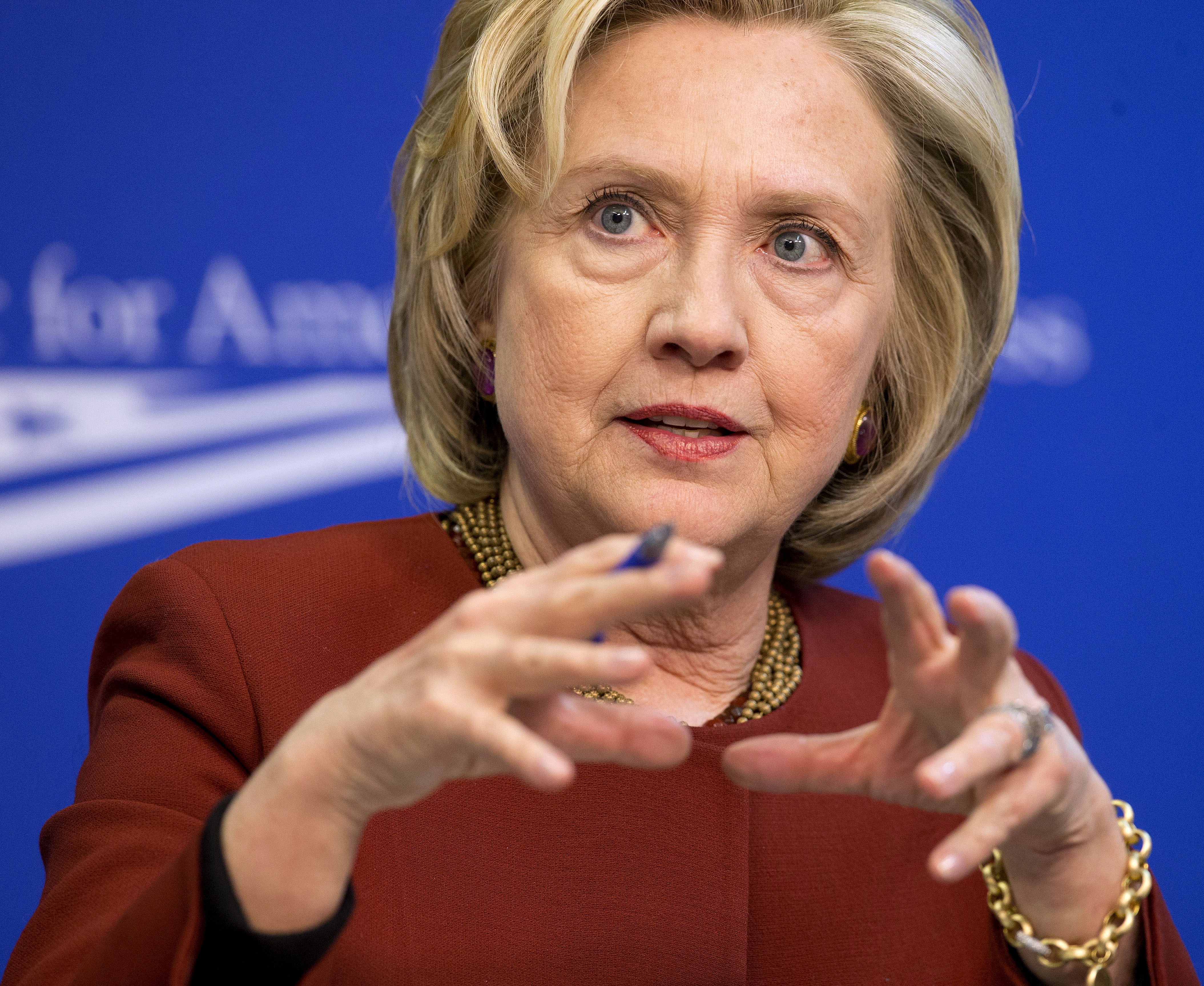
 Former Secretary of State Hillary Rodham Clinton speaks at an event hosted by the Center for American Progress (CAP) and the America Federation of State, County and Municipal Employees (AFSCME), Monday, March 23, 2015, in Washington. (AP Photo/Pablo Martinez Monsivais)
WASHINGTON — The effective kickoff of Hillary Clinton’s presidential campaign was an act of deck clearing so breathtaking, so brazen, that it remains difficult to process.
A former secretary of state summoned reporters to the United Nations, made a statement on Iran nuclear negotiations, then admitted deleting more than 30,000 emails she deemed personal from the account she exclusively used while in office. This was the culmination of a deliberate, multiyear end run around congressional oversight, the Freedom of Information Act and the archiving of federal records. Documents she found inconvenient to sort while in government were convenient to destroy after leaving office.
Those looking for a historical parallel turned, inevitably, to one figure. According to Rep. Darrell Issa, R-Calif., Clinton is “a modern, Democratic Richard Nixon.” Politico’s Todd Purdum did a careful historical comparison to Nixon, finding Clinton similarly “suspicious, defensive, contemptuous of the press and scornful of political adversaries.”
Clinton’s email housecleaning — barring future revelations — may work. But Republicans clearly hope the Nixonian label — which some in the media find credible — will stick. They believe the email controversy, while not politically fatal in isolation, will add to the composite image of a candidate driven by secrecy and resentment, surrounded by a ruthless palace guard and convinced that rules apply only to others.
A Republican candidate for president in 2016 (like every candidate for president) will need to negatively characterize his or her opponent. But the narrative of Clinton as Nixon underestimates both leaders.
First, the obvious: Nixon won two presidential elections, after being associated with low political tactics (against Helen Gahagan Douglas) and a series of scandals (including a political donation controversy that nearly forced his resignation as vice president, and a political favoritism scandal somehow involving his brother Donald and Howard Hughes). Well before Watergate, Nixon was not viewed as an ethical paragon. But he was generally viewed as smart, tenacious, tough and knowledgeable about the world. Which sounds familiar.
The comparison to Clinton can certainly be overplayed. By all accounts, she lacks Nixon’s personal awkwardness and strangeness. But a portion of the characterization “Nixonian” is a compliment: hardworking, untiring, relentless. While another portion — wary, secretive, ruthless — can lead down some dark alleys.
Right now, Clinton is generally benefiting, not suffering, from this reputation. The next president, from either party, will need to provide a contrast of strength and purpose to President Obama’s foreign policy of disengagement that has resulted in disaster and led to inadequate, ad hoc responses. Clinton is generally positioned to Obama’s interventionist right on foreign policy matters (especially on Syria). She is a Democrat who would be seen as a tougher, more responsible alternative to her former employer.
Clinton is not unbeatable, but the effort to label her as Nixonian will not beat her. Republicans face a very difficult electoral map; their party is still viewed more negatively than the alternative; they have managed to alienate large numbers of working-class and minority voters; and all of their prospective presidential candidates are currently losing to Clinton by double digits.
If the next election is viewed by Republicans as a referendum on Hillary Clinton’s scandals — and this distracts from the task of reconstituting the Republican message and appeal — then Clinton may take the Nixonian path to the Oval Office.
Washington Post Writers Group