
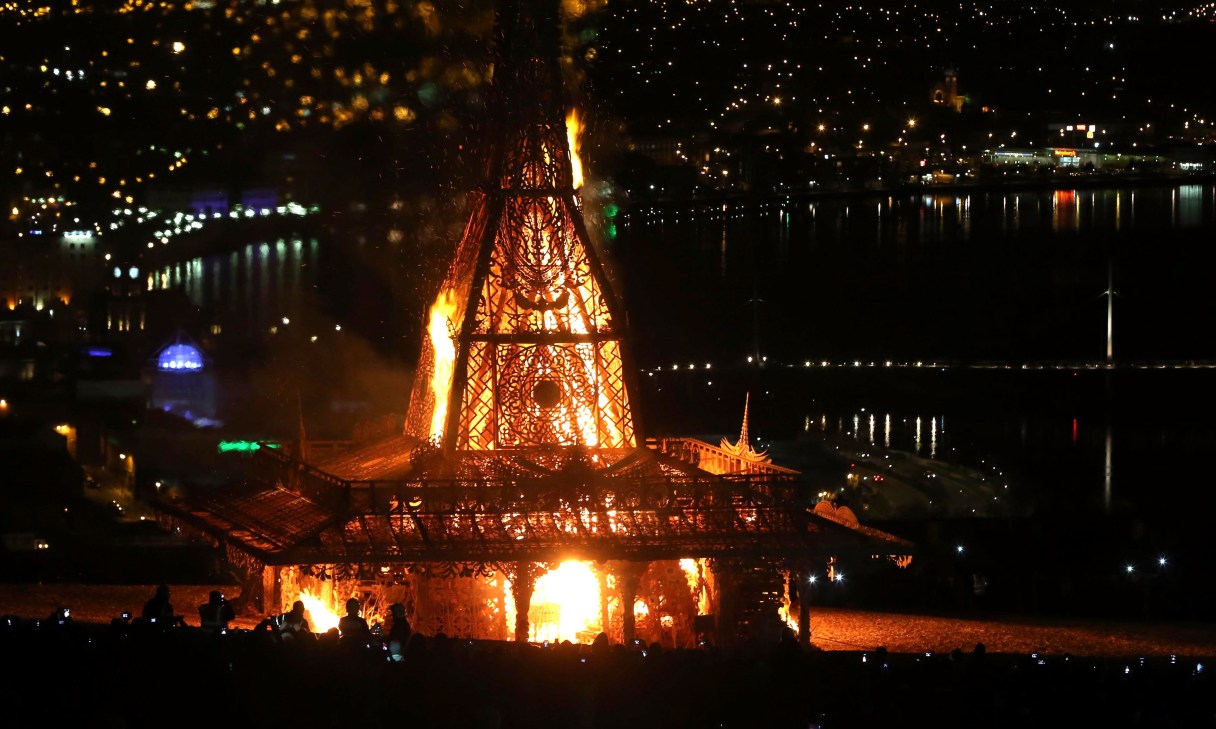
DUBLIN (AP) – They came. They saw. They burned it down.
Over the past week, more than 60,000 people have taken turns writing messages – often to loved ones in the grave or still in the midst of suffering – on a hand-carved wooden temple overlooking Northern Ireland’s second-largest city, Londonderry.
The 72-foot (22-meter) structure, built to resemble a cross between a Buddhist shrine and arabesque palace, was the brainchild of Californian artist David Best, who is famous for his temples built for the Burning Man festivals in Nevada.
He was invited to build one in Northern Ireland, where bonfires usually are a magnet for community division, and specifically in Londonderry, a city so divided that its residents cannot even agree on its name. While it’s legally Londonderry, the name preferred on the predominantly Protestant east side, the Catholic majority insists on its pre-British version of Derry.
Best, 70, spent two months overseeing the Temple project supported by 40 apprentice carpenters drawn from both sides of the divide. It was erected on a hilltop on the Protestant east side overlooking the River Foyle and Catholic Derry beyond.