
Monday, November 16, 2026Nov 16

Knox’s ex-boyfriend on hand as Italy’s high court hears case

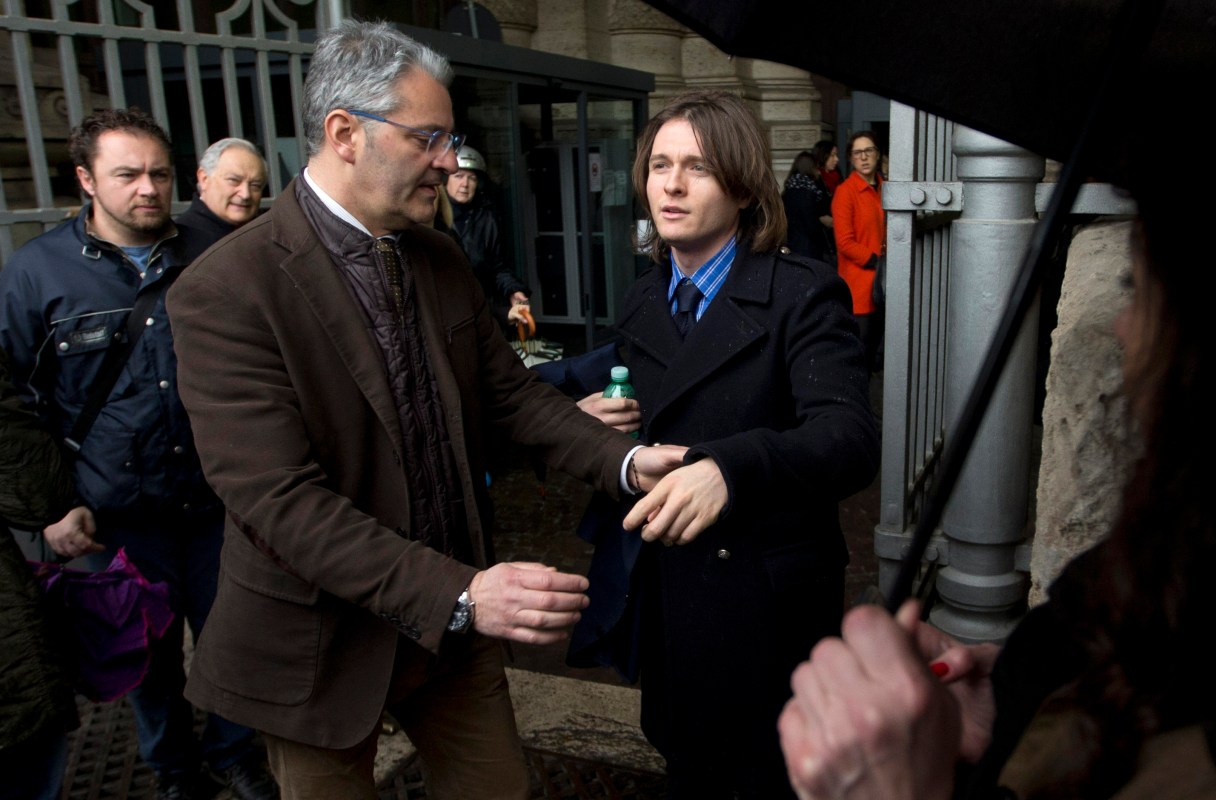
Amanda Knox's Italian ex-boyfriend Raffaele Sollecito, right, arrives at Italy's highest court building, in Rome, Wednesday, March 25, 2015. American Amanda Knox and her Italian ex-boyfriend expect to learn their fate Wednesday when Italy's highest court hears their appeal of their guilty verdicts in the brutal 2007 murder of Knox's British roommate. Several outcomes are possible, including confirmation of the verdicts, a new appeals round, or even a ruling that amounts to an acquittal in the sensational case that has captivated audiences on both sides of the Atlantic. (AP Photo/Alessandra Tarantino)

ROME (AP) – Amanda Knox’s ex-boyfriend has arrived at Rome’s high court for a hearing that will determine their fate in the brutal 2007 murder of Knox’s British roommate.

Dozens of journalists and camera crews mobbed Raffaele Sollecito as he made his way into the Court of Cassation for Wednesday’s final arguments and deliberations.

The ruling, expected later Wednesday, could bring an end to the high-profile Meredith Kercher murder case.

The judges could decide to confirm the convictions and 28 1/2 -year sentence for Knox and 25-year sentence for Sollecito, which would then raise extradition questions for Knox, who is in the U.S. The court could decide to throw out the convictions and order a third appeal trial. Less likely, it could overturn the convictions without ordering a retrial, tantamount to an acquittal.