
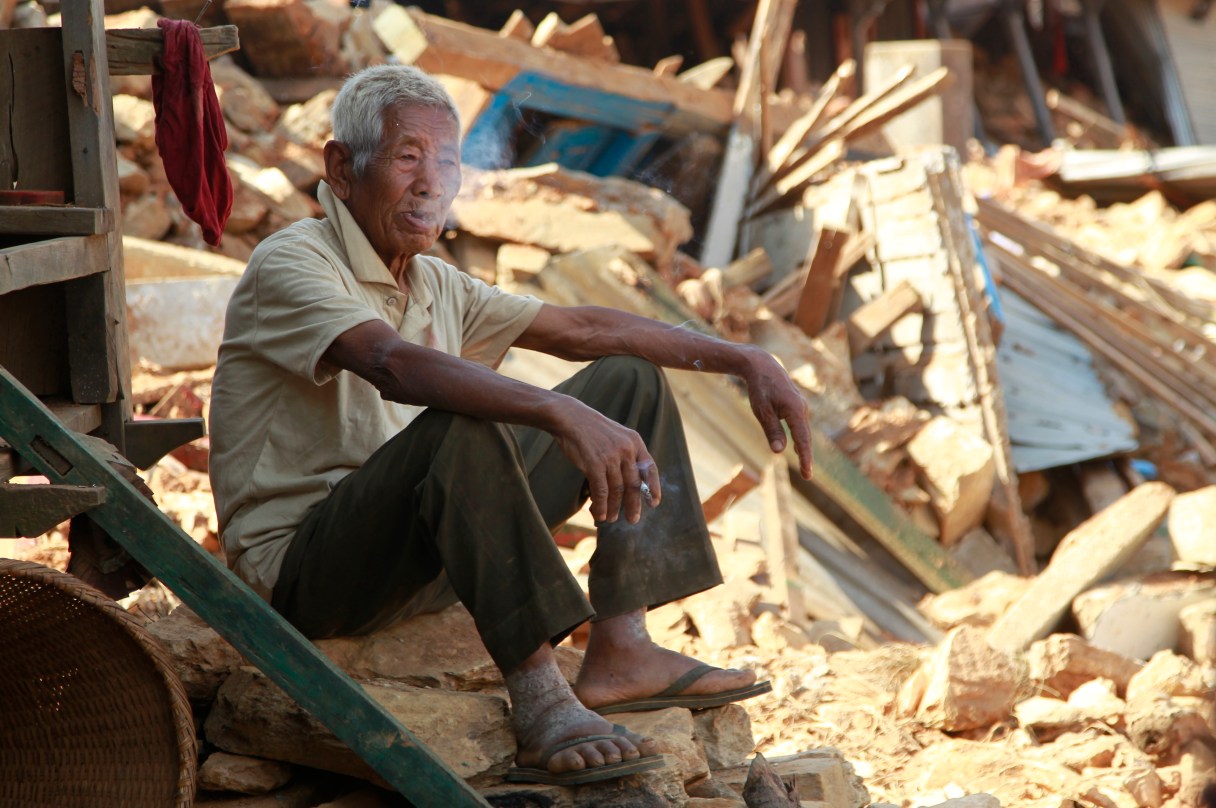
POKHARIDANDA, Nepal (AP) – He was 9 years old when he felt the earth tremble for the first time. He’d been out in a field, grazing his goats on wild grass below Nepal’s snow-covered peaks.
“The earth started shaking,” said Fattha Bahadur Rana, who at 90 years old is now the oldest man in this demolished farming village not far from the epicenter of the deadly April 25 earthquake. “I was a kid, I was scared. I saw everyone screaming, and I heard a loud roar.” He lisps a little, because he has just two teeth left. “I thought that a plane had crashed from the sky,” he said.
It was 1934. Hitler was on the rise in Europe, America was engulfed in its Great Depression, and Nepal was a sleepy, feudal Himalayan kingdom at the northern fringes of the British Empire.
Rana had become the man of his house a year earlier, after his father died in Kathmandu, the capital. He never learned the cause. He only knew it was up to him to help his mother and little brother on the farm.
The 1934 quake had a magnitude of 8.0. The epicenter was more than 200 kilometers (120 miles) away, near the Nepal-India border, and in Pokharidanda it did little more than frighten the villagers. In those days, news traveled slowly, but eventually they learned what had happened. More than 10,000 people had died and entire towns and cities had been smashed to the ground.