
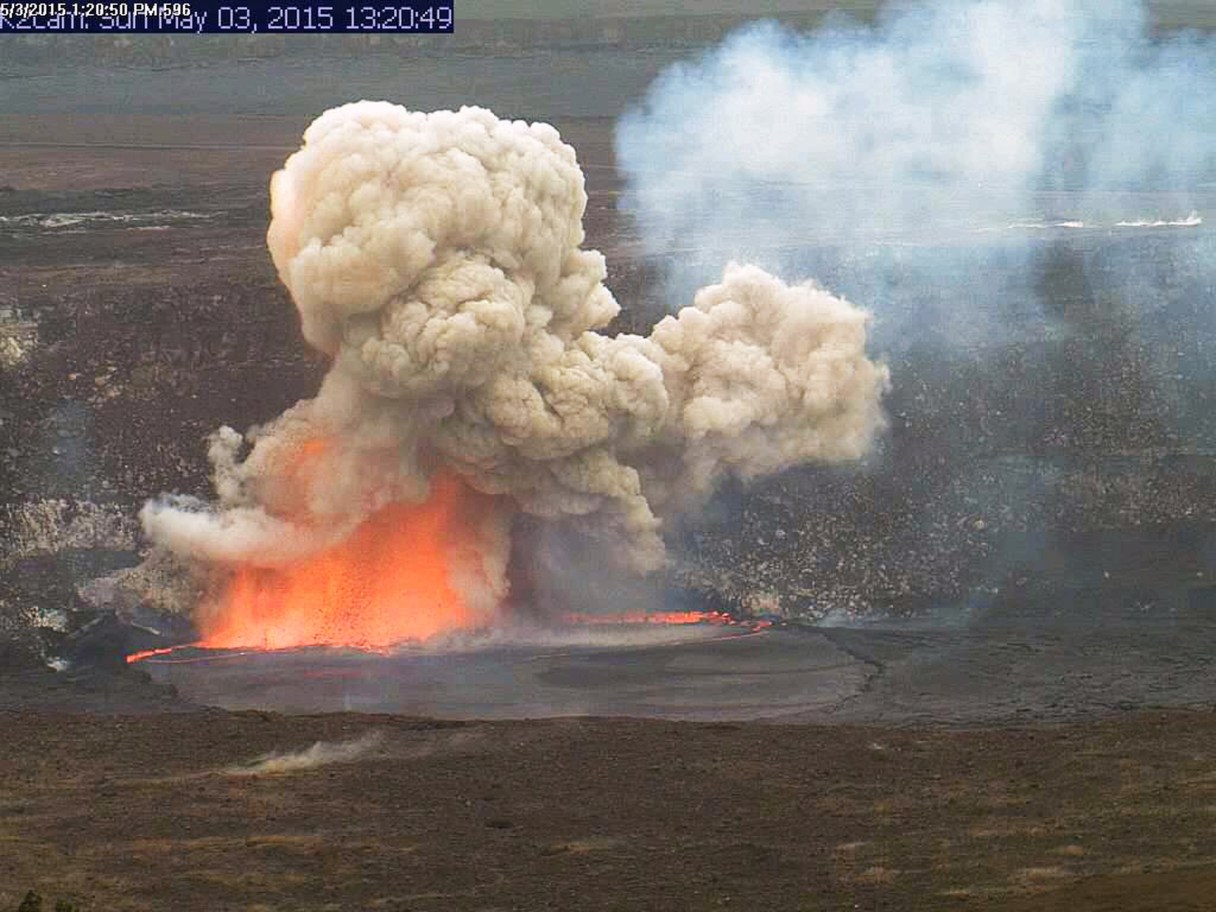
HONOLULU (AP) – Molten lava and rocks went flying through the air on Hawaii’s Kilauea volcano Sunday after an explosion was caused by the partial collapse of a crater wall.
The collapse triggered a small explosion, spreading lava and debris around the rim of Kilauea’s Halemaumau Crater, the U.S. Geological Survey’s Hawaiian Volcano Observatory says.
Video of the event shows a wall of rocks sliding into a lava lake that last week rose to a record-high level. The slide caused an explosion that sent fist-size chunks of rock onto the closed Halemaumau visitor overlook, according to the Geological Survey. The area has been closed since 2008, when the lava lake formed, and no one was injured.
The last time molten lava was visible in the crater was in 1982 when a fissure erupted. The last time there was a lake similar to this one was in 1974.
The vent within Halemaumau Crater has been rising and falling since it first opened, but it reached a record high last week. Even at its previous highest level in October 2012, the lake was too low for people to see. During the day, people could view the gas rising from the lake, and at night people could see the orange glow from the lava.
From the early 1800s up until 1924, there was a continuous lake of lava at Kilauea summit within Halemaumau. At that time, the crater was about half the diameter of what it is now.
In 1924, there was a huge eruption inside the volcano that doubled the size of the crater.
Since 1924, lava lakes have been present at different times. In 1967 and 1968, the entire crater was filled with molten lava. You can still see a “bathtub ring” on the walls of the crater where the lava had risen to at that time.
A magnitude 3.6 earthquake was felt in the area early Monday morning, according to the Geological Survey.
___
Follow Caleb Jones on Twitter: @CalebAP