

Status quo with the Hamilton County Schools may as well be going backward.
Inherently, schools officials, teachers and parents know the district’s high-poverty schools will never improve dramatically with the simple influx of more money, with students from high-poverty homes going to school only with students from other poor households, and with high-poverty schools continually having a high teacher turnover rate and thus the most inexperienced educators.
Despite a concentration of resources, the district’s lowest performing schools – its Innovation Zone – have seen little improvement. Without further improvement, a state takeover is a possibility in the future.
So what to do?
No easy answers are on the horizon, but UnifiEd Executive Director Elizabeth Crews believes a community conversation about possible changes for the district is worth having.
Among those changes, according to Richard Kahlenberg, a senior fellow at the Century Foundation, could be more socioeconomically diverse schools.
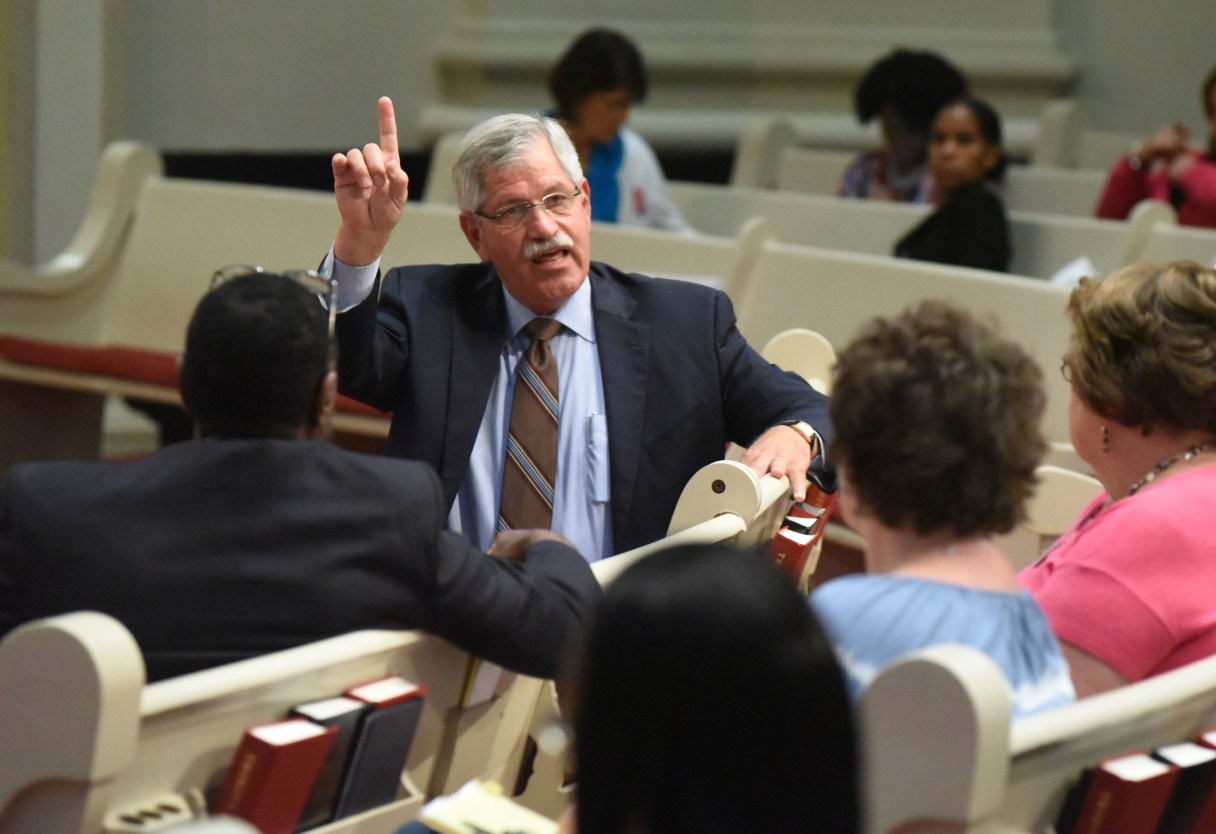
Research and data show that disadvantaged students at socioeconomically diverse schools perform better than disadvantaged students at segregated schools, he told a UnifiEd-sponsored gathering at The Church on Main Thursday night.
Kahlenberg earlier told the Times Free Press editorial board he didn’t “know whether it would work” or not in Hamilton County and, if it were possible, whether it could be implemented district-wide or needed to happen gradually by developing “success stories.”
He emphasized he is not suggesting a return to court-ordered busing, the failed method used in the 1970s and 1980s to force schools to become integrated. Busing, in fact, did integrate the schools, and neighborhoods, and then served to resegregate schools and, to some extent, neighborhoods. It drove families further into the suburbs, where new schools had to be built, and caused a rise in private school attendance.
Kahlenberg, who offered examples of success in the Louisville, Ky., Raleigh, N.C., and Hartford, Conn., districts, among others, said a system such as Hamilton County could build on the success of its STEM school or its magnet schools or create schools around specific themes or pedagogies in creating more socioeconomically diverse environments.
He also suggested changes would be easier at the creation of a new school.
In Hamilton County, for instance, that could come when Alpine Crest, DuPont and Rivermont elementary schools are combined into one larger campus, a plan which has been on the district’s school facility plan for several years.
In order to make such changes palatable to parents, who may have experienced or heard of the scars of forced busing, Kahlenberg said buy-in would be necessary on the front end and choice would need to be maximized.
Transportation would have to be provided for low-income families, which he admitted would be expensive, but the payoff would come in higher graduation rates, lower incarceration rates, and higher sales and property tax revenues for local governments, he said.
Socioeconomically diverse schools created around themes or established magnet schools might even bring back some students from private schools, Kahlenberg said.
After all, he said, “free is not a hard sell.”
Crews says Hamilton County Schools Superintendent Rick Smith believes there is a need for out-of-the-box solutions locally and that he peppered his drive for more funding for schools this past spring with such talk.
The central idea, she said, is “creating schools where parents want to send their kids.”
All parents want that, parents whose children have already gone through local schools, parents with children currently enrolled in local schools and even parents with children now in private schools.
Strong public schools help everyone, but every idea doesn’t make sense for every district. Any suggestion that students would have to leave a school where they’re comfortable to attend one where they’re uncomfortable would make all parents nervous, even those with students who would leave a high-poverty school.
But the exploration of turning some schools into additional magnets with the pedagogy of popular Chattanooga School for the Arts and Sciences and Chattanooga School for the Liberal Arts – with spots from students with all local ZIP codes – makes sense. So does theming additional schools such as Normal Park Museum Magnet, which draws from a diverse population of students.
On the other hand, so does a scholarship program, which offers low-income parents with students in failing public schools the opportunity to use taxpayer dollars to send their children to private schools, as a bill introduced in the state legislature last winter by Sen. Todd Gardenhire, R-Chattanooga, would do.
Kahlenberg is right that students who remain in high-poverty schools will have a harder time if they’re only educated with children from poor homes, and he is right that in order for changes to happen in a school district parents must have choices.
Just how those changes will occur will be a part of a continuing conversation, Crews said.
“There are a myriad of solutions,” she said. “We can do this.”
We must, because standing still is going backward.