
Editor’s note: Chattanooga native Dr. Stephen R. Roddy, wrote this in 2005 to chronicle his years as a member of the Knothole Gang. His widow recently discovered his recollections.
I was born and grew up in Chattanooga, graduated from Central High School class of 1941, void of academic laurels. I am a retired general surgeon in Houston. I wanted to make this article strictly a workout from memory. No outside sources were used, just simple impressions from long ago. As a member of Joe Engel’s Knothole Gang and regular in attendance, Chattanooga Lookouts baseball games ranked high on my list.
At that time, the Chattanooga Lookouts, Atlanta Crackers, Birmingham Barons, Knoxville Smokies, Memphis Chicks, Little Rock Travelers, Nashville Vols and New Orleans Pelicans made up the Southern Association.
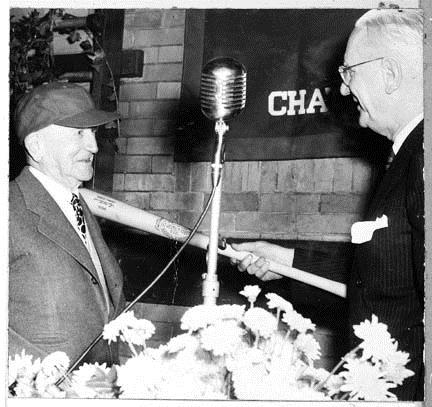 Col. Milton B. Ochs knighted by the Knothole Gang on Nov. 22, 1949.
The 1932 season came to an end and found the Lookouts one percentage point behind the Memphis Chicks. Memphians decreed upon themselves the championship. However, Joe Engel pointed out that earlier in the season the Lookouts had a game rained out in Knoxville that was not made up.
Engel persuaded the baseball commissioner’s office to allow the Lookouts to make up the rained-out game. The game was played in Knoxville with the Lookouts taking an easy victory. The win placed the Lookouts one percentage point ahead of the Chicks. The result: The Chattanooga Lookouts won the pennant – for the first time in the history of the Southern Association. Hurray!
Some of the players in and around that time were Harley Boss (first base), Johnny Milhalic (second base), who after baseball became an executive with Bendix Corp., Cecil Travis (third base), and Belton, a blustery, red-faced umpire behind the plate. Taft Wright (left field), Johnny “Red” Marion (center field – his brother was a major league star) and Fred Singleton. Can’t remember the name of the right fielder. Lefty Pettit and Alex McColl were pitchers.
Arch McDonald and Frank Lane announced the games on WDOD radio. Characteristically, before saying a word, they struck a gong once for a single, twice for a double, etc., making a clear vision as to what happened. When the Lookouts fell behind, a stanza of “The Old Pine Tree” was played.
Arch McDonald was drafted by the Washington Senators to announce for them – a tragic loss for Chattanooga fans.
Few bulked-up athletes were around. Anabolic steroids had not been invented. If anyone appeared “bulked up,” it was the result of vigorous training.
The Knothole Gang stands were located behind third base. We sat together and enjoyed a good view of the playing field. We followed every move with inspired attention.
It is worthy of note that only one policeman at a time worked at Engel Stadium. He doubled as traffic director to assist getting cars and pedestrians off the parking lot. Many fans walked long distances to come to games. Sidewalk traffic was heavy. Security was provided only on demand per incident basis.
Beyond the right field fence were railroad yards. The puffing from smokestacks was easily heard. Occasional dark clouds of smoke rolled in across the field and stadium. Located above the centerfield fence was the score board. Results of major league and other minor league scores were posted by hand.
In the 1933 era, there were no television games, and radio reception was often poor. Home 78 and 45 rpm record players were in short supply. There were many sandlot baseball games. Warner Park schedules were busy with league games.
It is appropriate to mention the maligned pinball machine. The pinball machine was always at turbulent war -being struck, bounced, yelled at, etc., by the user, resulting in frequent downtime and repairs.
The Great Depression was not yet over. Pocket change was scarce and greenbacks visibly guarded. Nevertheless, truthfulness and honesty were prime and the work ethic as well.
Poultices were common treatment for most injuries both at the scene and again at the hospital.
Prayer was common.
Years later in Memphis, my wife, Martha, and I encountered in our apartment a visiting group from our local Baptist church. One of the men asked if I ever knew a person by the name of Pettit. My answer was, “Yes, the Chattanooga Lookouts – years ago the Chattanooga Lookouts had a pitcher by the name of Lefty Pettit.”
He replied, “That’s me!” His appearance did not belie the good pitcher he was.
But again, this was an era before artificial “bulking” with steroids.
Dr. Stephen R. Roddy was born in Chattanooga in 1923, served in World War II and practiced general surgery in Florida and Texas. He died in 2006. For more, visit chattahistoricalassoc.org.