
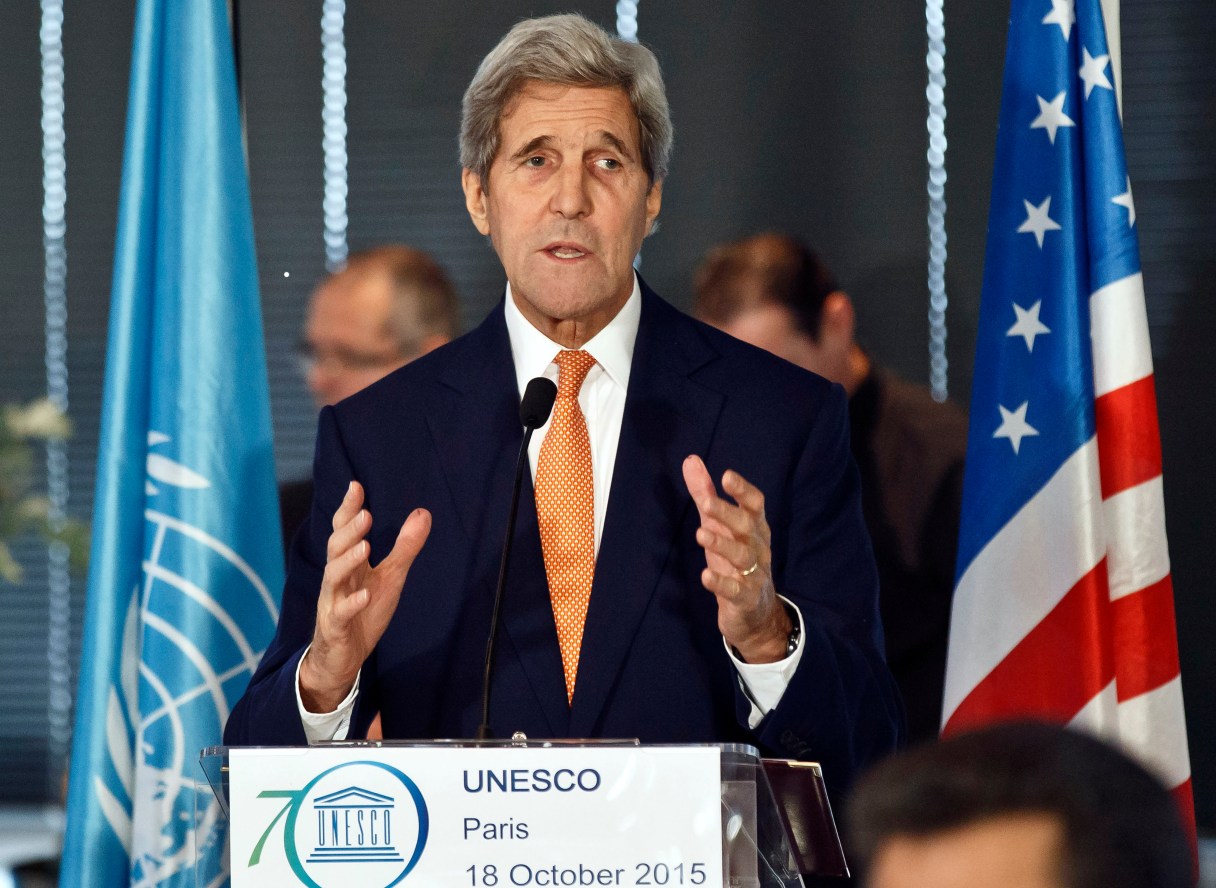
PARIS (AP) – The United States has succeeded in its bid to remain on UNESCO’s executive board, the only way to wield American power at the world’s cultural and scientific agency now that the U.S. government is no longer funding it.
The victory follows a U.S. diplomatic charm offensive aimed at fending off resistance to its re-election. Following a special visit by U.S. Secretary of State John Kerry to Paris-based UNESCO, Switzerland withdrew its candidacy and a Monday morning deadline expired for others to throw their hats into the ring – paving the way for the American re-election.
The U.S. bid to remain on the board was expected to run into resistance after it stopped paying its dues following the body’s decision to admit Palestine in 2011. U.S. law prohibits contributions to international organizations that recognize Palestinian statehood.
As a result of its financial arrears, the U.S. lost its vote in UNESCO’s general conference in 2013. The seat on the executive board was thus the last remaining formal tool of American influence at the U.N. Educational, Scientific and Cultural Organization, which the U.S. co-founded in 1945 following World War II.
The executive board, which consists of 58 member states each with a four-year term, prepares the UNESCO agenda and is responsible for implementing programs adopted by the General Conference.