
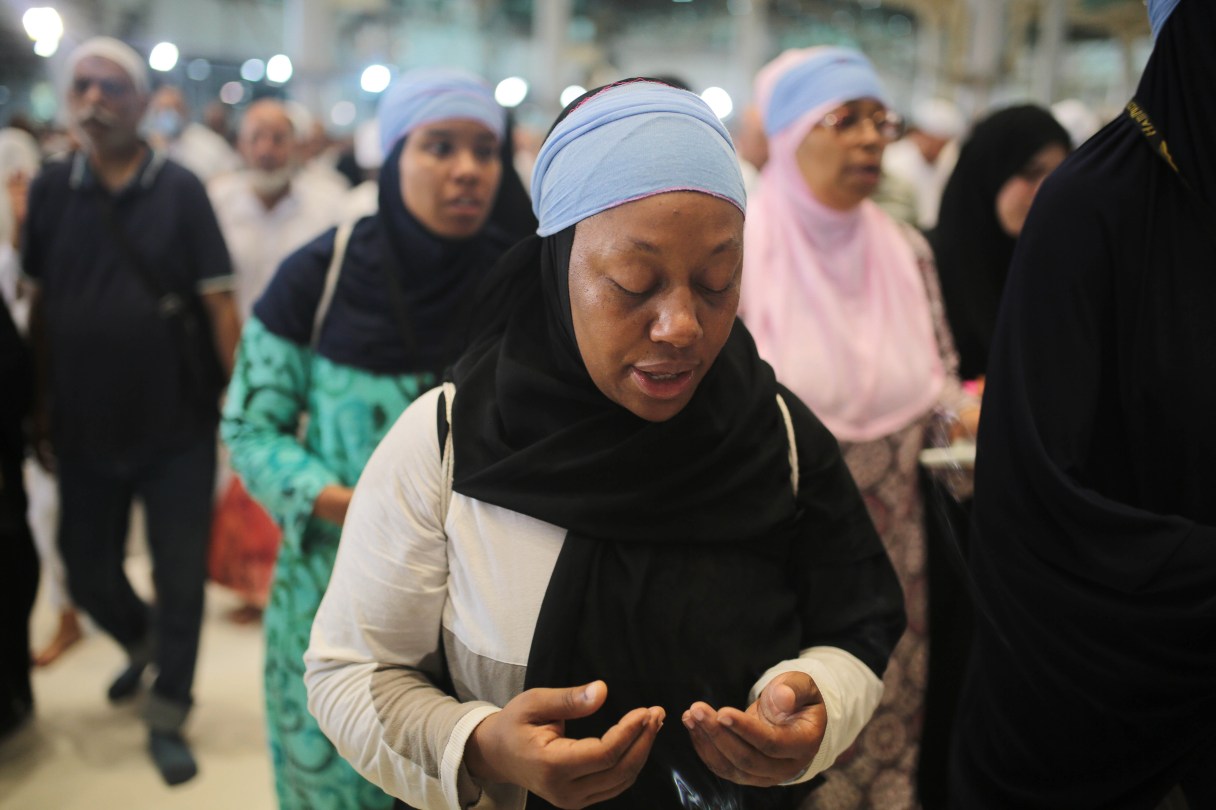
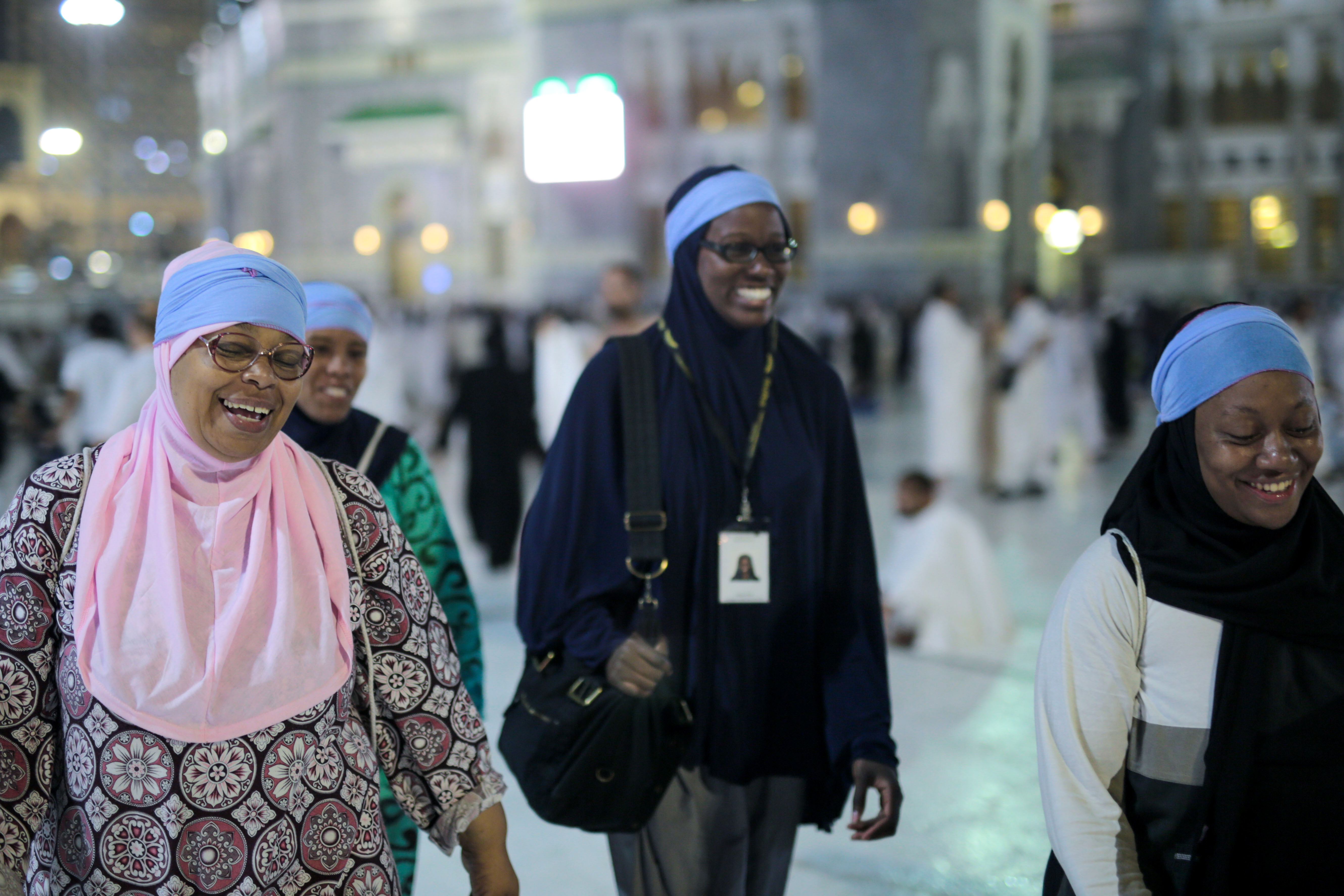
 In this Monday, Sept. 21, 2015 photo, American Muslims Zainab Nasir, left, Shahidah Sharif, Jamila Rashid, second left, and an unidentified friend walk outside the grand mosque on their way to circle the Kaaba, the cubic building at the Grand Mosque in the Muslim holy city of Mecca, Saudi Arabia. For American black Muslims, this year brought a significant landmark, the 50th anniversary of Malcolm Xs death. A year before his assassination, Malcolm X underwent a transformative experience on hajj, seeing the potential for racial co-existence after witnessing, as he wrote, pilgrims of all colors displaying a spirit of unity and brotherhood. (AP Photo/Mosa’ab Elshamy)
MECCA, Saudi Arabia – As Shahidah Sharif, an African-American Muslim, joined millions of fellow pilgrims from around the world on the hajj this year, she felt a renewed connection. To her own “blackness,” she says, but also to humanity as a whole.
“When the human family becomes more important than just myself and my needs, nothing can get in the way of building relationships,” she says in Mecca. “It doesn’t matter if we have different faiths, different races, different nationalities, I can find something in common with you.”
For American black Muslims, this year brought a significant landmark, the 50th anniversary of Malcolm X’s death. A year before his assassination, Malcolm X underwent a transformative experience on the hajj, seeing the potential for racial co-existence after witnessing, as he wrote, pilgrims “of all colors displaying a spirit of unity and brotherhood that my experiences in America had led me to believe could never exist between a white and a non-white.”
This year’s hajj, which ended Sept. 26, came at a time when the debate over race in the United States is at its most heated in decades, with the Black Lives Matters movement arising after the deaths of a number of black men at the hands of police were captured on camera and seen widely by the public.
For Muslims, the pilgrimage is not just a duty, it’s a moment to reflect on oneself and on community. It’s an intensely personal experience. In Islam, each pilgrim presents him or herself directly to God, seeking forgiveness of sin, while performing rituals that include circling the Kaaba, the cube-shaped structure in Mecca. At the same time, it’s communal: more than 2 million pilgrims performing the same rites, underscoring unity and equality.