
Monday, November 16, 2026Nov 16

As US prepares to hike rates, Europe could reap benefits

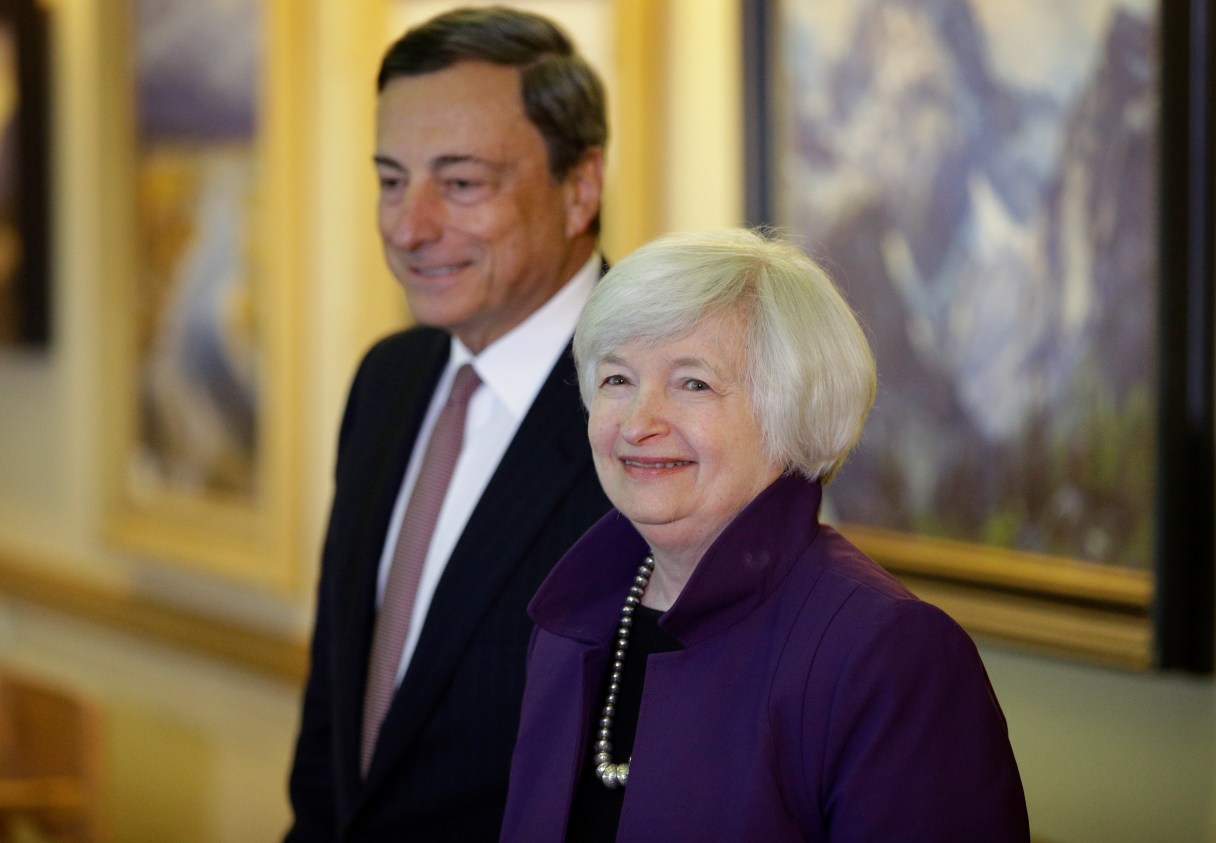
FILE - In this Aug. 22, 2014 file photo Federal Reserve Chair Janet Yellen, right, and European Central Bank President Mario Draghi walk together during the Jackson Hole Economic Policy Symposium at the Jackson Lake Lodge in Grand Teton National Park near Jackson, Wyo. In a significant event for the global economy, the central banks of Europe and the United States are set to take opposing actions in December _ the European Central Bank to cut rates, the Federal Reserve to raise them. (AP Photo/John Locher, file)

FRANKFURT, Germany (AP) – In a high-stakes juncture for the global economy, the central banks of Europe and the United States are set to take opposing actions in December: the European Central Bank to cut rates, the Federal Reserve to raise them.

For the struggling eurozone, it can’t happen soon enough.

The divergence between two of the biggest forces in the world economy has the effect of weakening the euro against the dollar, providing a valuable boost to economic growth in Europe at a time of mounting uncertainty. For the more solid U.S. economy, it is creating an unwelcome headwind.

The euro has fallen against the dollar since the ECB signaled last month that on Dec. 3 it would further trim interest rates or expand its monetary stimulus, both of which tend to weigh on a currency. At the same time, the Federal Reserve has been pushing the dollar higher by indicating it’s likely to raise rates on Dec. 16 for the first time in nearly a decade.

That “suggests the euro should be one of the weakest major currencies over time,” says Nick Bennenbroek, head of currency strategy at Wells Fargo Securities.