
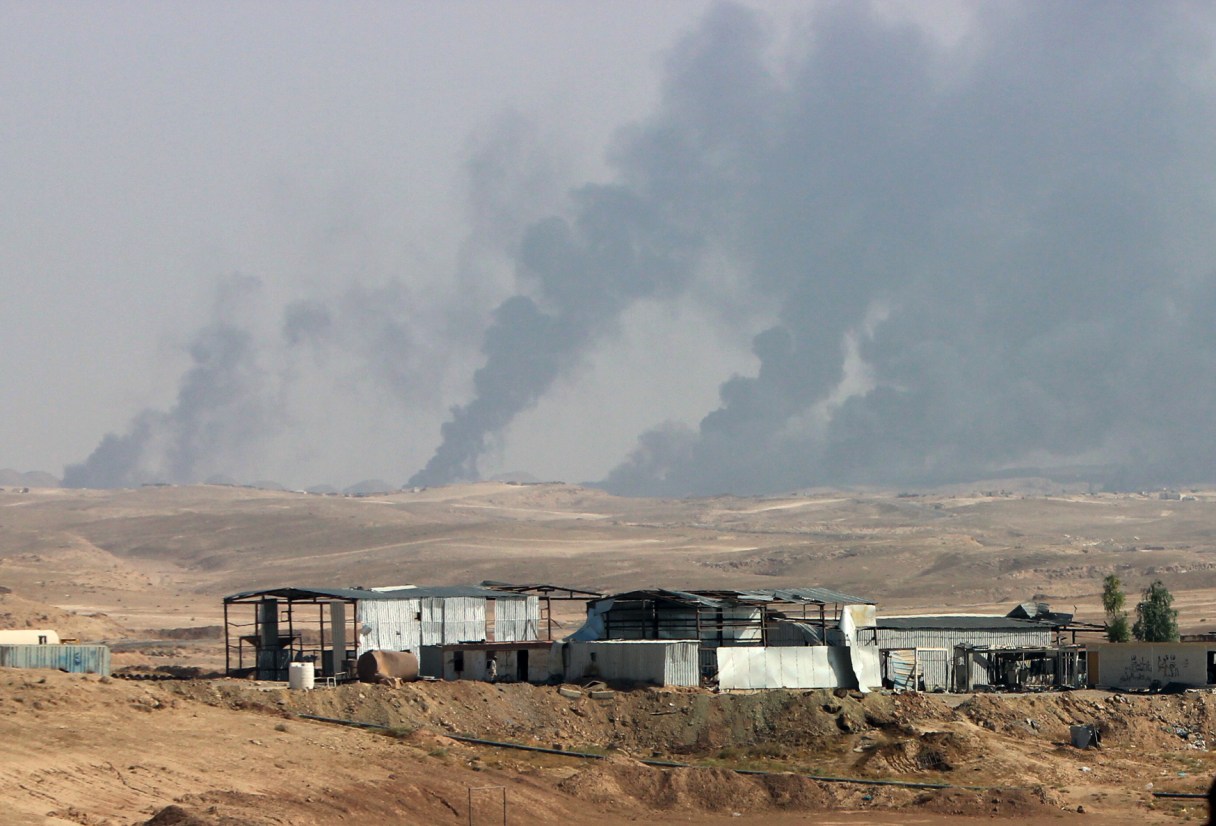
BEIRUT (AP) – The United States and Russia are going after the Islamic State group’s oil industry, destroying refineries and hundreds of tanker trucks transporting oil from eastern Syria in a heavy bombardment in recent days aiming to break the extremists’ biggest source of income.
The campaign already appears to be having some effect, with oil prices rising in areas of Syria that rely on crude smuggled out of IS areas. But experts say it will be difficult to cut off the militants’ trade completely since they are likely to switch to smaller, more elusive vehicles.
Putting a total end to the industry would mean destroying the oil fields in Syria, but that would also bring hardship to millions in the population under IS rule and others who depend on the group’s oil, causing fuel shortages as winter sets in. Otherwise, taking the fields would require ground forces.
Still, the campaign could hit hard on an industry that U.S. officials say generates more than half the revenue the Islamic State group uses to maintain its rule over its swath of territory across Syria and Iraq and pay its fighters.
IS controls almost all of Syria’s oil fields, concentrated in the east of the country, producing some 30,000 barrels a day, along with one field in Iraq. It smuggles most abroad, mainly to Turkey, selling at cut-rate prices and generating nearly $50 million a month.