
Friday, November 13, 2026Nov 13

ECB chief: ‘won’t hesitate’ to expand stimulus if needed

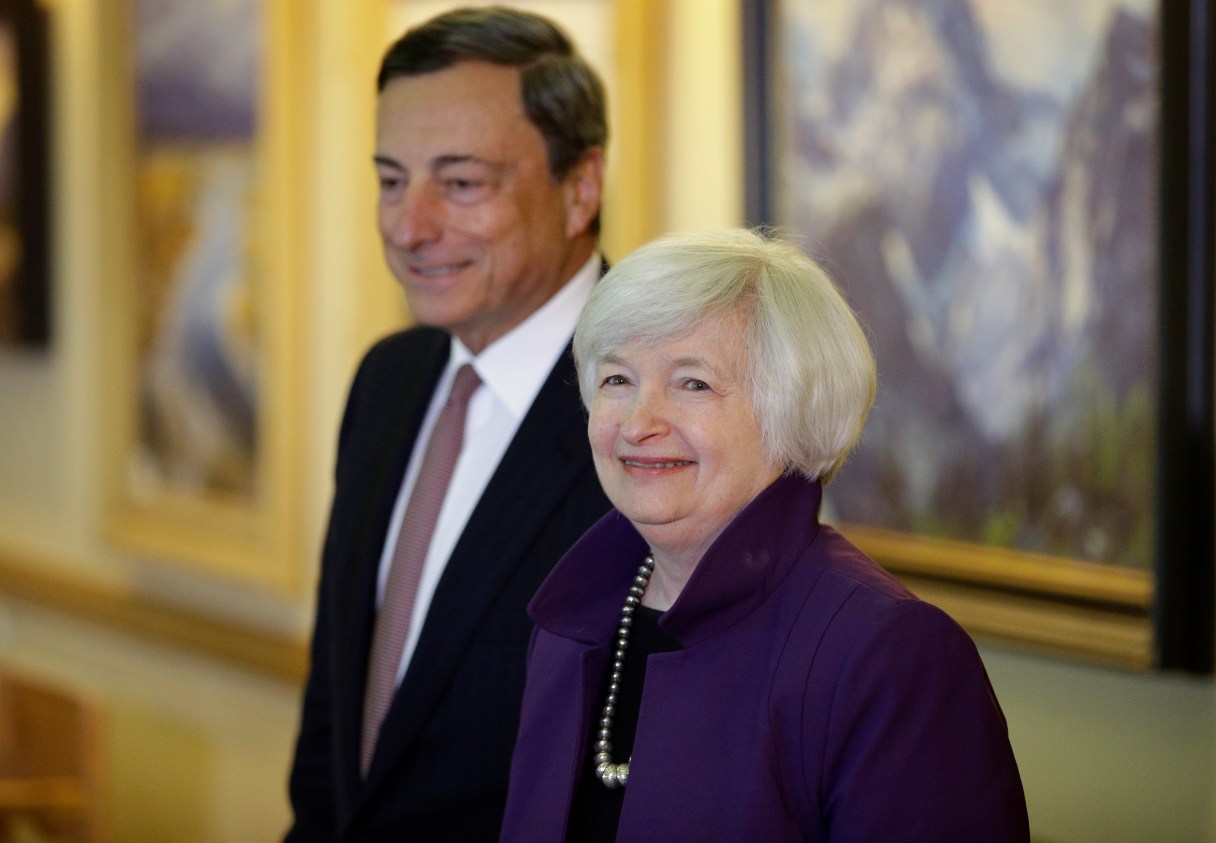
FILE - In this Aug. 22, 2014 file photo Federal Reserve Chair Janet Yellen, right, and European Central Bank President Mario Draghi walk together during the Jackson Hole Economic Policy Symposium at the Jackson Lake Lodge in Grand Teton National Park near Jackson, Wyo. In a significant event for the global economy, the central banks of Europe and the United States are set to take opposing actions in December _ the European Central Bank to cut rates, the Federal Reserve to raise them. (AP Photo/John Locher, file)
FILE - In this Aug. 22, 2014 file photo Federal Reserve Chair Janet Yellen, right, and European Central Bank President Mario Draghi walk together during the Jackson Hole Economic Policy Symposium at the Jackson Lake Lodge in Grand Teton National Park near Jackson, Wyo. In a significant event for the global economy, the central banks of Europe and the United States are set to take opposing actions in December _ the European Central Bank to cut rates, the Federal Reserve to raise them. (AP Photo/John Locher, file) FILE - In this Aug. 22, 2014 file photo Federal Reserve Chair Janet Yellen, right, and European Central Bank President Mario Draghi walk together during the Jackson Hole Economic Policy Symposium at the Jackson Lake Lodge in Grand Teton National Park near Jackson, Wyo. In a significant event for the global economy, the central banks of Europe and the United States are set to take opposing actions in December _ the European Central Bank to cut rates, the Federal Reserve to raise them. (AP Photo/John Locher, file)

FRANKFURT, Germany (AP) – European Central Bank head Mario Draghi said the chief monetary authority for the eurozone “will not hesitate” to expand its stimulus program at its next meeting if needed to support the economy.

Draghi’s speech in Frankfurt on Friday reinforced his earlier statements taken by markets as a green light for action at the Dec. 3 meeting.

He said the ECB needed to assess whether “if left to its own forces, the economy will be able to achieve a self-sustaining trajectory. If not, then it will require more monetary stimulus.”

The ECB could increase its 1.1 trillion euro ($1.2 trillion) program of bond purchases, which injects newly printed money into the economy. It could also lower its rate on money deposited by banks farther into negative territory, a move that effectively pushes the banks to lend more. Currently, that rate is minus 0.2 percent.

Draghi argued that the current stimulus has had a strong effect in supporting the economy, which has this year been growing only gradually. He said the ECB’s efforts have cut borrowing rates for companies and increased their access to the credit they need to do business and expand.