
More Info
BlueCross by the numbersBlueCross BlueShield of Tennessee is Chattanooga’s biggest private employer and Tennessee’s biggest health insurer with 5,511 employees, including more than 4,400 at the company’s headquarters on Cameron Hill in Chattanooga.Racial makeup* 73 percent – White/Caucasian* 18 percent – Black/African-American* 2 percent – Asian* 1.3 percent – Hispanic/Latino* 5 percent – Others or not specifiedGender makeup* 74 percent – Women* 26 percent – MenWhere they come from* 79 percent – Tennessee* 17 percent – Georgia* 2 percent – Alabama* 2 percent – All other statesAge distribution* 58 percent – Generation X (1961-1979* 24 percent – Generation Y/Millennials (1980 or later)* 18 percent – Baby boomers (1945-1960)* 1 percent – Silent generation/Traditionalists (1922-1945)Source: BlueCross BlueShield 2014 Diversity Report
More Info
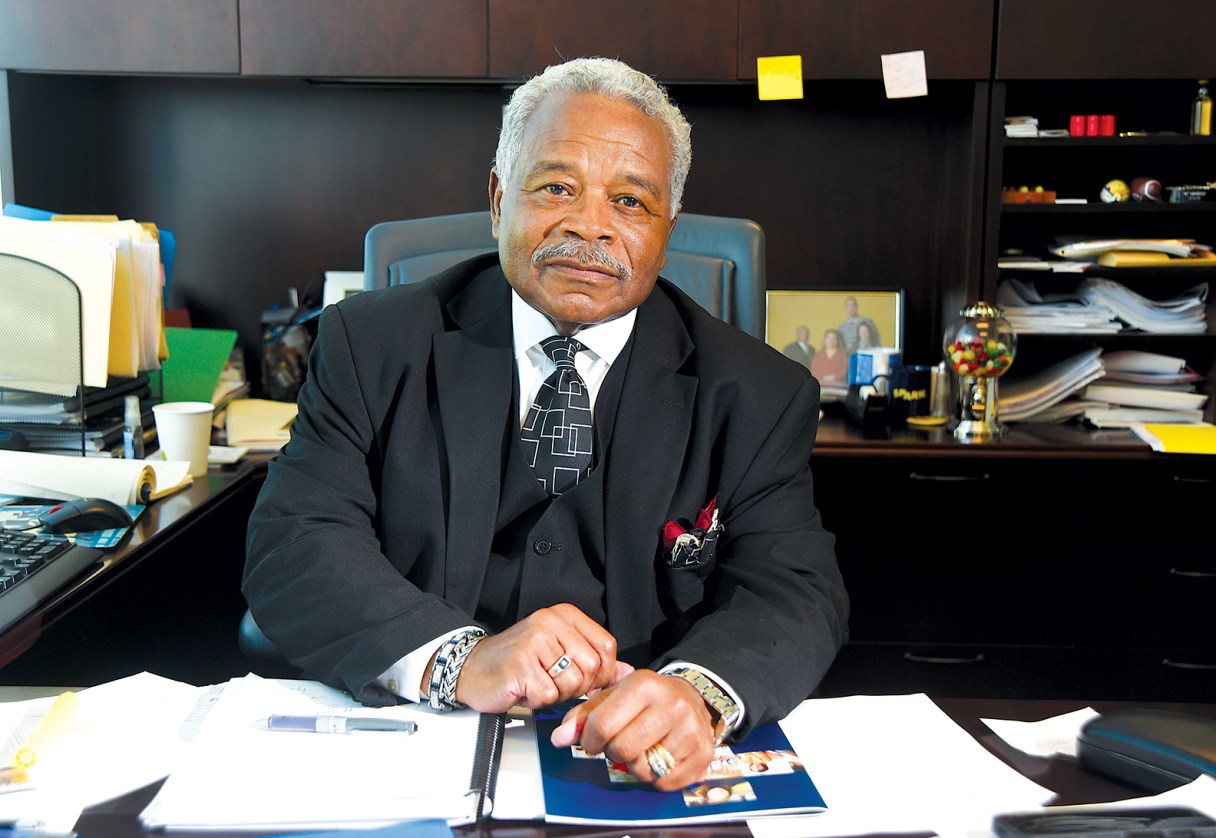
About Ron HarrisJob: Director of corporate workforce diversity for BlueCross BlueShield of TennesseeEducation: A native of Chattanooga, Harris graduated from Howard High School, attended Chattanooga City College and the University of Tennessee at Chattanooga and served as a medic in the U.S. Army.Career: He was director of human resources at Central Soya Co., from 1974 to its closing in 1984 and has since worked as a customer service provider and later director of corporate workforce diversity at BlueCross BlueShield of Tennessee.Faith: Harris is a lifelong member and an associate pastor at Second Missionary Baptist ChurchPersonal: Harris and his wife, Rosalind, reside in East Brainerd
Ron Harris grew up when Chattanooga schools were still segregated. He graduated from the then all-black Howard High School in 1967 and went to the former Chattanooga City College when the black college was merged with the former University of Chattanooga to create the University of Tennessee at Chattanooga in 1968.
The next year, only three days after he was married, Harris was drafted into the U.S. Army and headed to Europe.
“I was put into a completely integrated military after growing up in a segregated society,” Harris recalls of his two years in the military as an Army medic. “I had to quickly learn to deal with different types of people and to deal with them on an individual basis.”
On the battlefield or on the surgery table, you don’t have time to pay attention to an individual’s demographic background, Harris said.
It’s a lesson that has helped Harris more than four decades later in his job as director of corporate workforce diversity at Chattanooga’s biggest private employer, BlueCross BlueShield of Tennessee. Harris is the only one who has held the job since former BlueCross CEO Tom Kinser created the position in 1997 to help the health insurer better serve and represent Tennessee’s diverse population after the Chattanooga-based BlueCross plan merged with BlueCross of Memphis.
Karen Ward, chief human resources officer at BlueCross, worked in the Memphis BlueCross plan at the time of the merger and recalls how Memphis was more attentive to addressing racial diversity issues than was Chattanooga.
“Memphis at the time had a much more open dialogue and focus on race relations than folks in East Tennessee, and I think Tom Kinser recognized that he needed to create this role,” she recalls. “I think Ron Harris was a perfect person to take that role and to continue to develop it to what it is today. He has such a passion for educating employees and for the community at large about the value of inclusion. But he is also a patient and understanding person who recognizes you have to stick with it for the long haul.”
Harris says he likes to talk about inclusion, rather than diversity.
It’s what he learned from his Christian faith and his grandmother, the late Isadora Walker, who died just a week before Harris began working at BlueCross. Harris’ own mother died when he was 11 and he never spent much time with his father.
“My grandmother taught me about people, patience and faith,” Harris says. “She didn’t care a lot about democracy in the household. I would call it a dictatorship with twinges of benevolence. There was a lot of discipline, but I always knew that I was loved and I was never hungry.”
When he told his grandmother he didn’t like asparagus because “it looks like something that shouldn’t be eaten,” she immediately retorted that she had never before made young Ron any asparagus “so how do you know you don’t like it.”
Harris grew up in McCallie Homes, or as many of his peers called it simply “the projects.”
“I never saw myself as being poor, and actually when we moved into McCallie Homes I got my own bed for the first time in the 8th grade,” Harris recalls. “It was like the “McCallie condominium” for me.”
Previously, Harris lived in small home with his brother, six cousins, an aunt, an uncle and two grandparents squeezed into a few bedrooms in East Chattanooga.
“If I complained about Charlie having some nice new shoes, my grandmother would tell me to go live with Charlie if you thought it would be better, and that ended that discussion pretty quickly,” Harris recalls.
His grandmother would tell Ron and his brother, “you have an address at 3469 Highland Avenue. You don’t live in the projects.”
“When the mailman comes, he doesn’t deliver mail to ‘the projects,'” Harris recalls his grandmother telling him. “He delivers it to an address.”
Growing up in the 1960s, Harris said he was never an activist or protester against racial segregation. But he says he did learn from his family and teachers the need for respect and inclusion for all people.
“I was raised to believe that people are just people and I was never in an environment where I felt intimidated or to see people with horns or somehow evil,” he says. “I wasn’t on the front lines of activism, but I had a great sense of right and wrong. I always have known and believed that racism, segregation, bigotry and hatred are wrong and you don’t get caught up in that. My grandmother always told me, “you don’t have the right to not like anything or anybody that you didn’t know.”
Faith has always been an important part of Harris’ life since he was taken as a boy to Second Missionary Baptist Church. Harris says one of his mentors through his life has been the Rev. Paul McDaniel, who served for 48 years as pastor of his church.
Harris is now an associate minister at Second Missionary Baptist, reflecting the faith and speaking abilities he learned at a young age. Harris says he has had an ability to communicate throughout his life “so somebody is always sticking a microphone in front of me.
“I’ve always had encouragement from school, family, friends, bosses” he says.
After serving in the Army and a brief stint at the Chattanooga magazine company, Harris joined Central Soya Co., as a clerk in 1972. After a couple of years, his boss called him into his office on a Friday afternoon and told him to come back Monday with a suit on because he was going to be assistant personnel director. Harris, who says he had to either take that job or find another one, bought his first suit that weekend and has been wearing one ever since.
He became director of human resources at Central Soya and stayed until the company’s Chattanooga plant closed in 1984. A year later, he joined BlueCross as a claims and customer service supervisor. He was named the company’s first director of diversity in 1997 at the urging of his colleagues.
At the same time, Harris said his son passed along some material on the importance of a diverse workforce that he had received from a class at the University of Tennessee in Knoxville where Harris’ son was a junior. Harris studied the material and even asked his pastor to pray that he would get the job.
“Rev. McDaniel said he wasn’t going to pray for me to get the job, but if it was God’s will it would happen – and it did,” Harris recalls.
Over the past 18 years, Harris has led hundreds of classes, discussions and seminars at BlueCross with job recruits, new hires and company managers to help elevate the importance of having and promoting a diverse workforce and company.
“It’s not just a side issue for us now,” he says. “It’s an integral part of our mission and foundational to our purpose of providing peace of mind.”
Harris works to help recruit, develop and work with demographic groups often underrepresented in top jobs and to cultivate a workplace that is comfortable and respectful for all types of workers.
“The reward is when you can talk comfortably about really uncomfortable things,” he says.
BlueCross does not use quotas or racial, age or gender preferences. But the company does regularly measure the diversity of its staff and management and works to better reflect the market it serves. Over time, the employment mix has reflected more African Americans, Asians, Hispanics, veterans and other traditionally under represented demographics.
Harris has worked to incorporate diversity into all parts of the company: corporate training, staff recruitment, management and organizational development and corporate policies.
“You have to weave diversity into the entire organization because it’s not just an HR program,” Karen Ward says. “I would definitely say in the 18 years that Ron has been in this role there has been a change in the culture and a lot of that is generational, too. We just have a broader perspective than we did 20 years ago.”
To help develop and promote more minorities, women and veterans into management jobs, BlueCross supports a variety of mentorship programs, including programs that pair promising young workers with top managers and the AIM (Achievers In Motion) program to bring hourly and exempt workers together. Two years ago, BlueCross added a minority mentorship program to expose a half dozen minority managers to the top executives for six months.
In the community, BlueCross also supports a diversity scholarship that recently was doubled to $10,000 and the company continues to support a Women’s Leadership network and programs to help veterans. Diversity is one of BlueCross strategic goals on the same level as other top company objectives.
“All of these programs and objectives are about opportunity, growth, development, exposure and retention to give a balance and an engagement to our workforce,” Harris says.
The company also offers cultural awareness programs for employees every three months to help enlighten staffers by allowing persons from different cultures to lead a program to help others understand their culture.
“We even had to do one on the ways and language of the South (in the United States) because people didn’t always understand what “bless your heart” means,” Harris says. “We have a global workforce today and we need to better understand people of different cultures.”
Harris insists that all employers should work to ensure that their workers understand and promote the importance of including others with diverse backgrounds to broaden the labor pool, improve customer service to an increasingly diverse population and strengthen creativity in workplace teams.
“You are either going to be intentionally inclusive, or unintentionally exclusive,” Harris says.