
Thursday, November 12, 2026Nov 12

Farmer finds woolly mammoth bones in Michigan field

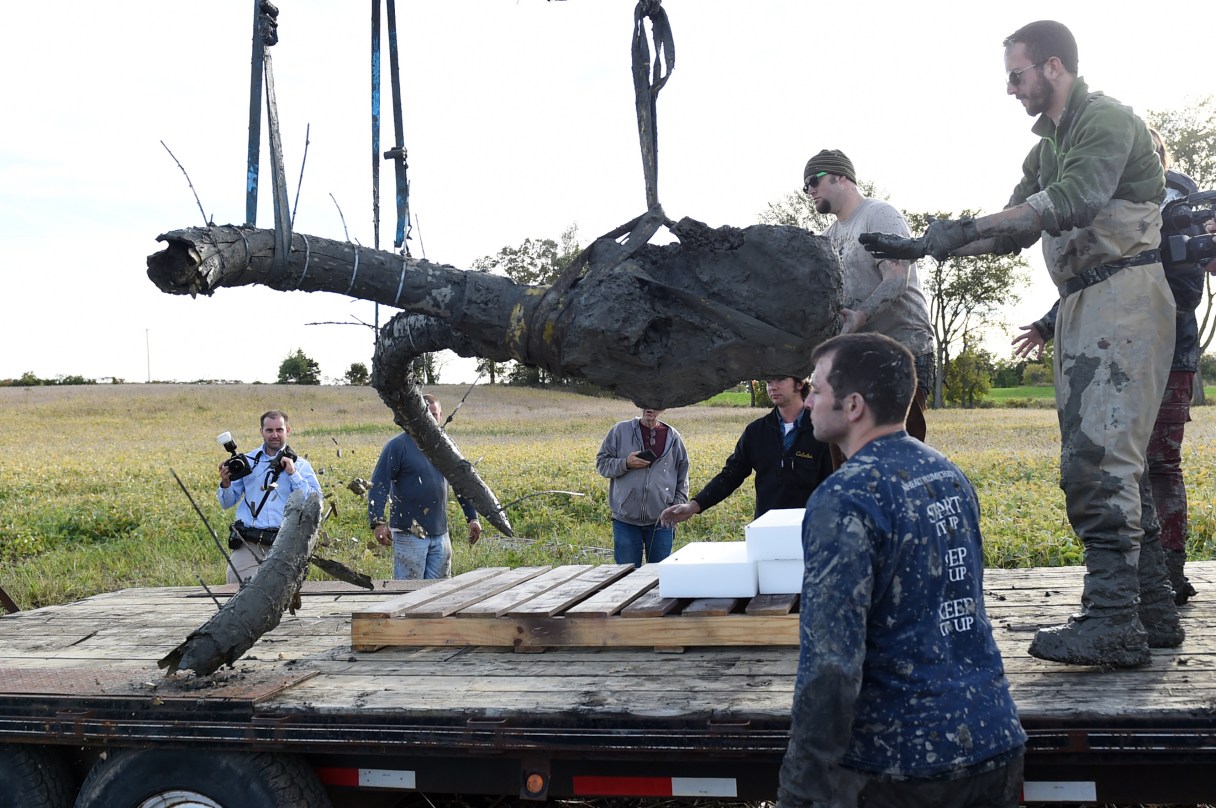
In this photo taken Oct. 1, 2015, a piece of a tusk, lower left, snaps off the end as crews transfer the remains of a woolly mammoth from the ground to a trailer for transport, as University of Michigan professor Dan Fisher and a team of Michigan students and volunteers work to excavate a woolly mammoth found on a farm near Chelsea, Mich. (Melanie Maxwell/The Ann Arbor News via AP) LOCAL TELEVISION OUT; LOCAL INTERNET OUT; MANDATORY CREDIT
In this photo taken Oct. 1, 2015, a piece of a tusk, lower left, snaps off the end as crews transfer the remains of a woolly mammoth from the ground to a trailer for transport, as University of Michigan professor Dan Fisher and a team of Michigan students and volunteers work to excavate a woolly mammoth found on a farm near Chelsea, Mich. (Melanie Maxwell/The Ann Arbor News via AP) LOCAL TELEVISION OUT; LOCAL INTERNET OUT; MANDATORY CREDIT In this photo taken Oct. 1, 2015, a piece of a tusk, lower left, snaps off the end as crews transfer the remains of a woolly mammoth from the ground to a trailer for transport, as University of Michigan professor Dan Fisher and a team of Michigan students and volunteers work to excavate a woolly mammoth found on a farm near Chelsea, Mich. (Melanie Maxwell/The Ann Arbor News via AP) LOCAL TELEVISION OUT; LOCAL INTERNET OUT; MANDATORY CREDIT

LIMA TOWNSHIP, Mich. – James Bristle and a friend were digging in his southern Michigan soybean field when they unearthed what looked like a bent fence post, caked with mud. Instead, it was part of a pelvis from an ancient woolly mammoth that lived up to 15,000 years ago.

A team of paleontologists from the University of Michigan and an excavator recovered about 20 percent of the animal’s skeleton this week in Washtenaw County’s Lima Township. Aside from the pelvis, they found the skull and two tusks, along with numerous vertebrae, ribs and both shoulder blades.

“We think that humans were here and may have butchered and stashed the meat so that they could come back later for it,” Daniel Fisher, the scientist who led the dig, said Friday.

Three boulders the size of basketballs found next to the remains may have been used to anchor the carcass in a pond, he said.

Mammoths and mastodons, another elephant-like creature, were common in North America before disappearing around 11,700 years ago. Remains of about 300 mastodons and 30 mammoths have been discovered in Michigan, Fisher said, although most of the mammoth finds aren’t as complete as the one in Bristle’s field.