
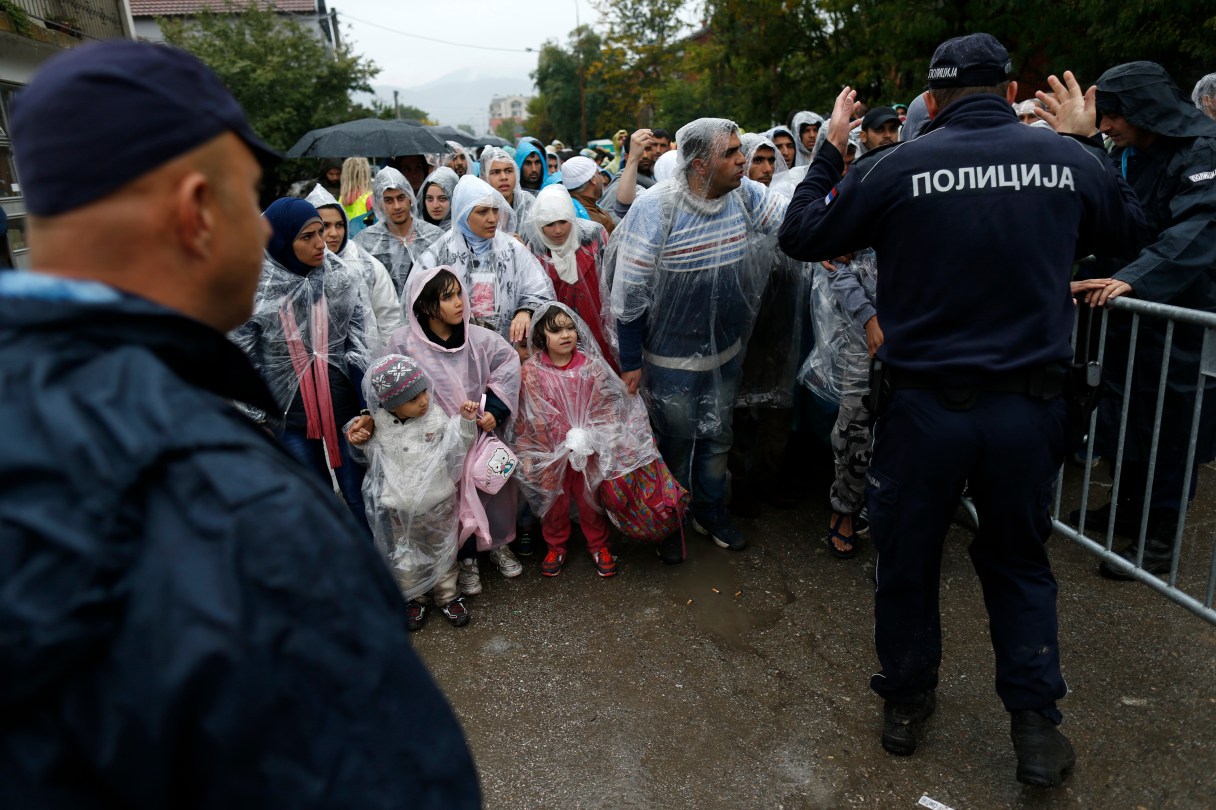
BRUSSELS (AP) – The latest developments as hundreds of thousands of people seeking safety make an epic trek through Europe. All times local.
___
4:25 p.m.
German Chancellor Angela Merkel has told European lawmakers that Europe can’t shut itself off from the outside world in an effort to keep out migrants.
European Union countries have squabbled over how to deal with this year’s influx, with Hungary building a fence on its border with Serbia to try to halt it.
Merkel told the European Parliament on Wednesday: “We have to recognize that, even if we tried to seal ourselves off completely – even at the price that people could suffer at our borders – that would help no one.”
She said people would find a way to come to Europe anyway and added: “Sealing and cordoning yourself off in the age of the Internet is an illusion. No problem would be solved; additional and serious problems would arise.”
Merkel also said Europe needs to work together to help resolve crises in its neighborhood that are prompting flows of refugees.
Germany has struggled to get other EU countries to share the burden of hosting refugees. Merkel said: “In the refugee crisis, we must not succumb to the temptation of falling back into national action. Quite the contrary: now we need more Europe.”
___
4:20 p.m.
French President Francois Hollande is calling on the European Union to adopt a common asylum policy.
In a speech Wednesday before the European Parliament, Hollande said it would be a “tragic error” to call into question Europe’s open borders. Instead, he said, the member states need to come up with a coherent asylum policy.
Hollande and German Chancellor Angela Merkel were speaking before a sometimes skeptical audience in Strasbourg, France, as the EU faces bitter divisions over how to cope with the influx of migrants, including many fleeing the ravages of war and dictatorship.
___
4:10 p.m.
Italian Interior Minister Angelino Alfano says the first transfer of Eritrean asylum seekers to Sweden is the “practical proof of the success we’ve had in Europe on migration policy.”
Alfano plans to be on hand Friday morning at Rome’s Ciampino airport to bid farewell to the Eritreans who are being relocated under the EU’s plan to eventually share 160,000 refugees from countries hardest hit by the migration crisis.
Italy for years has demanded Europe shoulder more of the burden of the continent’s refugee crisis, even though most migrants prefer to pass through Italy en route to destinations further north. Alfano though is keen to show off the first flight to try to quiet anti-immigrant critics at home.
___
4 p.m.
Slovak President Andrej Kiska is criticizing the government for its handling of the migrant crisis and opposition to EU quotas.
The leftist government of Prime Minister Robert Fico is challenging a European Union decision to redistribute 120,000 asylum-seekers among the bloc’s 28 nations.
Slovakia voted against the plan along with the Czech Republic, Romania and Hungary.
Addressing the country’s Parliament on Wednesday, Kiska said the government doesn’t understand that the quota plan shows solidarity among EU member states.
Kiska said Slovakia is in a position to take in thousands of refugees fleeing war and that it would not harm his country. Kiska says it is the refusal to accept to the quota system that harms Slovakia and has led it to isolation.
___
3:15 p.m.
Hungary’s president says the United States, Canada and China are secure countries “and therefore suited for taking in refugees.”
Ader, speaking after a meeting with Croatian President Kolinda Grabar-Kitarovic, noted that the United States “has taken in 1,500 Syrian refugees so far.” Hungarian Prime Minister Viktor Orban and other officials have also called for non-European countries to accept their share of refugees in a system of global quotas.
Grabar-Kitarovic said the migrant crisis had “cast a shadow” on the rapport between Hungary and Croatia, but she agreed with Ader that this should not ruin their traditionally strong relations.
This year, over 324,000 migrants and refugees entered Hungary, which has built fences on its southern borders with Serbia and Croatia in an attempt to control their flow.
___
3 p.m.
The German government is moving to improve coordination of its response to the migrant crisis and putting Chancellor Angela Merkel’s chief of staff in charge of the effort.
Government spokesman Georg Streiter said after a Cabinet meeting Wednesday that Peter Altmaier will be in charge of “political coordination” of the response. Germany has seen hundreds of thousands of refugees and other migrants arrive this year – more than any other country in the European Union – and the influx is straining its capacity to house the newcomers and process asylum applications.
Streiter says coordination between ministries will be strengthened. He says the government hopes to speed up management of the crisis.
___
2:50 p.m.
A small group of Eritrean asylum seekers is to be moved to Sweden on Friday as the European Union’s effort to relocate migrants away from overburdened Italy and Greece gains momentum.
The Eritreans will be sent to Sweden from Italy under the EU’s plan to eventually share 160,000 refugees from countries hardest hit by the arrival of more than half a million people this year.
The EU has deployed asylum and border teams to Italy to identify people who might qualify for asylum or those coming to Europe in search of jobs and who should probably be sent home.
EU spokeswoman Mina Andreeva said Wednesday that similar fast-track asylum teams could also be operational in Greece within two weeks.
__
10: 35 a.m.
The European Union says it is going after suspected migrant trafficking and smuggling vessels in the international waters of the Mediterranean with an Italian aircraft carrier and five other vessels.
In reaction to the tens of thousands of people crossing the Mediterranean and the thousands of lives lost, the EU set up an operation that initially centered on saving those drifting on the high seas and would later also include directly targeting smuggling and trafficking operations.
Led by the Italian flagship Cavour, the flotilla also includes two German and a British, French and Spanish warship each. Seven planes and helicopters are also part of Operation Sophia.
Naval personnel of EU nations are allowed “to board, search, seize and divert vessels suspected of being used for human smuggling or trafficking on the high seas, in line with international law” as of Wednesday.