
KNOXVILLE — Through five games Tennessee is on pace to rush for more yards in a single football season than it has in nearly two decades.
The other dimension of the offense isn’t trending in the same way.
The Volunteers continue to be unreliable in the passing game, and with the meat of the schedule set to present better defenses more focused on stopping the ground game, that area of the offense has to improve quickly.
Vols glance
* Tennessee (2-3, 0-2 SEC) vs. No. 19 Georgia (4-1, 2-1) * Saturday, 3:30 p.m. * CBS and 102.3/106.5 FM
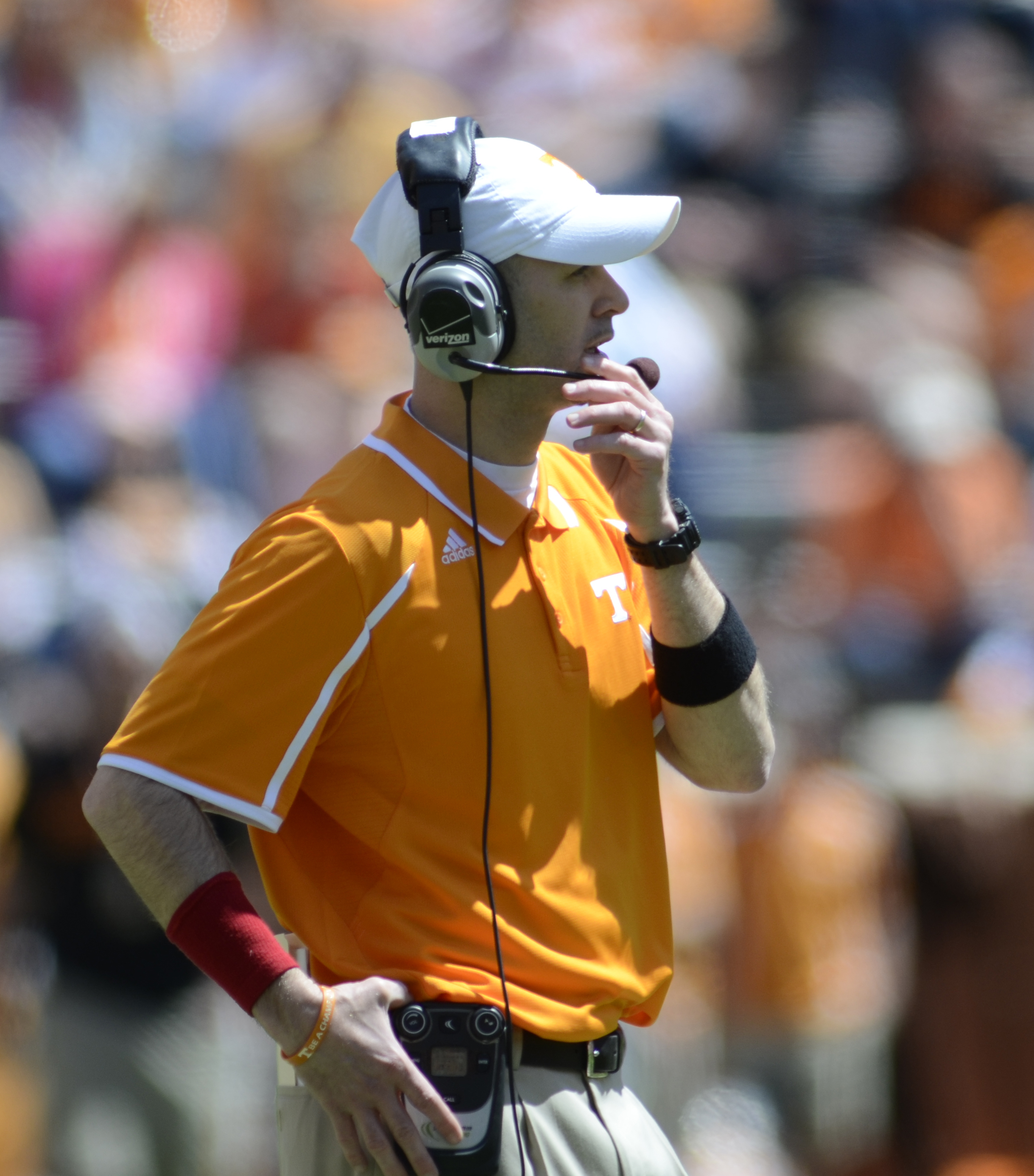 Receivers coach Zach Azzanni watches the Orange and White game at Neyland Stadium in this file photo.
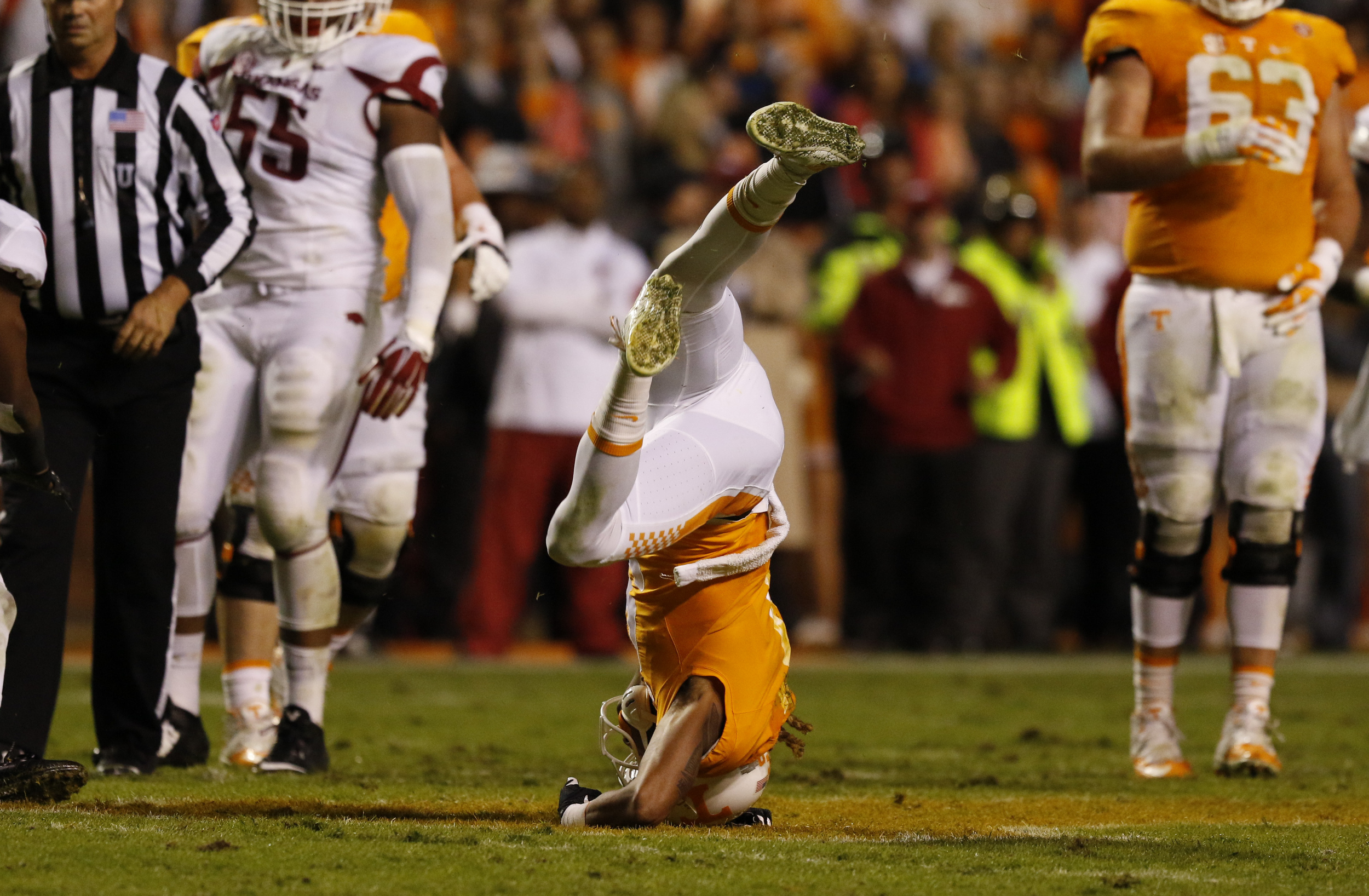 Staff Photo by Dan Henry / The Chattanooga Times Free Press- 10/3/15. UT’s Von Pearson (9) ends up on his head after missing a pass while playing Arkansas during the second quarter of play on October 3, 2015. The Volunteers played the Razorbacks at home in Neyland Stadium late Saturday evening.
“I think everyone wants to whip it around a little bit more, and the reality is we didn’t need to for a couple of games,” receivers coach and passing game coordinator Zach Azzanni said after Tuesday’s practice.
“We were up by a lot points and we were running the ball well and we had to complement. We were 12-of-19 against (Florida). I think people forget that. Is it flashy at times? No, but we’re trying to grind out some W’s.
“There’s some guys up front, some guys in the back, some guys on the perimeter – it all has to work hand in hand. It’s not just the receiver room. It’s everybody all working together firing on all cylinders that make that thing go, and we’re working on it every day and everyone’s all in.”
Heading into Saturday’s visit from Georgia, the Vols are third in the Southeastern Conference in rushing (225 yards per game), but they must throw the ball better, particularly down the field, to stretch defenses and find success after a disappointing 2-3 start.
Tennessee passed for 232 yards – a season high against FBS competition – in the 24-20 loss to Arkansas last week, but the Vols accrued that total mostly with passes either behind the line of scrimmage or less than 5 yards downfield.
Of the 37 passes the Vols threw, only 11 were thrown 10 or more yards beyond the line of scrimmage, and only three were completed.
“There were some things that we executed very well, and there’s other things that we didn’t,” offensive coordinator Mike DeBord said. “And those are just things, again, that we have to clean up, with the passing game and with the run game. The run game’s not perfect, either. We just continue to work on execution.”
Two of those downfield completions – a 31-yard pass to tight end Ethan Wolf and a 13-yard pass to Von Pearson that converted a third down into a first – came over the middle, but Tennessee continues to focus most of its passes to the perimeter.
“That always depend on the coverage, when you can get the ball inside and when you can’t,” DeBord said. “Usually that’s more split-safeties and stuff like that.
“We got the ball to Ethan Wolf right down the middle one time on the play-action deal, so we tried to take advantage of that. We tried to get Jalen (Hurd), in fact, on a similar play, but we ended up throwing the ball outside to Von up the middle, too.
“It just depends. They were not giving you that because their underneath coverage was carrying very well.”
Quarterback Josh Dobbs wasn’t helped by five dropped passes, including two on the penultimate possession, but he also misfired on a handful of throws. On Tennessee’s first possession in the second half, he threw behind an open Josh Malone on second-and-9. The simple throw and catch would’ve given Tennessee a first down inside the Arkansas 15. Instead, the third-down pass was batted at the line and the Vols kicked a long field goal.
On the final drive, Dobbs, who did a good job of checking the ball down to his running backs all game, short-hopped a pass to Hurd in the flat. A better throw would’ve given Hurd the chance to run into space. Instead of a shorter fourth down, the Vols faced a fourth-and-13, and Dobbs and Malone couldn’t connect on a deep ball against single coverage.
“We had guys wide open last (game) and we dropped a pass or missed a throw,” Azzanni said. “Those are the ones we need to make. If we make those plays that are wide open, we’d be talking different right now.
“We need to continue to motivate our kids and make sure that they’re not getting down.”
Dobbs’ completion rate (63.3 to 57.5 percent), efficiency (138.3 to 121.1) and quarterback rating (130.5 to 121.1) are all down from his six-game stint to end 2014, but the problems go beyond the quarterback.
“We’ve got to give him chances on the perimeter and run better routes and help him and give him a wider window,” Azzanni said. “We can do our part to help his fundamentals be better. The O-line can do their part and help his fundamentals be better. As coaches we can put him good positions. It’s everybody. It’s all of us helping him.”
Contact Patrick Brown at pbrown@timesfreepress.com.