
Sunday, November 15, 2026Nov 15

Researcher: Children’s cancer linked to Fukushima radiation

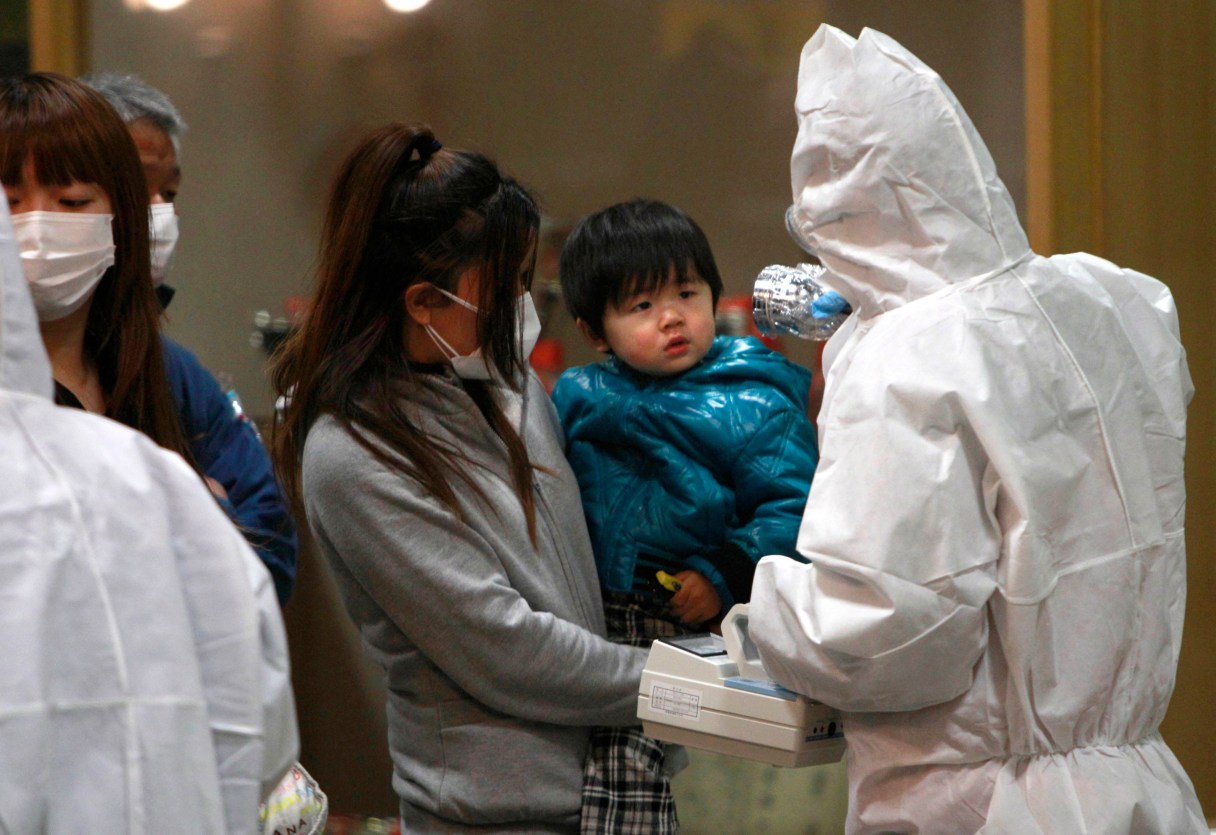
FILE - In this March 15, 2011 file photo, a child is screened for radiation exposure at a testing center in Koriyama city, Fukushima Prefecture, northeast of Tokyo, after a nuclear power plant on the coast of the prefecture was damaged by March 11 earthquake. A new study says children living near the Fukushima nuclear meltdowns have been diagnosed with thyroid cancer at a rate 20 to 50 times that of children elsewhere, a difference the authors contend undermines the government’s position that more cases have been discovered in the area only because of stringent monitoring. Most of the 370,000 children in Fukushima have been given ultrasound checkups since the March 2011 meltdowns at the tsunami-ravaged Fukushima Dai-ichi nuclear plant. Thyroid cancer has been diagnosed in 137 of those children, though more broadly the disease occurs in only about one or two of every million children. (AP Photo/Wally Santana, File)

TOKYO (AP) – A new study says children living near the Fukushima nuclear meltdowns have been diagnosed with thyroid cancer at a rate 20 to 50 times that of children elsewhere, a difference the authors contend undermines the government’s position that more cases have been discovered in the area only because of stringent monitoring.

Most of the 370,000 children in Fukushima prefecture (state) have been given ultrasound checkups since the March 2011 meltdowns at the tsunami-ravaged Fukushima Dai-ichi nuclear plant. The most recent statistics, released in August, show that thyroid cancer is suspected or confirmed in 137 of those children, a number that rose by 25 from a year earlier. Elsewhere, the disease occurs in only about one or two of every million children per year by some estimates.

“This is more than expected and emerging faster than expected,” lead author Toshihide Tsuda told The Associated Press during a visit to Tokyo. “This is 20 times to 50 times what would be normally expected.”

The study was released online this week and is being published in the November issue of Epidemiology, produced by the Herndon, Virginia-based International Society for Environmental Epidemiology. The data comes from tests overseen by Fukushima Medical University.

Making sense of the relationship between radiation and cancer is precarious: It’s scientifically impossible to link an individual cancer case to radiation. Looking harder with routine check-ups, like the one in Fukushima, leads to quicker discovery of tumors, inflating the tallies in a so-called “screening effect.”