
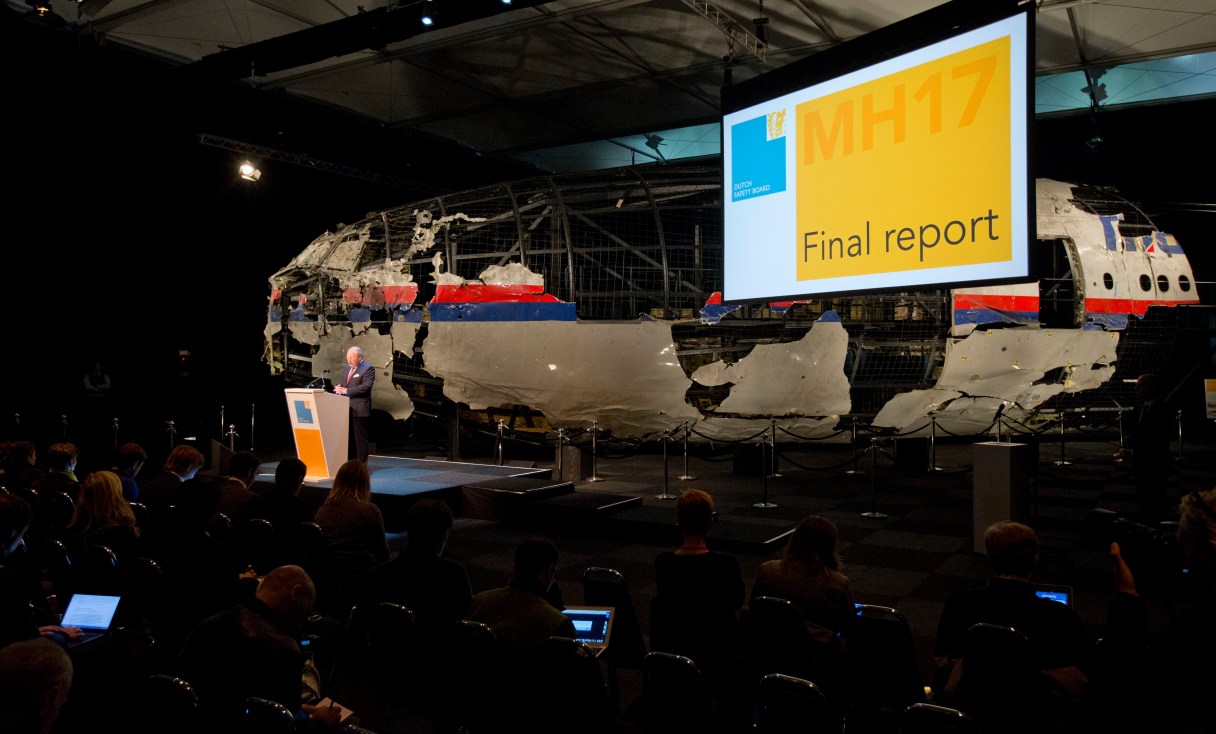
GILZE-RIJEN AIR BASE, Netherlands — The missile shot skyward from war-ravaged eastern Ukraine. With deadly accuracy more than six miles up, it detonated just in front of the Malaysia Airlines jetliner, sending hundreds of jagged steel shards ripping through its aluminum skin at up to 5,600 mph and shearing the cockpit from the rest of the plane.
The two pilots and purser in the cockpit died instantly, and the Boeing 777 disintegrated and fell to earth, killing the rest of the 298 men, women and children aboard Flight 17 on July 17, 2014, Dutch investigators said Tuesday in a long-awaited report.
Some of the victims may have been conscious for 60 to 90 seconds, the Dutch Safety Board said, but they probably were not fully aware of what was happening in the oxygen-starved, freezing chaos. The tornado-like airflow surging through the doomed jet as it came apart was powerful enough to tear off people’s clothes and leave naked corpses amid the fields of sunflowers.
The 15-month Dutch investigation blamed a Soviet-made surface-to-air Buk missile for downing the Amsterdam to Kuala Lumpur flight, but it did not explicitly say who had fired it. It identified an area of 320 square kilometers (120 square miles) where it said the launch must have taken place, and all of the land was in the hands of pro-Russian separatists fighting Ukrainian forces at the time of the disaster, according to daily maps of fighting released by the Ukrainian National Security Council.
The Dutch Safety Board also found that the tragedy wouldn’t have happened if the airspace of eastern Ukraine had been totally closed to passenger planes as fighting raged below.