
Thursday, November 5, 2026Nov 5

This story is free to read.

Text of rule for 7th-inning play in Rangers-Blue Jays

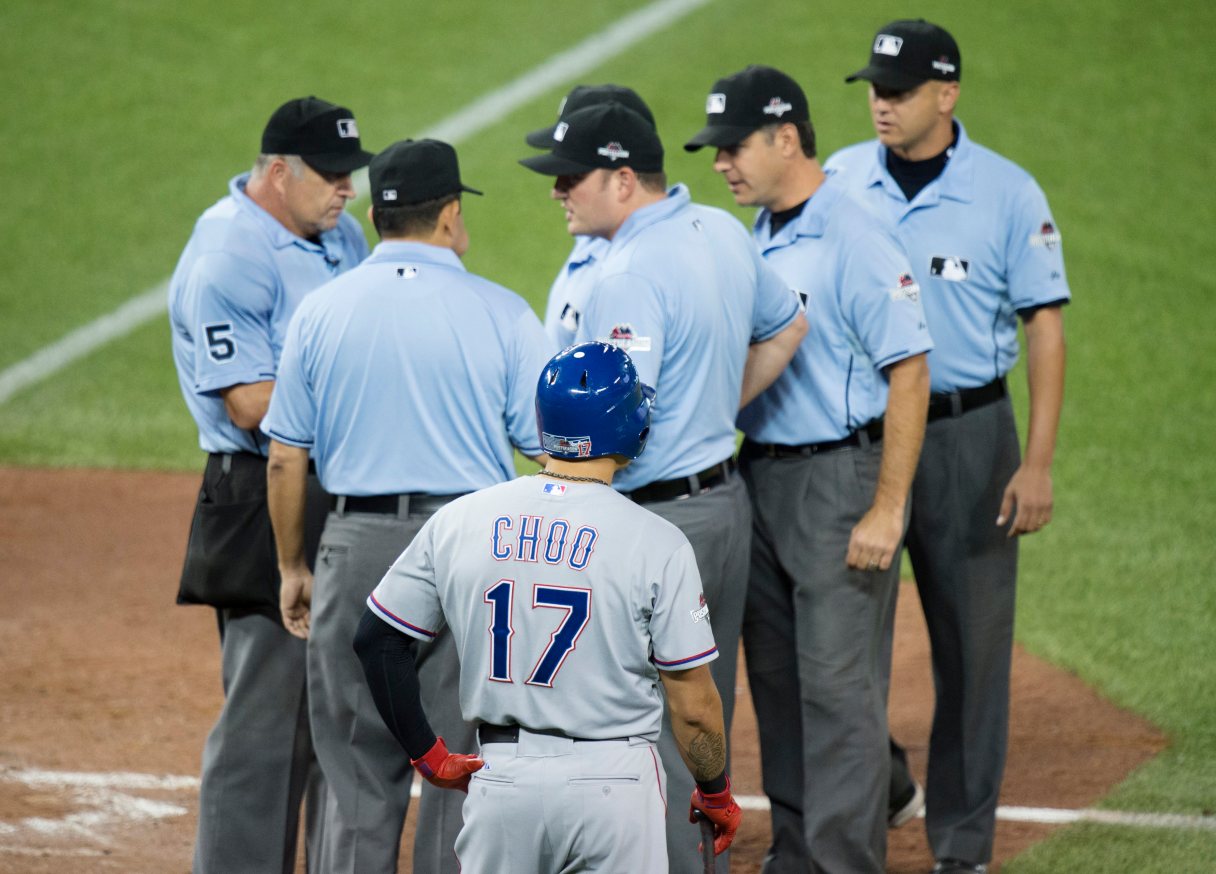
Texas Rangers' Shin-Soo Choo, of South Korea, waits as the umpire crew discusses a play during the seventh inning in Game 5 of baseball's American League Division Series against the Toronto Blue Jays, Wednesday, Oct. 14, 2015, in Toronto. The Blue Jays clinched their first trip to the American League Championship Series since 1993, overcoming one of the most bizarre plays in playoff history by taking advantage of three Rangers errors for a 6-3 victory.  (Darren Calabrese/The Canadian Press via AP) MANDATORY CREDIT
Texas Rangers' Shin-Soo Choo, of South Korea, waits as the umpire crew discusses a play during the seventh inning in Game 5 of baseball's American League Division Series against the Toronto Blue Jays, Wednesday, Oct. 14, 2015, in Toronto. The Blue Jays clinched their first trip to the American League Championship Series since 1993, overcoming one of the most bizarre plays in playoff history by taking advantage of three Rangers errors for a 6-3 victory. (Darren Calabrese/The Canadian Press via AP) MANDATORY CREDIT Texas Rangers' Shin-Soo Choo, of South Korea, waits as the umpire crew discusses a play during the seventh inning in Game 5 of baseball's American League Division Series against the Toronto Blue Jays, Wednesday, Oct. 14, 2015, in Toronto. The Blue Jays clinched their first trip to the American League Championship Series since 1993, overcoming one of the most bizarre plays in playoff history by taking advantage of three Rangers errors for a 6-3 victory. (Darren Calabrese/The Canadian Press via AP) MANDATORY CREDIT

TORONTO (AP) – Text from the Major League Baseball Umpire Manual on the rule covering the play in which Toronto catcher Russell Martin’s throw back to the pitcher deflected off Rangers batter Shin-Soo Choo and allowed a run to score:

___

54. BATTER INTERFERES WITH CATCHER’S THROW BACK TO PITCHER

Rule 6.03(a)(3) (former Rule 6.06(c)):

If the batter interferes with the catcher’s throw back to the pitcher by stepping out of the batter’s box while at bat (no runners attempting to advance), it shall not be considered interference under Official Baseball Rule 6.03(a)(3) (former OBR 6.06(c)). In such cases, the umpire shall call “Time” only (no interference).

The ball is dead and no runner shall advance on the play.

This interpretation does not, of course, give the batter license to interfere intentionally with the catcher’s throw back to the pitcher, and in such cases the batter shall be called out. If the batter becomes a runner on ball four and the catcher’s throw strikes him or his bat, the ball remains alive and in play (provided no intentional interference by the batter-runner).

If the batter interferes with the catcher’s throw to retire a runner by stepping out of the batter’s box, interference shall be called on the batter under Official Baseball Rule 6.03(a)(3) (former OBR 6.06(c)).

However, if the batter is standing in the batter’s box and he or his bat is struck by the catcher’s throw back to the pitcher (or throw in attempting to retire a runner) and, in the umpire’s judgment, there is no intent on the part of the batter to interfere with the throw, the ball is alive and in play.