
Read more
* Chattanooga says no timetable for newest Holmberg pedestrian bridge damage
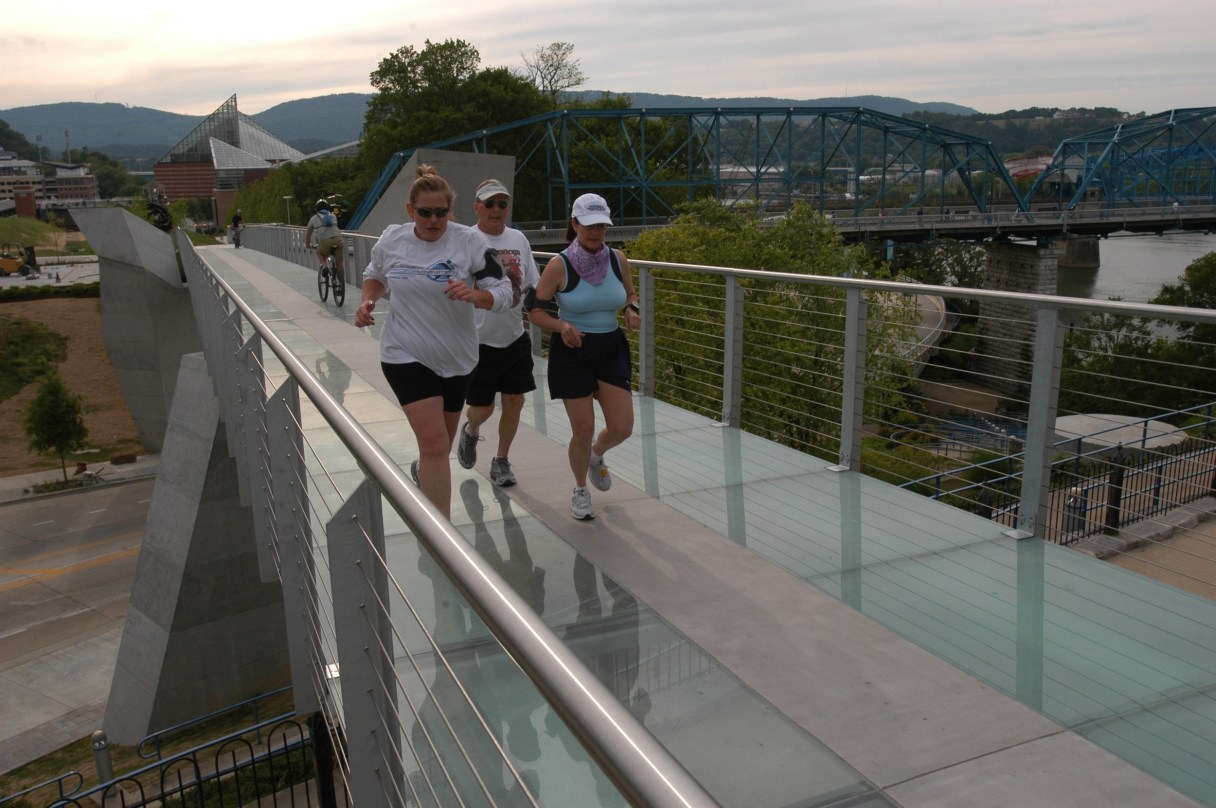
Let’s be sure we understand an unfortunate suggestion by a city official about the Ruth S. and A. William Holmberg Pedestrian Bridge that connects the downtown district and the Walnut Street Bridge with the Hunter Museum of American Art.
The $1.6 million glass bridge built in 2005 was named for Ruth Holmberg and her deceased husband, “Bill,” who have been tireless patrons for the Chattanooga arts community – along with many other charities – for decades.
But now, as the bridge comes under a microscope because, here in the “Big-Gig City” with our oh-so-fancy innovation zone, we can’t figure out why the glass keeps breaking; some have suggested “scrapping” the bridge – or at least getting rid of the “glass.” The idea, it seems, is that concrete or wood might be cheaper and more durable. Well – cheaper, maybe. But we’re still regularly replacing portions of the footpaths on the Walnut Street Bridge, so nothing lasts forever.
Lee Norris, Chattanooga’s Department of Public Works administrator, acknowledged in a story in Friday’s paper that scrapping the bridge – of at least the most artsy part of it, the glass – “has been discussed.”
Wait a minute! Where do we live? Isn’t this Chattanooga, Tennessee? Haven’t we heard something of late about 3-D printers in Oak Ridge making a car? Haven’t we come to realize that in the Big-Gig city anything is possible?
Norris said he doesn’t know the total amount the city has spent fixing the bridge, but he estimates – estimates, mind you – it has needed between $10,000-$20,000 a year in repairs.
Each glass panel costs $3,985 to replace, according to city officials. So by our math, that’s about five panels a year.
And if the city has spent $20,000 a year, that’s about $200,000 in the decade. If we carry the high end of Norris’ “estimate” and our projection forward, that’s about an eighth of what the bridge originally cost.
Staying with the numbers, the city originally spent $120 million on the 21st Century Waterfront, which included the Holmberg Bridge and the 23-acre Renaissance Park on the North Shore.
Since the Waterfront project was completed and opened in 2005, repairs to sections of the Waterfront have been nearly constant. In less than a decade, a 1,000-foot portion of the 21st Century Waterfront starting sinking into the Tennessee River in several places, jeopardizing the bedrock of the city’s downtown renaissance.
The latest Waterfront redo, we learned last week, will take longer than expected after engineers unearthed new issues with the steel and concrete structure that undergirds Ross’s Landing, according to city officials.
Between Ross’s Landing and the Passage, a water feature along the Tennessee Aquarium, Chattanooga taxpayers are on the hook for roughly $9 million in repairs. Norris said the latest problems on the Waterfront will cost about $518,000 to complete by the new year.
So by all means, let’s scrap the Waterfront, too.
Of course, we’re being facetious. And certainly we hope Norris and others are just being flippant (or over-reactive) about the glass on the bridge, as well.
When this newspaper has job candidates, we often take them down to the Waterfront and we always point out the glass bridge. It’s a no-brainer, wow-factor component for selling our city to these young innovators and Gig users of tomorrow.
Scrap the bridge? Please, no. Instead, why doesn’t the city engineering department try some of that innovative thinking we’re trying so desperately to tout?