
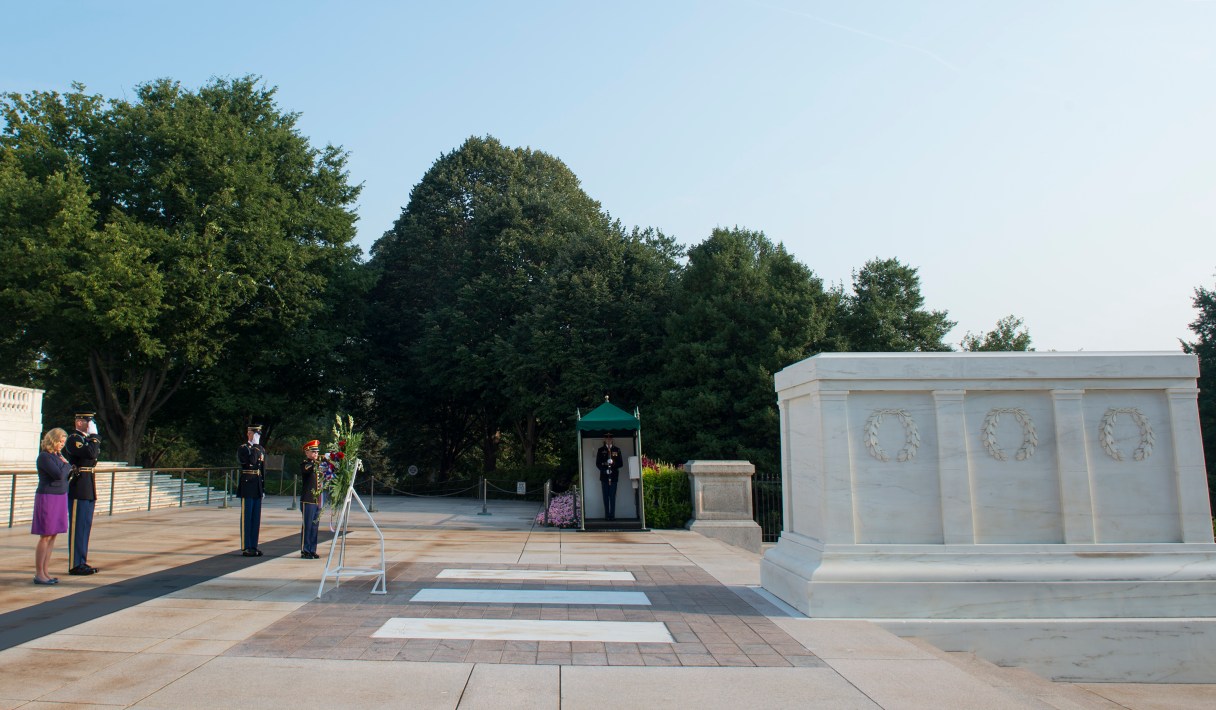
I went for an early run recently in Washington, D.C. The morning sunlight glistened off the columns of the Arlington plantation on a hill overlooking thousands of graves of American heroes. The plantation was the home of Gen. Robert E. Lee, and a huge U.S. flag fluttered gently on its lawn.
The irony of that flag, flying highest among others in our capitol, was striking. Lee was a man who epitomized the ideals of republican (small “r”) freedom that the Confederacy cherished – states’ rights. Many today label him and all Confederates as traitors and racists, yet the illuminating light of history makes their arguments specious. The fact that their battle flag, the red, white, and blue star-spangled cross of St. Andrew, has been and still is abused by ignorant thugs and racists should not change the decency of their patriotic ideals.
Lee was born into an aristocratic Virginia family without wealth. He barely knew his father, Gen. “Lighthorse Harry” Lee, a hero of the Revolutionary War and the man who delivered the eulogy at George Washington’s funeral. Harry became a land speculator and lost his money, much of his friends’ money, and his life, leaving his family destitute. The younger Lee’s earliest memories were of creditors coming into their home to repossess family furnishings.
Young Robert entered West Point with the class of 1829. He distinguished himself there and after graduation married Mary Custis, great-granddaughter of Martha Washington. Success followed him. After the Mexican War, commanding Gen. Winfield Scott said Lee was “the very best soldier that I ever saw in the field.” He served as superintendent of West Point, and he served with distinction leading the U.S. Army on the frontier in Texas.
From Texas, he watched the nation he loved descend toward war as the debate between slaveholders and abolitionists reached a crescendo. Lee’s position never wavered. He frequently wrote his wife about his disgust with slavery. He never owned slaves, unlike his counterpart, Ulysses Grant. To a friend in 1856, he wrote, “There are few, I believe, in this enlightened age, who will not acknowledge that slavery as an institution is a moral and political evil.”
In March 1861, with war imminent, Lee was recalled to Washington and offered command of the entire U.S. Army, but he refused. He wrote, “I declined the offer to take command of the army stating as candidly and courteously as I could, that though opposed to secession and deprecating war, I could take no part in an invasion of the Southern States.” His “country” of Virginia had only recently voted to join other Southern states in secession. Lee refused to mortgage the fame and glory of military command against his principles.
Shortly after the war, Lee attended a church service at St. Paul’s Episcopal Church in Richmond. A black man went to the communion altar and knelt in prayer. The church’s white congregation sat spellbound until Gen. Lee left his pew and knelt near him. The congregation followed.
A few months later, he assumed presidency of Washington College, now Washington and Lee University. During his five-year tenure and near the end of his life, he reflected a great deal on the U.S. government and the Constitution. He wrote, “I was not in favor of secession, and was opposed to war; in fact I was for the Constitution and the Union established by our forefathers. No one now is more in favor of that Constitution and that Union.”
Lee’s intelligence, courage in battle, grace in defeat, discipline in his personal life, and love of God and liberty are traits Americans of all ethnicity should respect, not disparage. As a nation we should search for such common ground, not focus on our differences. It is fitting the U.S. flag on Gen.Lee’s lawn flies above all the others in our capitol.
Roger Smith, a local author, is a frequent contributor to the Times Free Press.