
Monday, November 9, 2026Nov 9

Congress-White House Iran dispute a side-show for world

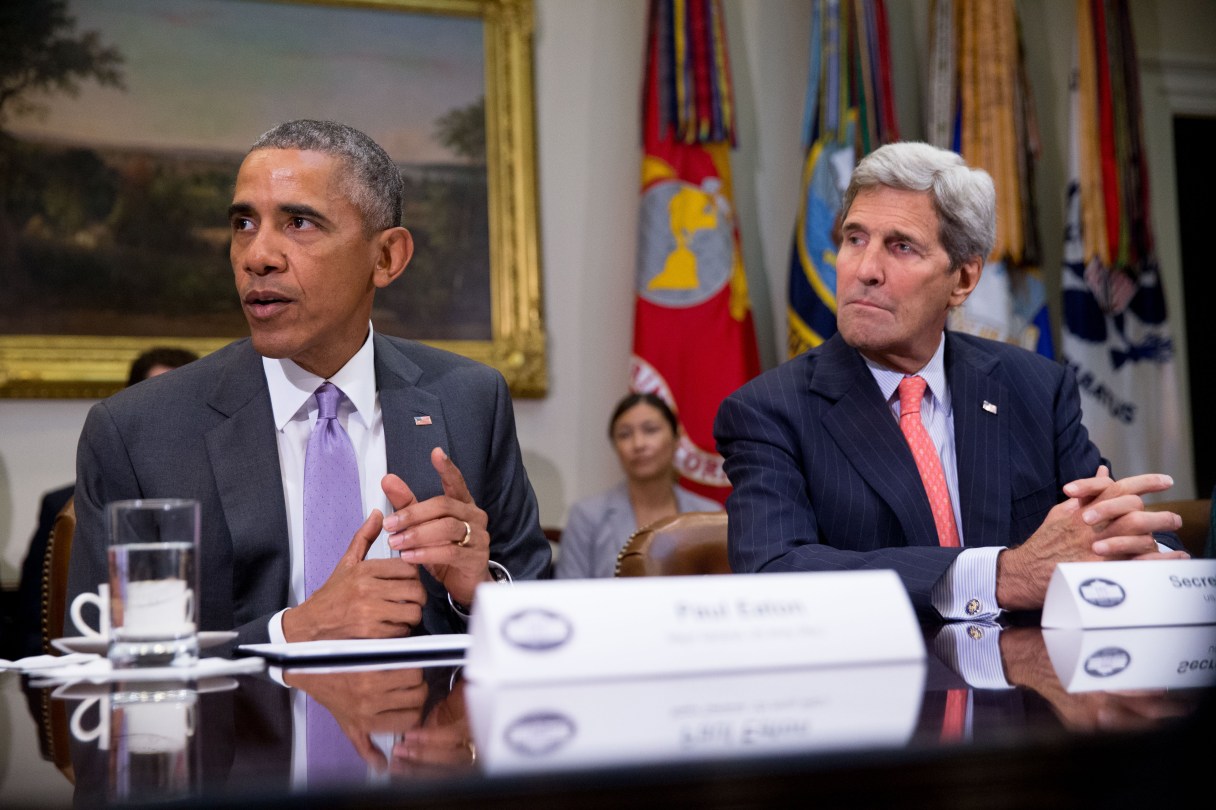
FILE - In this Sept. 10, 2015 file photo, President Barack Obama, accompanied by Secretary of State John Kerry, meets with veterans and Gold Star Mothers to discuss the Iran Nuclear deal, in the Roosevelt Room at the White House in Washington. A lame-duck president, an empowered opposition, a looming election: they’re hardly the ingredients for a resounding White House success. Yet President Barack Obama emerged victorious on the Iran nuclear deal in Congress this past week. The reasons involve politics, policy, and a president searching for one crowning foreign policy win. (AP Photo/Andrew Harnik, File)
FILE - In this Sept. 10, 2015 file photo, President Barack Obama, accompanied by Secretary of State John Kerry, meets with veterans and Gold Star Mothers to discuss the Iran Nuclear deal, in the Roosevelt Room at the White House in Washington. A lame-duck president, an empowered opposition, a looming election: they’re hardly the ingredients for a resounding White House success. Yet President Barack Obama emerged victorious on the Iran nuclear deal in Congress this past week. The reasons involve politics, policy, and a president searching for one crowning foreign policy win. (AP Photo/Andrew Harnik, File) FILE - In this Sept. 10, 2015 file photo, President Barack Obama, accompanied by Secretary of State John Kerry, meets with veterans and Gold Star Mothers to discuss the Iran Nuclear deal, in the Roosevelt Room at the White House in Washington. A lame-duck president, an empowered opposition, a looming election: they’re hardly the ingredients for a resounding White House success. Yet President Barack Obama emerged victorious on the Iran nuclear deal in Congress this past week. The reasons involve politics, policy, and a president searching for one crowning foreign policy win. (AP Photo/Andrew Harnik, File)

VIENNA (AP) – As Congress was debating the merits of the Iran nuclear deal last week, the U.S. political world was whipping itself into a frenzy. Not so much the rest of the world – it was busy restoring relations with Tehran, selling it weapons, and inking contracts with Iranian firms.

Republicans tried last week to push through a resolution of disapproval of the nuclear deal and a second vote, also expected to fail, is scheduled for Tuesday.

But U.S. companies will be sidelined no matter how the U.S. political tussle plays out because core sanctions imposed by Washington will remain even after the nuclear-related sanctions are lifted.

These secondary sanctions are linked to U.S. charges of Iranian human rights violations, terrorism and other allegations of wrongdoing. They have the effect of banning doing business with Iran, with only few exceptions, such as supplying parts for Iran’s civilian aviation sector.

“Non-U.S. companies are not in general subject to the U.S. sanctions,” says William McGlone, a Washington-based lawyer specializing in sanctions law. “As long as a non-U.S company is not involved in using persons or operations in the United States, then in general those companies could proceed with their transactions.”