
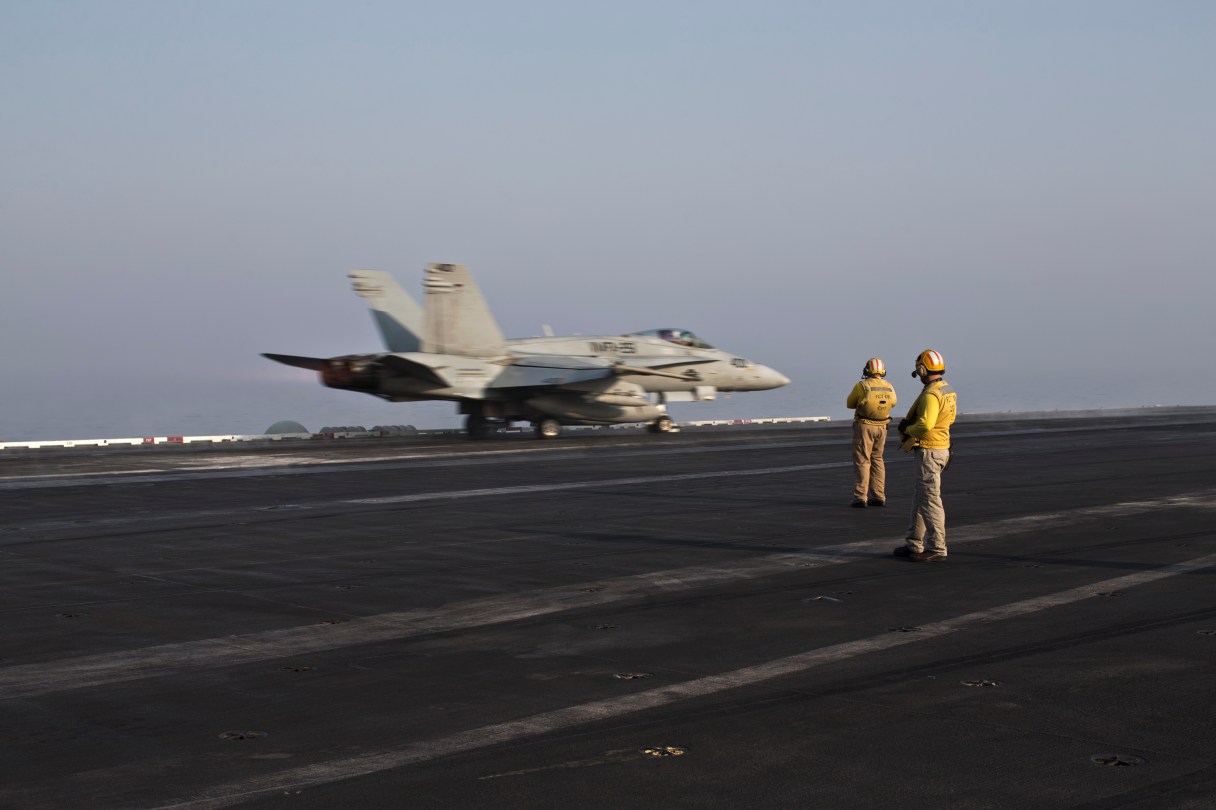
PARIS (AP) – French lawmakers are debating the decision to join a military air campaign over Syria, raising new questions about what a year of U.S.-led bombing of the Islamic State group has accomplished.
British, Australian and Belgian leaders are also considering expanding ongoing airstrikes in Iraq to Syria – but critics in all countries are questioning the point of widening a campaign that has failed to stem advances by the extremist organization.
French reconnaissance flights in Syria began last week, and President Francois Hollande said airstrikes there would follow soon. Tuesday’s parliamentary debate is not a request for permission – the government needs none – but rather an opportunity to explain its decision before a skeptical audience.
Prime Minister Manuel Valls told Parliament that France will decide “alone” on it targets, and ruled out any ground intervention. He justified the decision to intervene in Syria as “self-defense” against terrorism. France has seen deadly attacks this year linked to Islamic extremists abroad.
The United States, Canada and Middle Eastern allies Bahrain, Saudi Arabia, Jordan and the United Arab Emirates have been striking targets in Syria for months and were recently joined by Turkey. Until now, France, Britain, Australia, Belgium, Denmark and the Netherlands have only conducted airstrikes in Iraq, where the government has requested help dealing with the IS onslaught, fearing that hitting at IS in Syria would ultimately help the government of Syrian President Bashar Assad.