
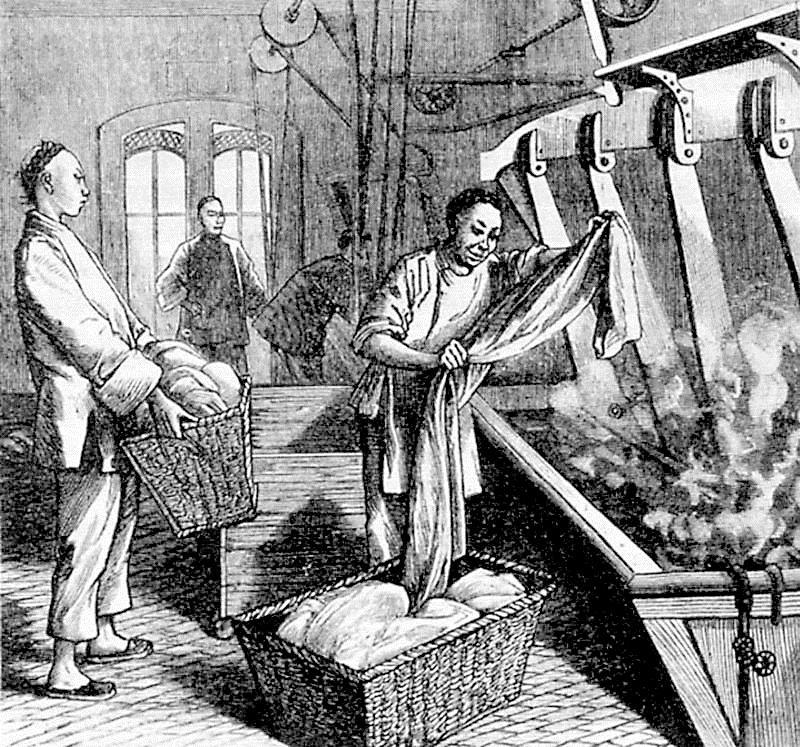
“Cleanliness is akin to Godliness,” read Chan Chee’s advertisement on Jan. 3, 1885, for his hand laundry at 18 E. Seventh St.
Chee’s laundry was one of the first of several Chinese hand laundries in Chattanooga. The Chinese, who had come to work on railroads and canals in the South, later turned to laundries as viable businesses that required little capital or English – and due to discrimination – was one of the few occupations open to them. Most came as single men hoping to raise money for their families in China.
The first to arrive in Chattanooga came in January 1884 to open a business in the Ruohs Building, 535 Chestnut St. A fire destroyed it a month later, but the resourceful Sam Wah reopened the next week at the corner of Eighth and Chestnut streets.
The Chinese succeeded in their laundry operations but encountered difficulties with local police over gambling with dominoes and dice and smoking opium. July 1887 saw eight Chinese laundrymen arrested on Eighth Street. Several officers swooped down on the Chinese gamblers, piled them in a police wagon and sent them to jail. When interrogated in court, Yee Wah stated: “Me no gamblee; me play domino for funee. Nobody gamblee, all play for funee,” according to newspaper accounts. The Chinese were fined $5 each and dismissed.
The opium smoking caused the police much concern, and they vowed to pull down a joint operated by Tony Parker in the Ohio House on Carter Street in August 1889. This young blood had broken into Chan Yee’s Laundry and had taken an opium pipe to set up his own den. When the newspaper interviewed Chan Yee about smoking opium, he said that the “Chinaman knows how to quit using opium, but when the American uses it once, he wants it all the time.”
Other disruptions in the Chinese community were the deaths of three of their group. All three were buried in Forest Hills Cemetery. Two died by their own hand. Chan Yuh cut his throat and stabbed his stomach in a delirious fever and died in August 1887. The Chinese honored him in an elaborate ceremony called Hong Tong in which whiskey, rum and soda pop were poured liberally on the grave. The party placed two roasted chickens on the grave for the departed spirit. They lit incense, prayed for the dead, wrapped up the chickens, and departed, later giving the chickens to a family.
Four years later, Yee Man severed his windpipe with a razor then shot himself in Sam Wah’s laundry at 812 Chestnut St. “The funeral was one of the most peculiar ever held in Chattanooga,” announced the Chattanooga Times on July 4, 1891. Along the burial route, the Chinese scattered small pieces of paper representing money. They burned the bedding and clothing at the grave, lit joss sticks and placed food and wine on the grave. After prayers, the funeral attendants scattered the food and wine and left.
Most of the laundrymen stayed true to their ancestral custom and dress. However, the newspaper of Dec. 2, 1885, told of one naturalized Chinese, Chan Yee, who voted in elections, attended church, wore American dress and read English.
Although most of the laundrymen were single, two Chinese laundrymen married their African-American employees. In February 1890, Chan Ock wed Ida Mullard. The other wedding, between Sam Wah and Ida Twartt, took place in May 1892. Neither wedding was looked upon with favor by Chinese or African-Americans.
By 1896, most Chinese laundrymen had returned to China. The Chattanooga Times on June 1 reported that “steam laundries have taken the major part of the business from the pig-tailed aristocracy of the tubs.”
The two interracial marriages and a law requiring the Chinese to be photographed were other incidents that led to the shrinking Chinese community. In 1900, the Times reported the death of Sam Lung, “the last of a once flourishing colony of Chinese laundrymen died at 2 o’clock Friday afternoon at his laundry on E. Ninth Street.”
Suzette Raney is the archivist at the Chattanooga Public Library. For more information, please call 423 757-5317 or visit the library.