
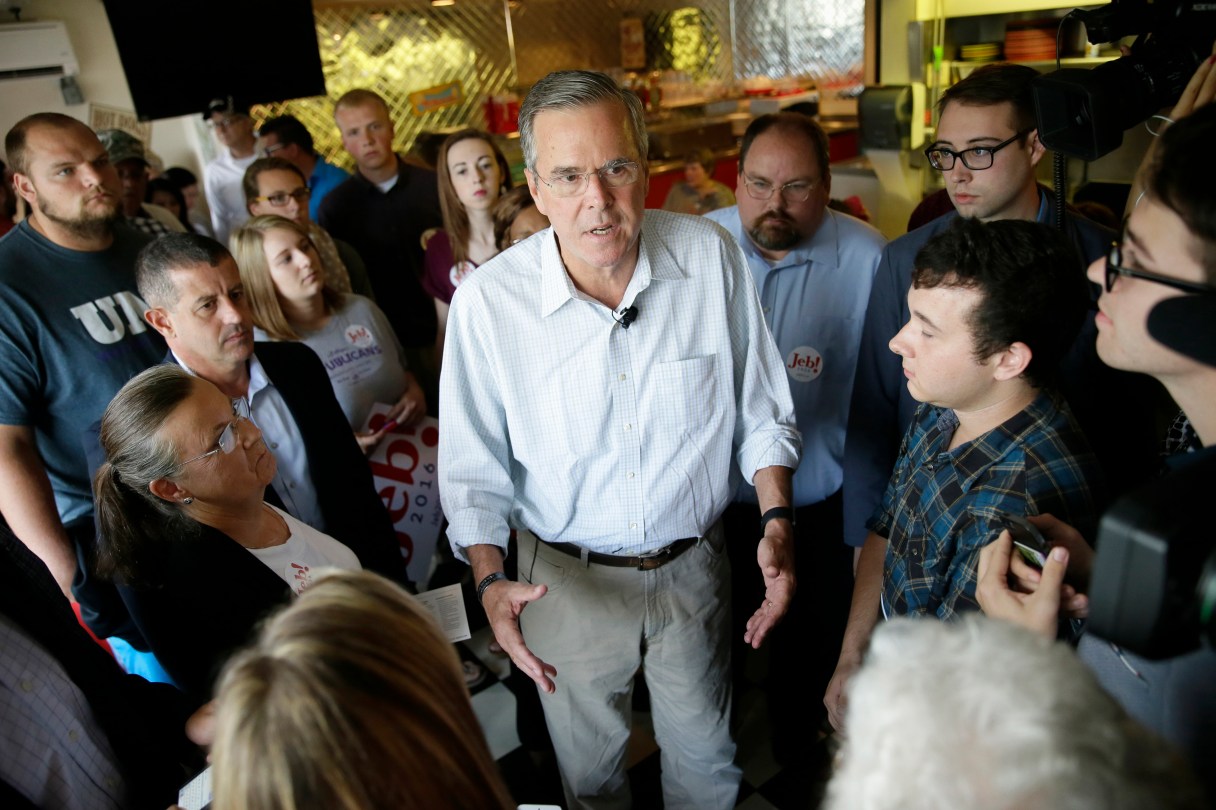
CEDAR FALLS, Iowa (AP) – Republican presidential candidate Jeb Bush said Tuesday that multiculturalism is bad for the United States, adding that immigrants who close themselves off from American culture deny themselves access to economic rewards.
The former governor of Florida, who speaks fluent Spanish and often touts his success winning Latino votes in a party that badly needs them, addressed the issue in a packed northern Iowa breakfast diner as he met people in the crowd.
A young woman approached the candidate and asked how the federal government could help refugees better incorporate into U.S. society.
“We should not have a multicultural society,” Bush said, before beginning a longer explanation of his views of what comprises culture in the U.S.
“When you create pockets of isolation_and in some places the process of assimilation has been retarded because they’ve slowed down_it’s wrong,” he added. “It limits people’s aspirations.”
A multicultural society gives all cultures equal prominence, but they remain separate.
Bush’s comments highlight the delicate balance he must strike as a candidate with strong ties to Hispanic culture running to lead a party that has struggled to attract Hispanic voters.
The remarks appear to conflict with the way he has presented himself throughout the campaign, but align him with other GOP presidential hopefuls who are hoping to appeal to the party’s core supporters.
Led by billionaire developer Donald Trump, other GOP presidential hopefuls have aired urged newcomers to assimilate. Some have suggested it’s their duty.
Recently in conservative South Carolina, Florida Sen. Marco Rubio was interrupted by applause when he said legal status for immigrants should be determined by what they could contribute and “whether they want to live in America or whether they want to be American.”
Trump has climbed to the top of national Republican preference polls in part by using stronger language. He’s described illegal immigrants often as violent, predatory criminals, vowing to deport them by the millions and proposing to build a wall between the United States and Mexico.
The approach clashes with the Republican Party’s effort to attract support from the increasingly influential Hispanic community, which the GOP has named as critical to the party’s successes. The national GOP is hosting events across the country to mark Hispanic Heritage Month.
Bush campaign aides did not immediately respond to requests to clarify the candidate’s comments.
Compared to most of his Republican rivals, Bush’s personal story gives his credibility with Latinos. His wife, Columba, is a Mexican native. Bush sometimes campaigns in fluent Spanish and is fond of relating details that highlight the influence of Hispanic culture at home.
“We eat Mexican food in the home. My children are Hispanic in many aspects. We don’t talk about it, but the Hispanic influence is an important part of my life,” Bush said, in a July interview conducted in Spanish with Telemundo.
Bush even took a shot at Trump on the issue, mocking the frontrunner’s credibility.
“Mr. Trump says that I can’t speak Spanish,” Jeb Bush, speaking Spanish, told supporters recently in Miami. “Pobrecito” (poor guy).
Yet Bush used the term “anchor babies,” to describe infants whose parents come to the United States specifically so they are born in the United States and granted automatic citizenship as the Constitution dictates. The term is considered offensive in the Hispanic community. Bush later said he was referring mostly to the so-called birth tourism industry that flies predominantly wealthy Asian women to the U.S. to give birth so their children will have U.S. citizenship – a real phenomenon that has drawn concern from the Obama administration.